“One day you’re waiting for the sky to fall The next you’re dazzled by the beauty of it all”
I was listening to a cool chill mix on Spotify the other day, and they played Bruce Cockburn’s Lovers in a Dangerous Time. This line seemed to personify how we’re all feeling right now, waiting for the sky to fall like Chicken Little*.
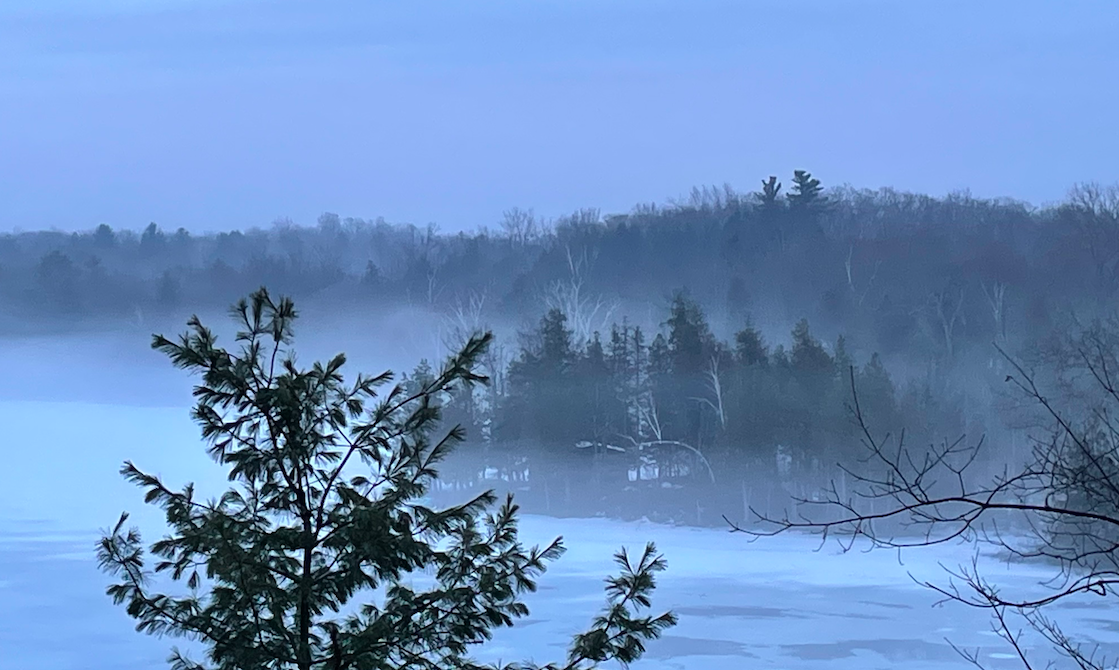
We all have different coping mechanisms. I’m ashamed to admit mine is to retreat into my writing and to my little lake where I can watch the mist rise on the shoreline, listen to the birdsong, and wait for the spring crocuses to appear. Escapism at its finest.
In my heart, I know this is no solution. I wish I was a better person. I wish I was like Carol, the wife of a fellow proctor at Queen’s University who officially retired years ago but keeps working at an outreach program operating out of one of the churches in Kingston, helping people on the street get warm food and shelter. Her response to the unfathomable problem of homelessness and drug use is to volunteer and make a difference.
Or like the millions of Americans in all 50 US states who took to the streets in the No Kings protests yesterday to raise their voices against Trump and his administration’s policies.
That’s not me. I choose to cope by living my small life, making a difference where I can.
Perhaps the ever wise and socially and environmentally conscious Cockburn has provided us with the answer. When the world seems out of control, look for the dazzling beauty in it all.
A magnificent sunrise or sunset. A child’s smile or laughter. The first snow drops or bluebells peeping through the frozen ground. Signs of hope and renewal.
Now it’s your turn to share. What do you do to cope when the world seems to be falling apart and you’re waiting for the sky to fall? Leave a comment below.
*a European folk tale about a chicken who believes the world is ending
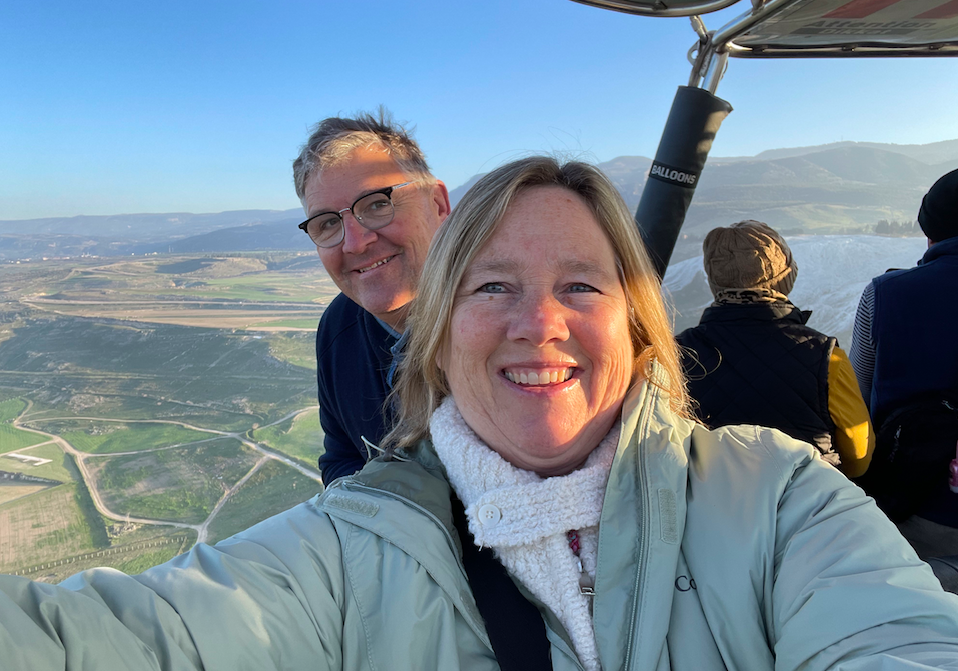
I can’t believe I’m here. I can’t believe I’m a thousand feet in the air soaring in the sky in a hot air balloon. It almost wasn’t to be.
When Dave and I decided on Turkey as a destination for a winter getaway, hot air ballooning was one of the premier attractions. The most famous place to hot air balloon in Turkey is Cappadocia over the fairy chimneys and primeval rock formations dating back thousands of years. The internet is teeming with pictures of this magical place where the skies are filled with dozens of colourful balloons in the sky at once.
We arrived in Cappadocia in the middle of a snowstorm. Our balloon ride was cancelled the next morning due to snow and the next day due to fog. We had one chance left to take to the skies the following morning in Pamukkale.
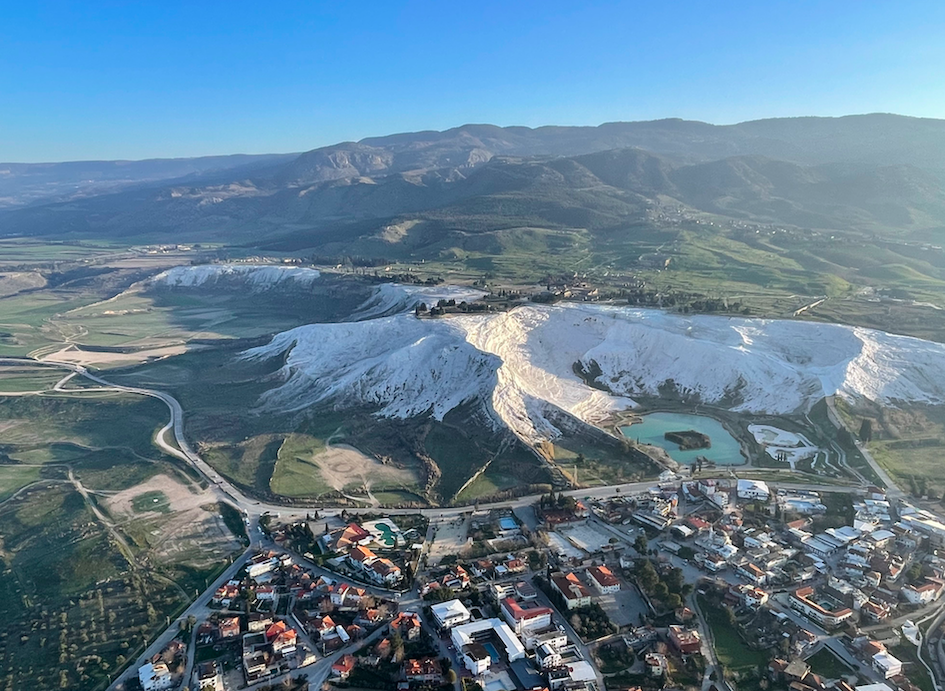
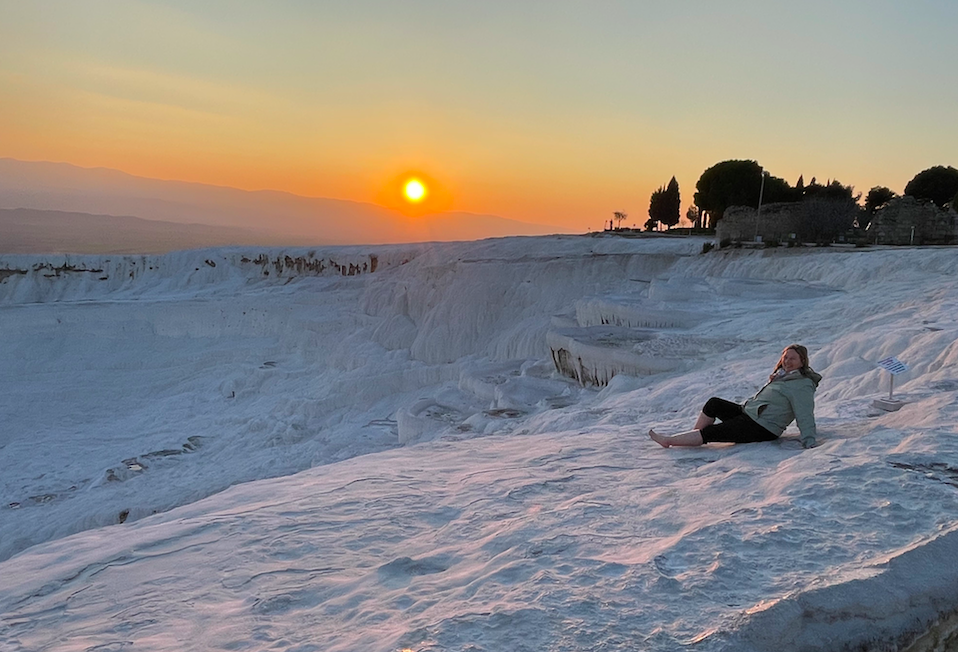
We had toured Pamukkale the day before. It was in fact, my favourite place in Turkey. Pamukkale, which means “cotton castle” in Turkish is a UNESCO World Heritage site famous for its white, thermal pools of calcium deposits the size of Niagara Falls. After soaking in its magical charm at sunset and exploring the ancient ruins of Hieropolis adjacent to it, I was bursting with anticipation to sail above it the next morning in a hot air balloon.
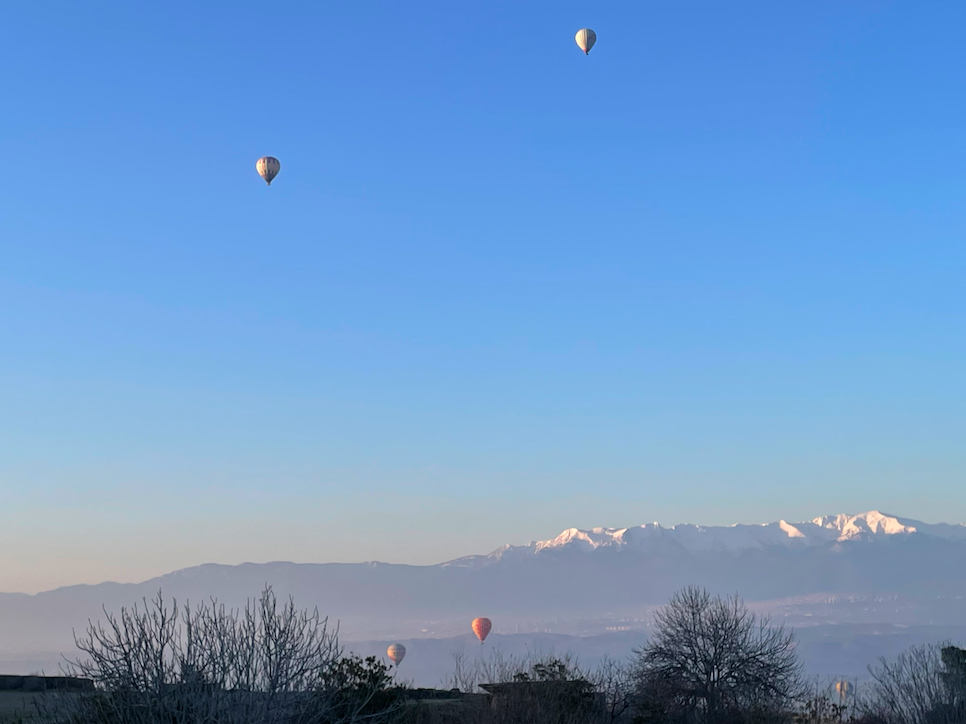
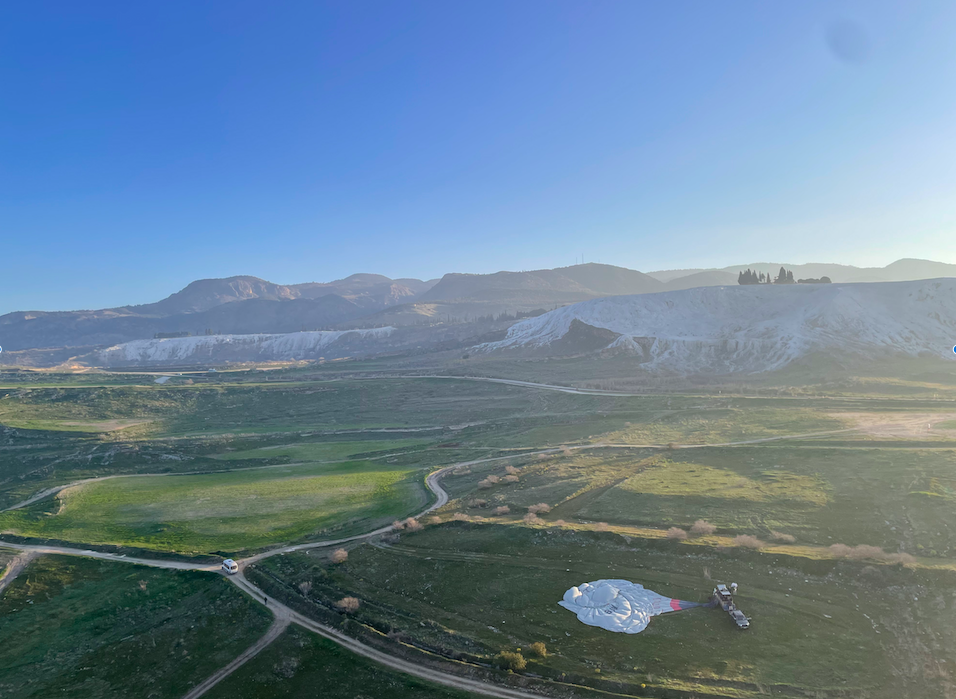
As our transfer took us down through the valley, we could see the first flight of balloons mid-air outside our windows. The sun had just breached the mountains to the east and the air had a soft, hazy glow.
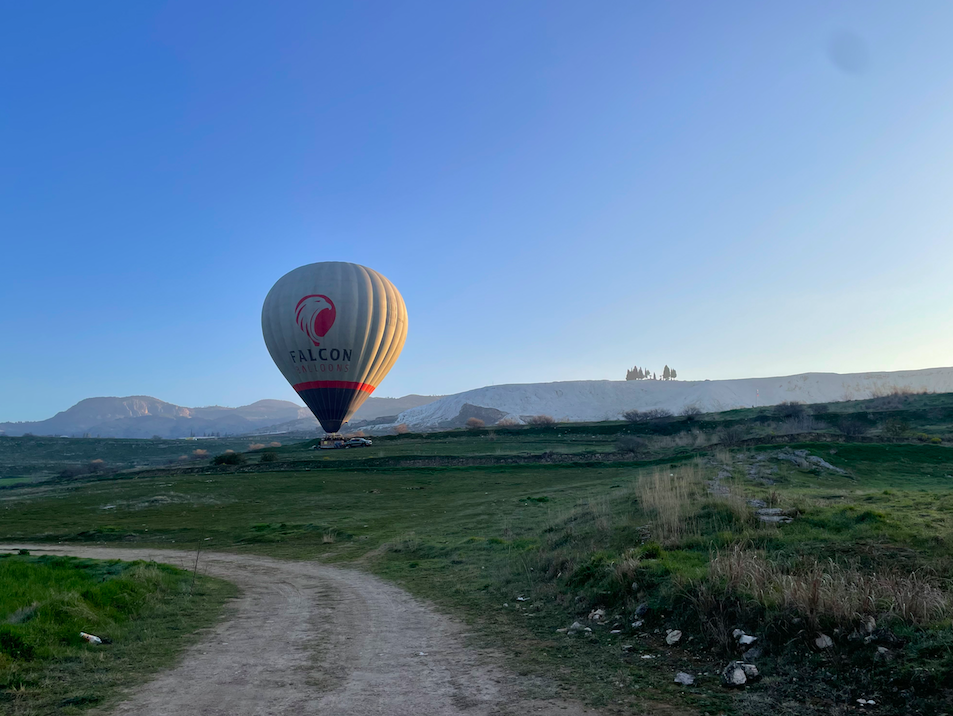
We arrived in a field and watched as the pilot landed the balloon we were about to fly in. They had to balance the weight, so as two people exited the balloon, two of our group entered. It was tricky climbing over the sturdy rattan basket, but the pilot and his crew members were there to help and our group of 12, who had become quite close in our week-long adventures congenially extended helping hands and hauled each other one by one into the basket.
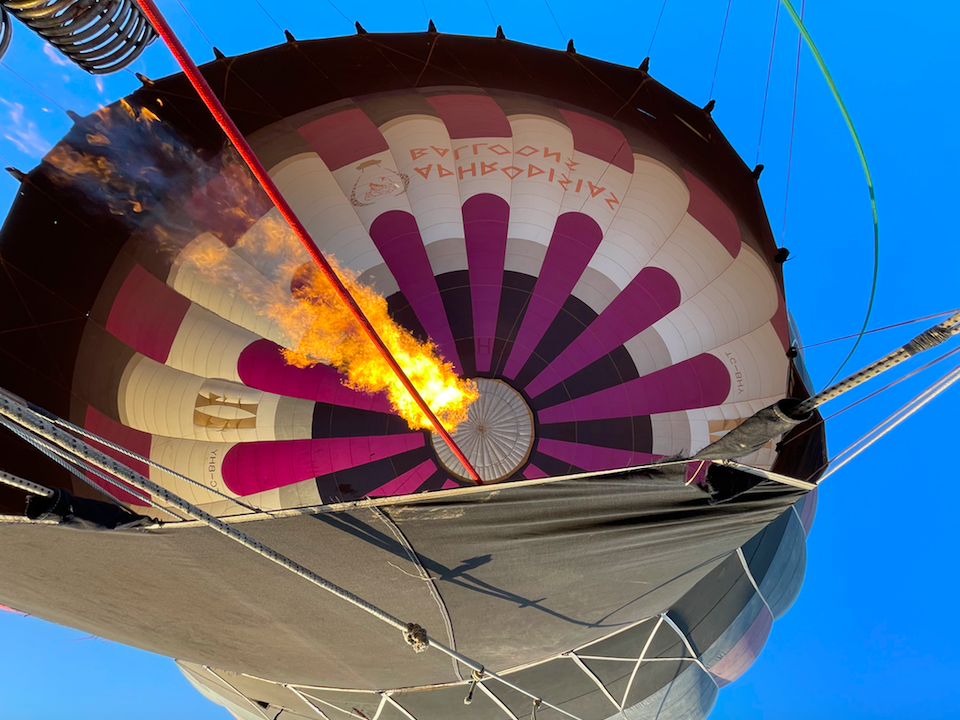
After a quick safety lesson, our pilot fires up the propane tanks. A burst of flames shoots upwards, sending waves of heat into my face as air fills the colourful balloon above us.
Lift off. The balloon begins to rise majestically, floating ever so gently, gaining altitude as the light from the daybreak casts a soft glow over the hills and valleys.
Our pilot watches the altitude, wind speed and conditions on his control panel. He releases more propane and we rise higher, higher.
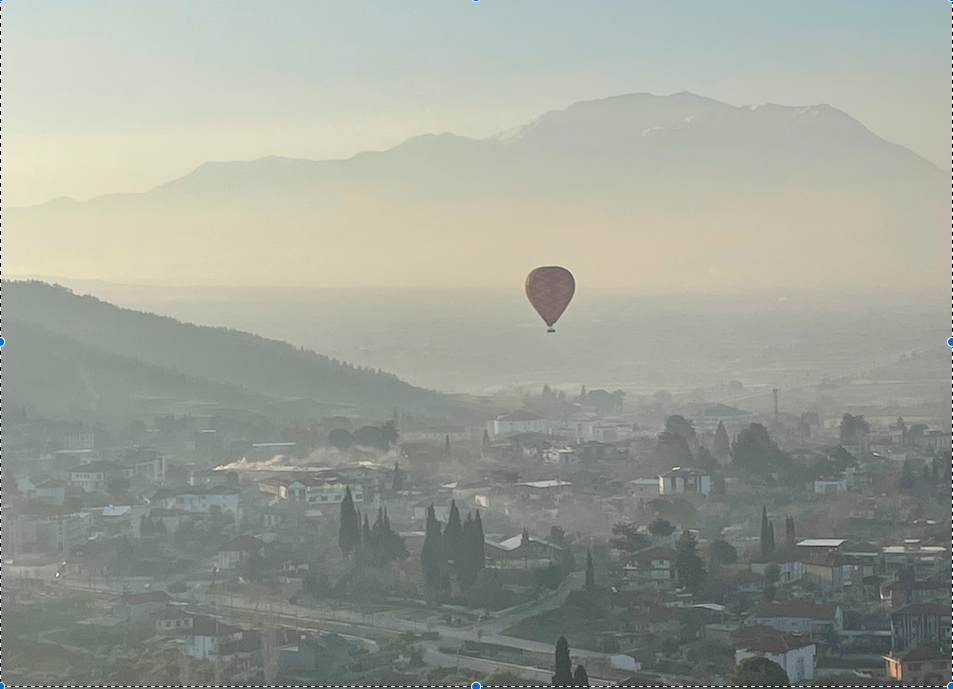
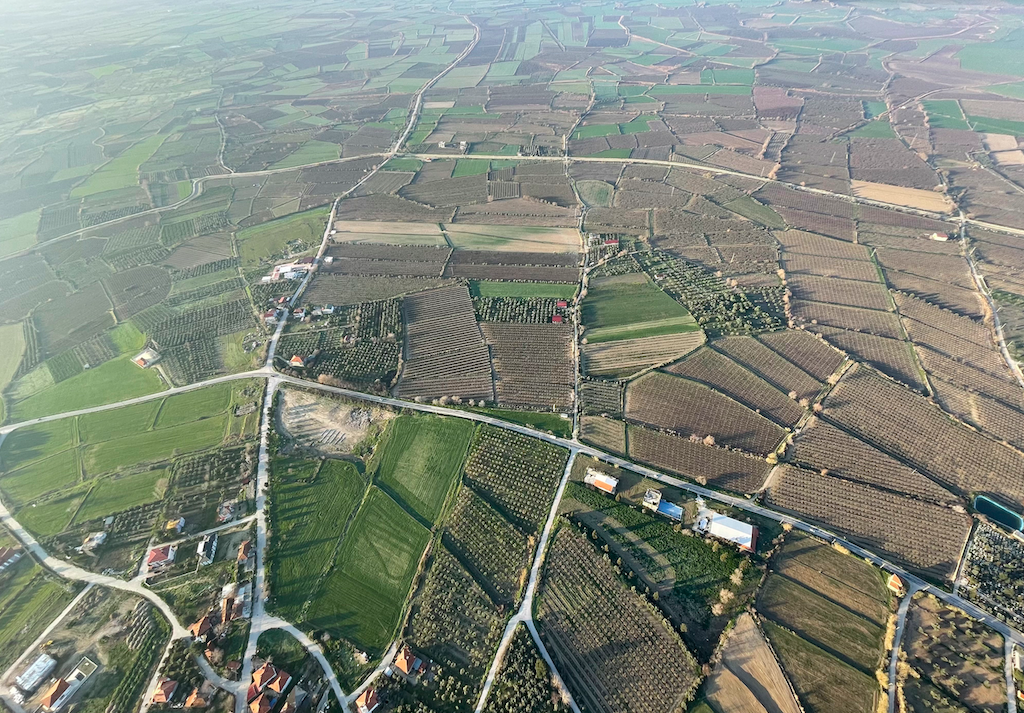
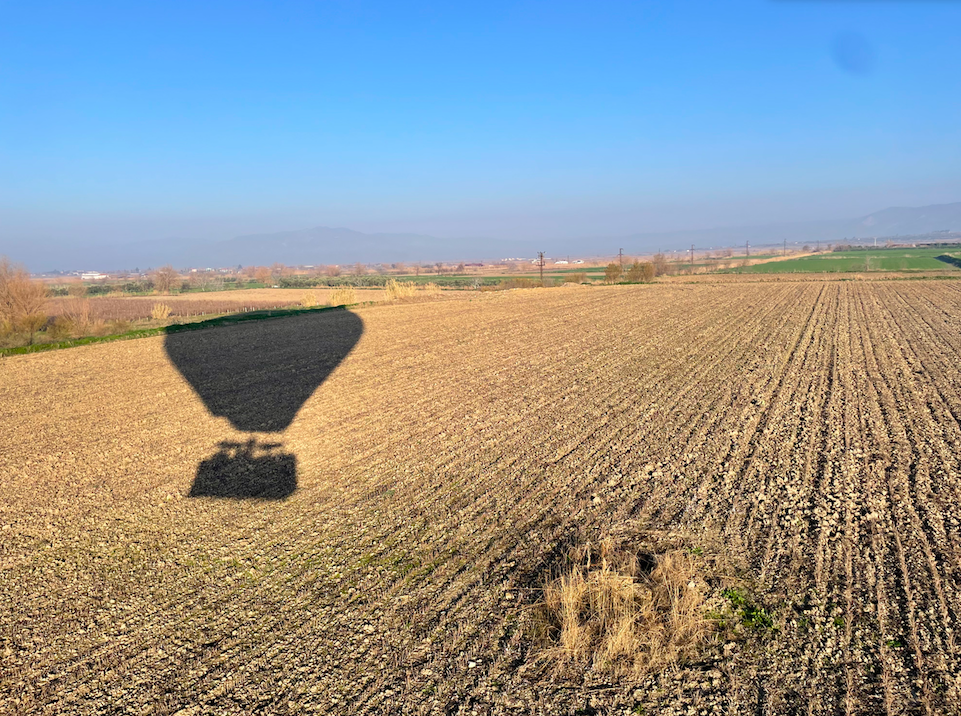
I look down and see a patchwork quilt of vineyards and fields filled with olive trees and grapes and little dots that are houses. There is a large waterpark below us, as we begin to drift towards majestic Pamukkale.
There is a hushed silence, as our group watches in wonder the beauty of the landscape, breathing in the cool air and feeling the warmth of the morning sun on our faces. We are in awe.
A thousand feet. Our pilot keeps turning the balloon from east to west so we can all enjoy the magnificent views of the cotton castle below us and the snow-capped mountains to the west.
We continue suspended in air and in time, floating blissfully, quietly, at peace with the world and immersed in the atmosphere around us.
It is time to land. We had been briefed on how to sit for a crash landing, low in the basket, gripping the handles. As we drift slowly, slowly towards the ground, some of us assume the position. The pilot laughs. He assures us the stance is not necessary, it will be a smooth landing today.
We touch down, barely a bump in a mud-caked farmer’s field. The crew is waiting to greet us with champagne. Another successful flight.
Our hot air balloon ride in Turkey was a magical once-in-a-lifetime adventure. I hope you get to experience something as equally special and meaningful to you some day. See my quick Instagram video here.
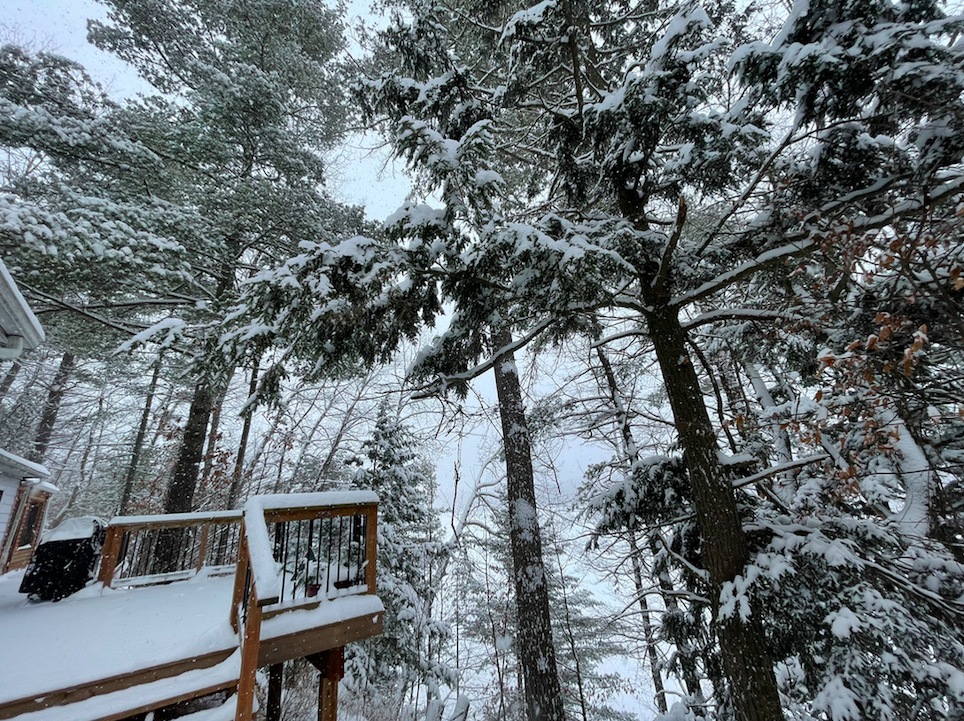
The snow keeps falling in an endless sea of white. Tiny feathery flakes fall in slow motion, causing the minutes and hours to tick by slowly. Winter in all its glory grips the landscape in its icy grasp.
There is something rhythmic and pleasing to falling snow. The world is gentle. Silent. Peaceful. The creatures of the forest seek shelter and rest, waiting for the storm to pass so they can emerge from their dens.
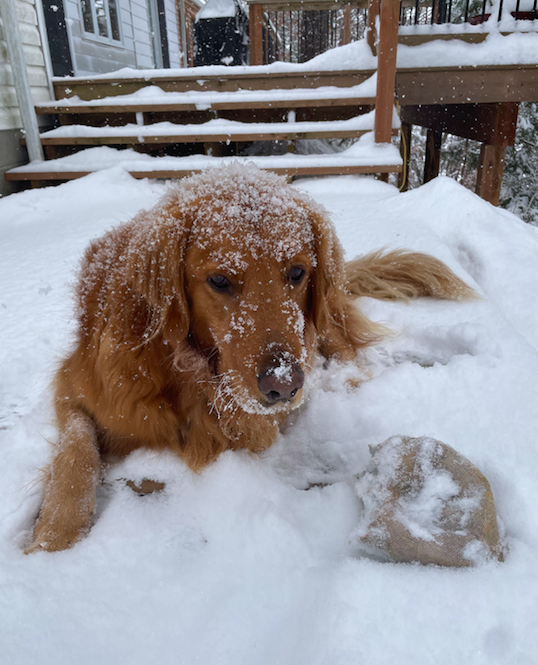
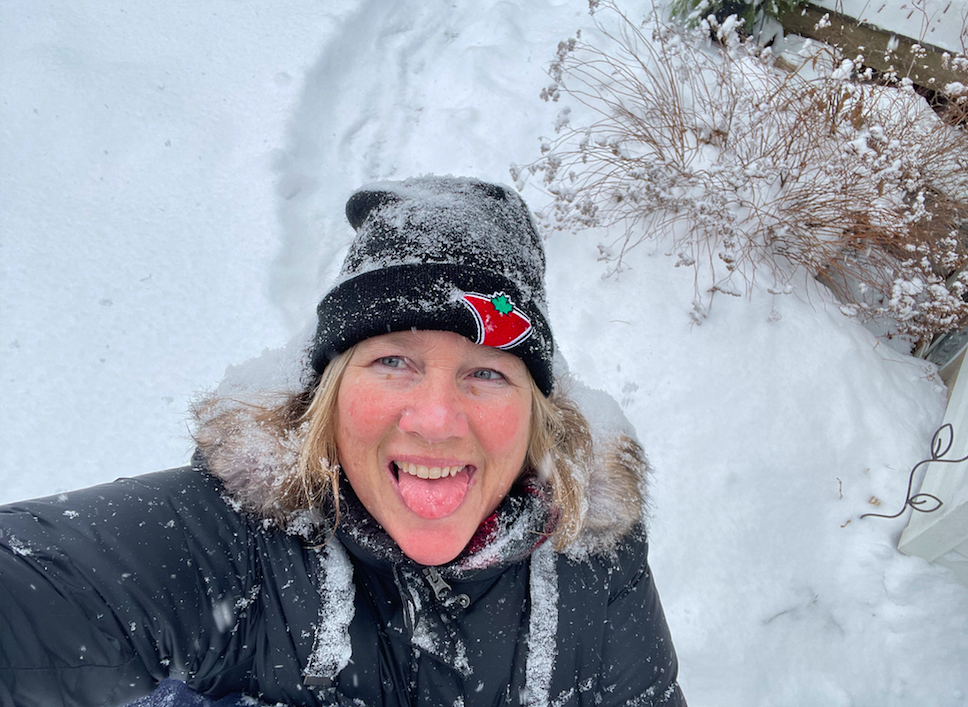
The snowflakes increase in size, the size of peas. I catch them on my tongue. Bentley is covered in white.
I usually love winter, but a few weeks ago, I said to Dave I’m done with winter. It has worn me down.
I become nostalgic, missing the days when a fresh snowfall was an excuse to go out and play with my children and celebrate winter’s bounty: skating on a frozen lake, racing down our driveway on toboggans, and building snowmen in the yard.
I spy an icicle on the side of my barn. My inner child seizes it and takes a hard, crunchy bite. It’s so brittle, it almost chips my weathered, withered teeth. The cold chunk melts in my mouth slowly as I savour the coolness on my throat and mouth. It’s so cold outside, when I take a second bite, the icy chunk sticks to my lips for a nanosecond.
The snow continues to fall and I realize I am fighting a lost cause. Better to embrace it.
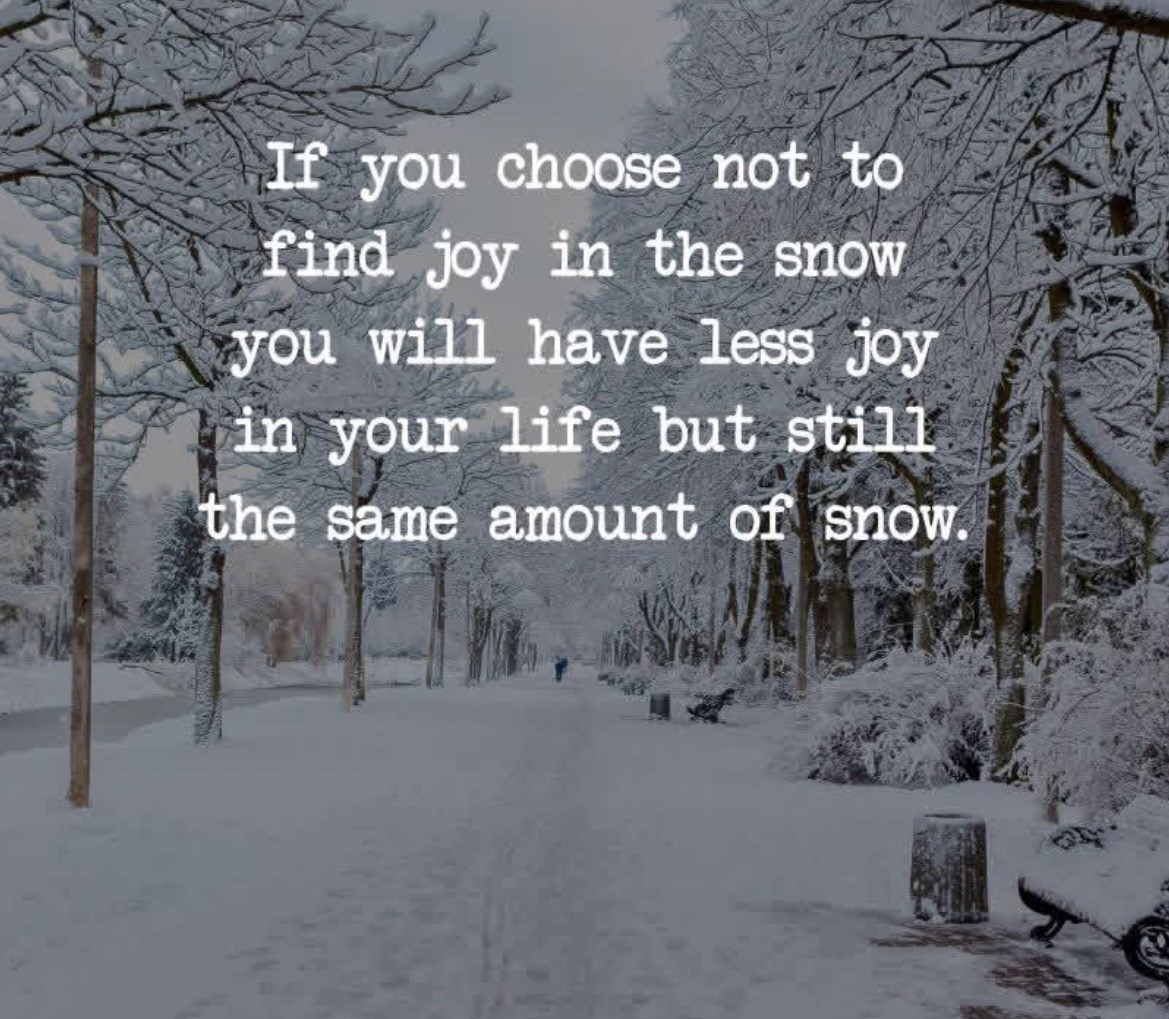
As the saying goes, if you choose not to find joy in the snow, you will have less joy in your life, but still the same amount of snow.
Bentley our weatherforecaster, me catching snowflakes and the view from our back deck. Winter is one of the most peaceful and beautiful times on our lake.
As I grow older, I am convinced more than ever that I am just an interloper on this earth. A transient squatter that one day will evaporate, ashes to ashes, dust to dust. The land, however, will live on.
I am reminded of this every day I watch the wildlife in the woods I live in and the lakes I paddle on. They belong to the blue jays, beavers, porcupines, deer, woodpeckers, dragonflies, butterflies and herons. And yet, humankind aspires to own property and claim it as our own, putting up fences and markers to demarcate what is rightfully ours, and keep people and animals out.
I love my property, but I have always believed it is ours to steward and share, not own. I know there are many of my neighbours who would disagree with me.
Since moving to the country, I’ve seen the widely opposing views on property. Some are generous, allowing people to hike, and even hunt on their land and use private water access points. Others are aggressive in their defence of “their land”, putting up gates and guarding their property with shotguns. You better know who you’re dealing with if you wander down a private laneway or path.
One of my favourite walks in Scotland this summer was on private property in the tiny seaside village of Plockton, just off the Isle of Skye. There is an isthmus that juts out to sea, owned by a local family who has granted permission to anyone to hike the trails around their modest farmhouse. It was one of the most beautiful hikes I’ve ever done, and reminded me of the seascape on Vancouver Island.
In 2003, Scotland adopted the Land Reform Act, commonly known as “right to roam” that gives the people of Scotland the right to access and roam the land and inland waterways, including public lands, farmers’ fields, and other private property. Basic principles include respecting people’s privacy, caring for the environment, leaving no trace, and ensuring no damage is caused to crops or livestock.
England has not been as progressive in adopting this principle and we had some interesting conversations with fellow hikers and locals about the right to roam and our relationship to land and property.
As a society, we have been poor stewards of the land. From polluting our oceans, to mismanagement of our forests and the ever-threatening impacts of climate change, we have failed in our attempts to be good stewards of this planet. One writer described it as “soiling our own nest”, an apt description.
We’ve also incurred irreparable harm to our planet and humankind by trying to define borders and territories. Wars have been fought and millions of lives lost from the desire to conquer land.
In this, as in so many things, we can learn from Indigenous peoples who have a deep connection to nature, viewing themselves as part of an interdependent ecosystem with a deep commitment to care for the land and its creatures for future generations.
This week’s #HappyAct is to do one small thing to care for the land and creatures in your backyard, all the while accepting it’s not really your backyard in the first place.
Photos: at top: the view from a trail owned by homeowner’s in Plockton, Scotland, looking out over the sea. Above: deer grazing in my garden.
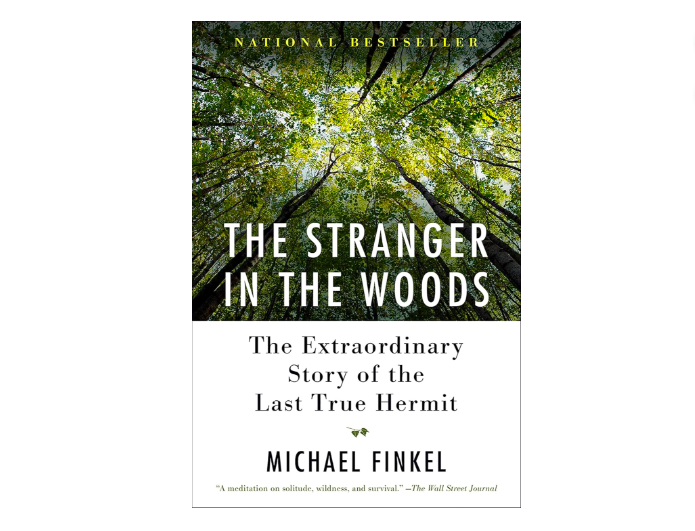
It’s the story of Christopher Knight, an average guy who at the age of 26, decided to live in the Maine woods on his own and didn’t talk or interact with another human being for the next 27 years.
He didn’t create art, he never kept a journal, he didn’t even talk to himself. He just spent his days in his clearing (the guy didn’t even have a cabin) surviving and existing.
Knight was never lonely during his time in the woods. He would sometimes read or listen to the radio, but spent the majority of his free time sitting in a lawn chair “in quiet contemplation” thinking about wherever his mind went. He claimed he was never bored and didn’t understand the concept of boredom. Boredom only applied to people “who felt they had to be doing something all the time.”
In considering Knight’s motives, Finkel explores various ancient beliefs and customs centred around living a life of solitude.
The first great literary work about solitude was written by a hermit protestor Lao-tzu in the sixth century. In Tao Te Ching, Lao-tzu wrote 81 verses about the pleasure of forsaking society and living in harmony with the seasons. Lao-tzu believed that only through retreat rather than pursuit, through inaction, rather than action, that we acquire wisdom and peace.
Finkel quotes the eighteenth-century philosopher Jean-Jacques Rousseau. “I have become solitary because to me the most desolate solitude seems preferable to the society of wicked men which is nourished only in betrayals and hatred.”
Carl Jung said that only an introvert could see the “unfathomable stupidity of man.” Sartre wrote “Hell is other people.”
Herman Melville who wrote Moby Dick withdrew from public life for 30 years. He wrote, “All profound things are preceded and attended by Silence.”
The greatest philosopher of all time, Dave says, “I prefer to spend my time with dogs than people.”
Knight related to the Greek philosophy of stoicism that held self-control and harmonious existence with nature constituted a virtuous life and you must endure hardship without complaint.
He also felt a kinship with Socrates who said, “Beware the barrenness of a busy life. You become free not when you fulfill your desires, but by eliminating desire. Those with less become content; those with more become confused.”
So what learnings can we take away from these philosophies and Knight’s experience? I’m not suggesting we turn our back on society, but perhaps we can experience a greater peace, stillness and happiness by seeking moments of solitude.
I asked at the start how many days can you go without speaking to another soul? I’ve learned for me the answer is three days. I can spend three days quietly at home, at peace in nature and be happy. After three days, I seek human interaction and connection and will reach out to friends or plan some social activity.
I have blogged before about the epidemic of loneliness. It’s important to delineate between being alone and being lonely.
Solitude when chosen, can be bliss, but when it is forced upon mankind, it can be torturous and is still to this day one of the great punishments inflicted on people.
Finkel makes this point in the book, quoting US Senator John McCain who spent more than five years as a prisoner of war in Vietnam, two of them alone. McCain described his experience as “awful. It crushes your spirit. The onset of despair is immediate.”
Solitude must be a choice.
It seems only fitting to bestow the final words to Knight: “If you like solitude, you are never alone. What I miss most in the woods is somewhere in between quiet and solitude. What I miss most is stillness.”
“Solitude bestows an increase in something valuable…Solitude increased my perception. But here’s the tricky thing: when I applied my increased perception to myself, I lost my identity. There was no audience, no one to perform for. There was no need to define myself. I became irrelevant.”
His isolation felt like a communion. “My desires dropped away. I didn’t long for anything. I didn’t even have a name. To put it romantically, I was completely free.”
This week’s #HappyAct is to experience solitude. Be happy and be free.
Leave a comment: how many minutes, hours or days could you go without talking to someone?
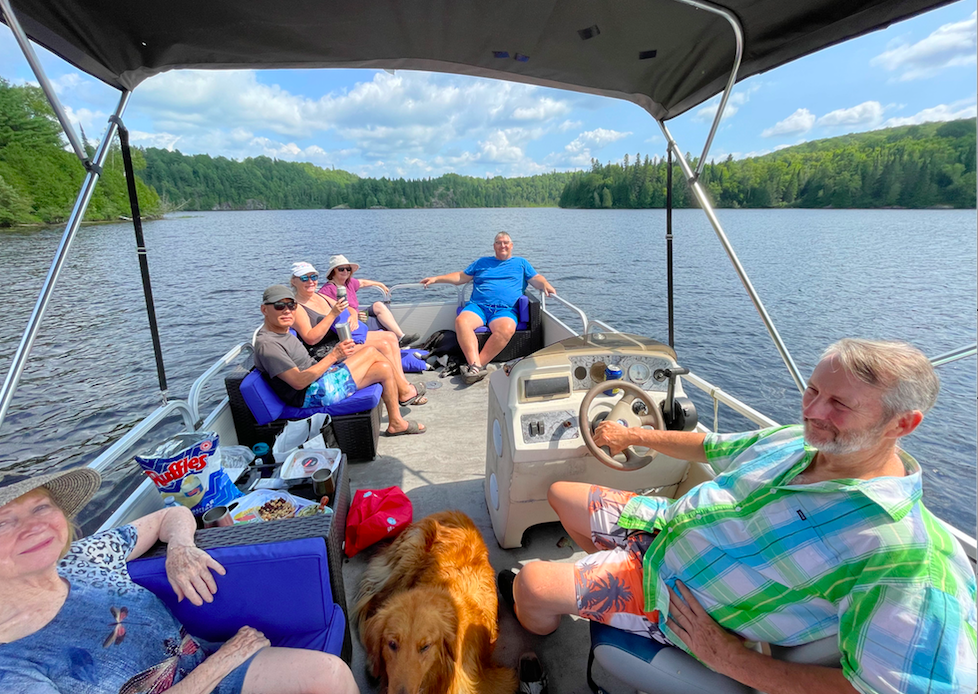
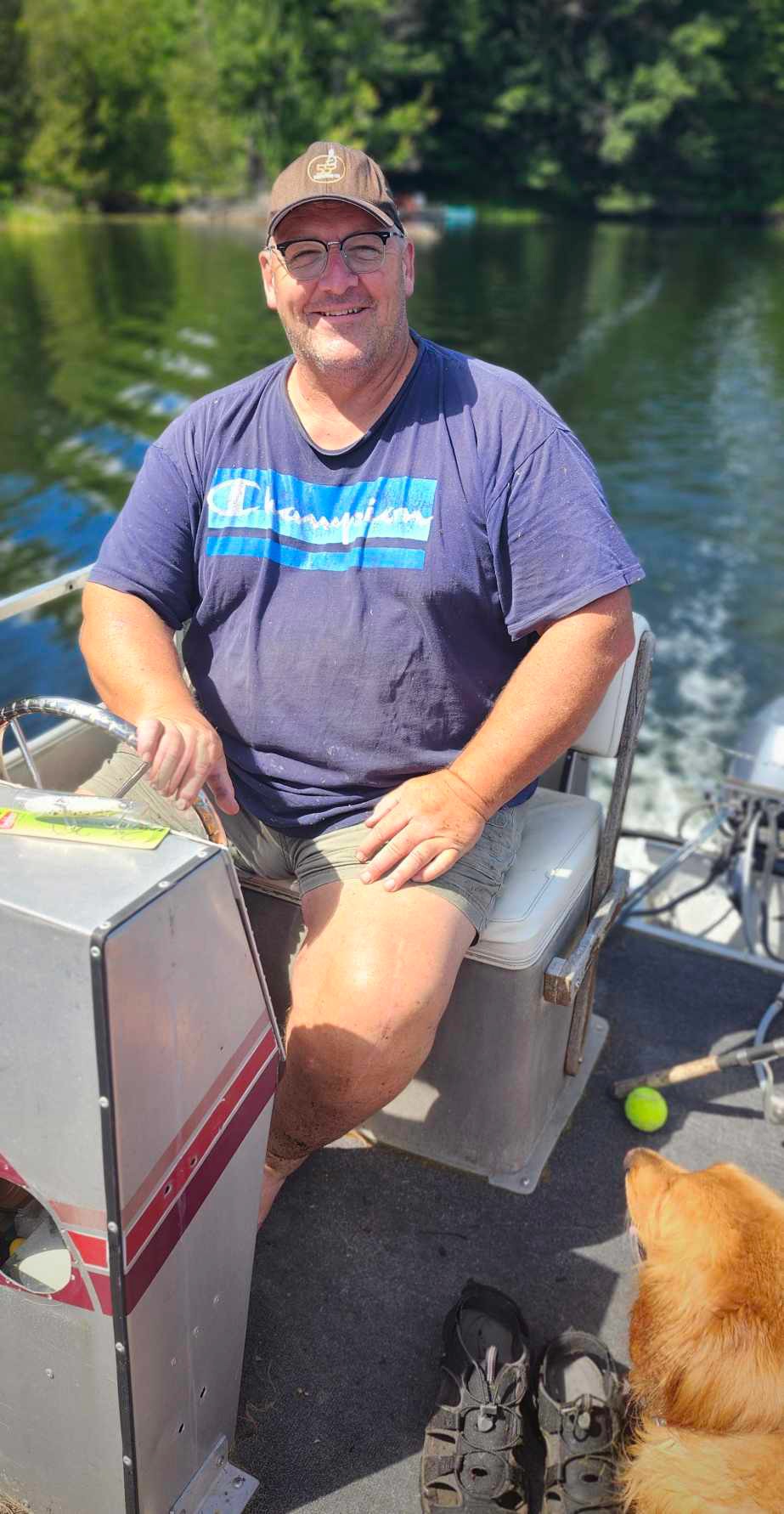
We have a new ride these days, a pontoon boat. Everyone is loving it, from the kids to the dogs, garnering Dave a new nickname, Captain Dave.
Since they were first introduced, pontoon boats have channelled the ultimate party vibe. Step onto the astroturf, get your koozie, let’s go.* You can fish, swim and tube off of them, or just sit back and enjoy the ride.
There is one cottage couple on our lake who take a nightly sunset tour on their pontoon boat, waving regally in the breeze to their neighbours on their docks and decks as they putter along the shoreline.
The pontoon boat is a relatively new invention. It was designed in 1952 by a rural Minnesota farmer named Ambrose Weeres who tied a wooden deck to two aluminum cylinders. He started manufacturing his invention, and the rest, they say is history.
When I was a teenager, I spent many of my summers up at friend’s cottages. Pontoon boats hadn’t made a splash yet on Ontario lakes in those days. It wasn’t until the early 2000s when boat manufacturers starting revving up the horsepower that pontoon boats became all the rage.
All of a sudden, pontoon boats started replacing high-powered speed boats on Ontario’s waterways. Now it seems the only people with speedboats are waterskiiers and fishermen. Today, more than 50,000 new pontoon boats are sold each year in the US.
Pontoon boats are great for many reasons. For people with accessibility issues, they provide a safe, stable means of getting out and enjoying the water. You can have a conversation on a pontoon boat, as opposed to yelling over the motor in a speedboat. They are also highly practical since they can carry large loads of people and items for cottagers needing to barge supplies across the water.
That’s all wonderful, but let’s face it, it’s the vibe of a pontoon boat that is irresistible.
Whether it’s the gentle breeze blowing in your hair, the lure of the perfect cast and catch at dusk, or simply enjoying a laugh and smile with friends and the people you love on the water, a pontoon is the ultimate summer ride.
The best months of summer are upon us. This week’s #HappyAct is to make some waves and catch some rays and party in the open on a pontoon.*
*Lyrics from Little Big Town’s 2012 hit, Pontoon
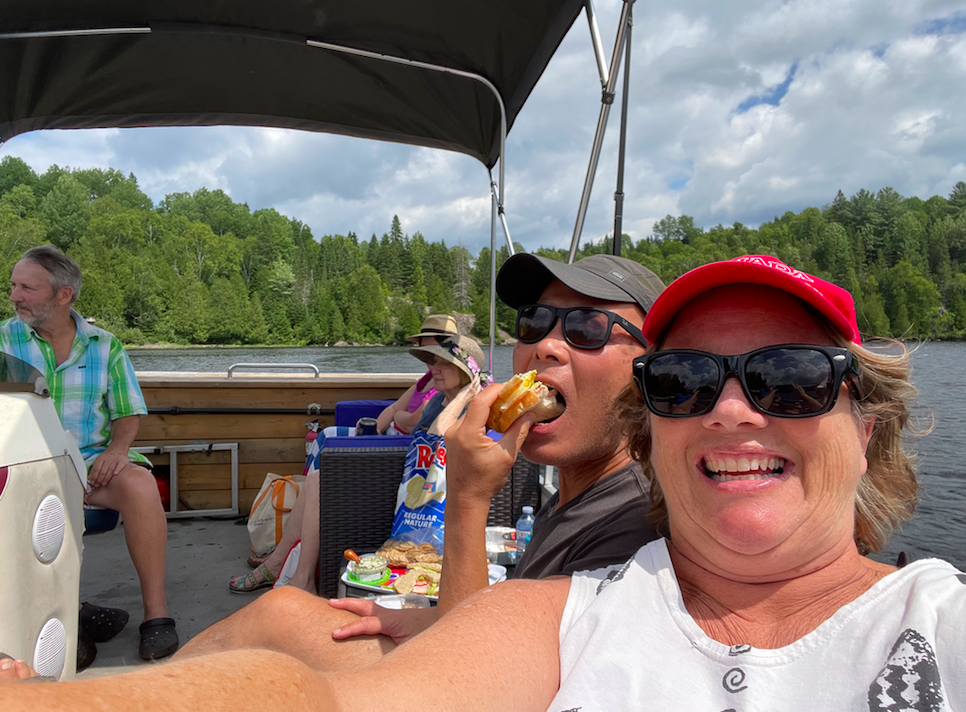
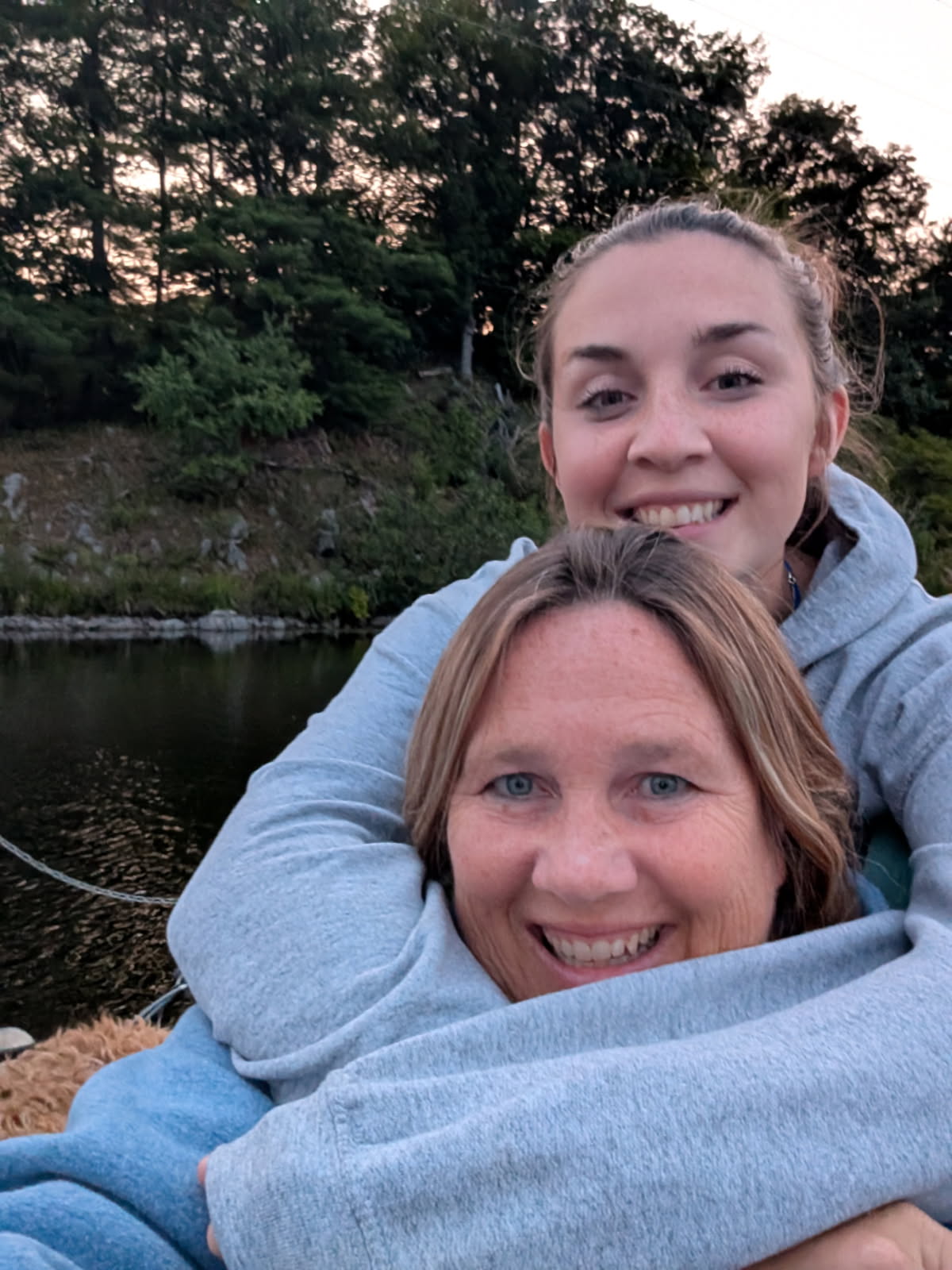
Pictured above: Partying on the pontoon last weekend at our friend Libby and Murray’s cottage; Below: Captain Dave, the girls, and Grace and me on our pontoon.
If you want to get a feel for a place, spend an afternoon in a city park.
A city park is a refuge, a place to exercise, play, eat, rest, and reflect. It’s a place where neighbours, friends, strangers, and lovers meet. It’s a special place that is often the life and heartbeat of the city and the community.
When I travel, one of the first things I like to do is take a stroll in a city park. Whether it’s Regent Park in London, Central Park in New York, or Stanley Park in Vancouver, I love exploring the meandering paths and watching the people and activity going on.
Gage Park in Hamilton has been my strolling ground lately since we are housesitting for Dave’s sister. Here’s what I’ve observed during my morning walks.
Conversations.
An older couple sit on a bench talking to a homeless man. He shares his experience of living in shelters across the country, from Charlottetown to Saint John to Hamilton. He spends part of every day at the Salvation Army. His voice breaks when he tells a story about being chased by street gangs downtown.
Two young mothers pushing strollers walk briskly, sharing confidences. “I’m always thinking, what can I do tomorrow to keep him entertained so I don’t lose my mind. Where’s me? I feel like I’ve lost me becoming a Mom.” The lament of every young mother. I say to them in my head, “Don’t worry, you’ll find yourself again.”
A man wearing a Toronto Blue Jays hat. He doesn’t think their chances are good this year. We chat about the weather and he asks Siri for the forecast, which is very detailed, chance of showers later in the day with a heat wave blazing toward us by the weekend. He used to work on a chicken farm on Starr’s Island in Port Perry and loves dogs. He takes the bus to the park.
Sights, sounds, and smells.
The fragrant scent of lilacs and peonies and roses and the surprising smell of vinegar in the rose garden.
Birdsong. Robins chirping in the trees. A cardinal singing, brightly welcoming the morning.
Black squirrels with brown tails and grey squirrels with black tails chasing each other around the craggy bark of a Kentucky coffee tree.
Bike bells chiming as a man on a bicycle passes a bunch of kids on scooters.
All ages from all walks of life.
A man in an electric wheelchair whirring around the park blasting out Steely Dan on loud speakers; it’s a Long Cool Woman in a Black Dress on his second tour.
City workers hunched low, pruning and weeding in the rose garden, talking about their plans for the weekend.
A young couple lying on a blanket, their heads resting on their elbows, almost touching, deep in conversation.
Toddlers in blue and pink onesies with hats with brims so wide you can’t tell if they stumble because of their pudgy little legs, or because they can’t see two feet in from of them.
A dog walker with six dogs, four types of doodles (always the doodles), a husky and some kind of German shepherd cross. How do the leashes never get tangled?
A parade of mostly mothers and strollers marching through the park and gathering in a circle under a big oak tree for a yoga class.
An older gentleman dressed nattily in a blue checked short-sleeved shirt, grey dress shorts and socks, black running shoes and a bowler hat, jogging slowly through the park. How does he manage to look so dapper jogging?
Teenagers splashing each other with water from the fountain, screaming and swearing, oblivious to the disapproving looks of the older woman sitting nearby.
That irritating older woman, always on her phone, looking down instead of up.*
This week’s #HappyAct is to take a stroll in your city park and discover the heart of your city.
*Ed. note: To truly experience the sights, sounds, and smells of your stroll, it’s recommended to stay off your phone. I did use my phone to take photos and notes since I have a poor memory. And for those of you with a historical interest: Many of Canada’s grandest city parks were built in the golden age of park development from 1874-1914. Mont Royal Park in Montreal was built in 1874, Stanley Park in 1888, Assiniboine Park in Winnipeg in 1909, and Gage Park in 1922. As cities developed, there was a recognition that people needed access to nature for their physical and mental health. The City Beautiful Movement rose which promoted beautiful public spaces, including buildings, streetscapes and parks.
It feels like it’s been raining cats and dogs and elephants this spring. The grass and yellow dandelions in the yard are a foot high, the plants from the garden centre sit shivering in our driveway, and muddy shoes lay strewn across the front porch caked with mud. Everyone I talked to is fed up with the rain.
It begs the question, how does rain affect our happiness and mood?
Rain can make some people sad or depressed. We can’t (or won’t) get outside to do the things we enjoy which puts a damper on our mood. This is true and well-documented for people who are more prone to suffer from Seasonal Affective Disorder (SAD) in the winter months. Lack of sunlight decreases the production of serotonin, a neurotransmitter proven to help regulate anxiety, happiness, and mood.
But you may be surprised to learn rain can have a positive impact on our mental health and happiness and there are some of us who love the rain. They even have a name: pluviophiles. For these people, rain can be rejuvenating, calming, and restorative. Let’s dive into the science.
When it rains, negative ions are released. These are odourless, invisible molecules which are created in moving water. When it rains and water hits a hard surface, the drops break up and pick up a charge. If it is a negative charge, it can generate electrons that can be picked up by molecules in the air, such as oxygen and carbon dioxide, forming negative ions. Research on the effects of negative ions indicates they boost mood, relieve stress, and give us more energy.
Then there is the impact on our olfactory senses. The earthy scent after a rain has a name too. It’s called petrichor, from the Greek words petra, meaning “stone”, and ichor, meaning “the fluid that flows in the veins of the gods”. Petrichor includes a chemical called geosmin, which is made by bacteria in soil. Inhaling it can have a calming effect.
I personally love the sound of rain. On a rainy day, I’m quite happy to sit in my screen porch and listen to the steady drumming of the raindrops on our steel roof. Relaxation and meditation videos use the sound of rain and buildings include features such as artificial fountains and indoor waterfalls for their relaxing sounds and calming effects.
There are even benefits to the grey skies that come with rainy days. With less light, the body tends to produce more melatonin, a hormone that regulates sleep, helping you rest better.
And yet we tend to be wet blankets when it comes to rain, hiding ourselves indoors until the stormy skies pass.
If you live on the West coast or in Great Britain, you make the best of the rain, dress for the weather and get on with your day.
I once spent six weeks in England and Scotland in November and December. It rained almost every day. That didn’t stop the intrepid Brits. The streets of London were bustling with shoppers, brollies in hand, and the parks were filled with young families with babies in strollers covered in plastic and little ones dressed in bright yellow and red raincoats, splashing in puddles.
Sure, there were days I was tired of the grey skies and panda-sized puddles on the slippery sidewalks, but I remember the wonderful feeling of coming in from the cold, and warming up with a hot cup of tea or enjoying a pint in a cozy pub with some friends.
This week’s #HappyAct is to become a pluviophile and get out for a walk in the rain. Time to go, I see the sun is starting to come out…
My brother is a desert person. There’s something about the light and landscapes of places like New Mexico, Utah and Nevada that speaks to him. Since I live on a lake, and am a water baby, it will come as no surprise to you that I’m a beach person.
And while Canada is blessed to boast three coastlines, all with stunning scenery, I have long since realized that I will always need to be or live on interior lakes where I can swim.
Here are ten interior lakes in Canada that hold a special place in my heart:
Big Hawk Lake: I’ve been visiting this beautiful lake north of Minden, Ontario since I was a teenager. The lake is on a popular canoe route and is dotted with pretty islands and bays and has several interesting features including rapids, a historic log chute, a rockface known as the three chiefs, rocks for cliff jumping and even a totem pole.
Lake Moraine: There is a reason why this picturesque lake in Banff National Park in Alberta was featured on our $20 bill. When you round the corner from the short hiking trail, your breath is literally taken away by its stunning turquoise blue colour and mountainous backdrop. (The colour is unique to glacial lakes and is caused by rock flour that is produced as glaciers grind against bedrock and is carried by glacial meltwater into the lake). Substitute any mountain lake in the Rockies or BC.
Red Lake: Anyone who has spent time in northern Ontario will understand why Dave’s father calls this region God’s country. Located where the road ends off the TransCanada highway near the Manitoba border, Red Lake is a fisherman’s dream, spanning 165 kms of islands, bays teeming with walleye, northern pike and muskie. The constant drone of float planes taking off from Howie Bay serenade you while on the water, but can make swimming in Red Lake hazardous!
Mazinaw Lake: Bon Echo Provincial Park houses this second deepest lake in Ontario, famous for its impressive 100 metre high Mazinaw Rock. While the rockface itself is magnificent, it’s the ancient pictographs painted centuries ago by the Algonquin and Anishinaabe peoples that are said to have spiritual meanings and qualities that attract people to the cliffs.
Georgian Bay: With more than 30,000 islands and grey granite sculpted shorelines, Georgian Bay is a boaters dream. Every time I’ve spent time in this beautiful region of Ontario, I fall in love all over again with its greenish blue waters, unique shorelines and undulating waves that stretch for miles and miles.
Lake Superior: The granddaddy of the Great Lakes, Lake Gitche Gumee is massive, majestic, and magical. It can be peaceful, calm, and breathtaking on a nice day, and dark, menacing and deadly on a stormy day. Take the Lake Superior Circle Tour, a 2,000 km route and enjoy the magnificent views and natural wonders. Be sure to take a slight detour to Mackinac Island just south of Sault Ste Marie.
Lake Memphramagog: This stunning lake in the Eastern Townships straddles the Quebec/Vermont border and offers picturesque mountain views. Legend has it that a sea monster inhabits the lake! Spend an afternoon strolling along the boardwalk in Magog or in the pretty town of Newport, Vermont which Dave and I explored last fall on our way back from the Maritimes.
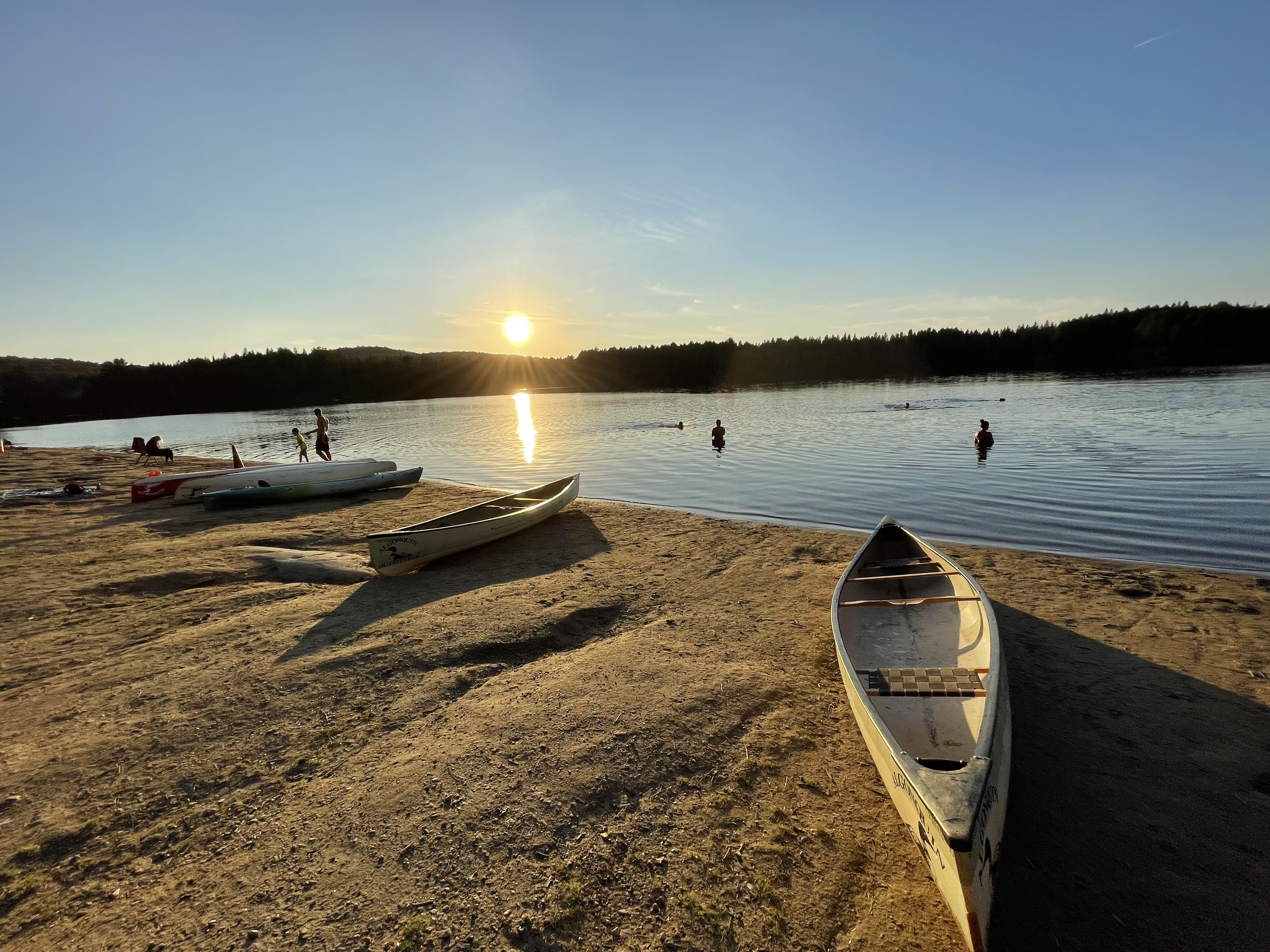
Opeongo Lake or any lake in Algonquin Park: There’s something about Algonquin Park that is special. When people think of a wild space, they think of Algonquin. Picture early morning mist gently rising off the water, revealing stately pines lining the shoreline and pure silence. It’s pure heaven.
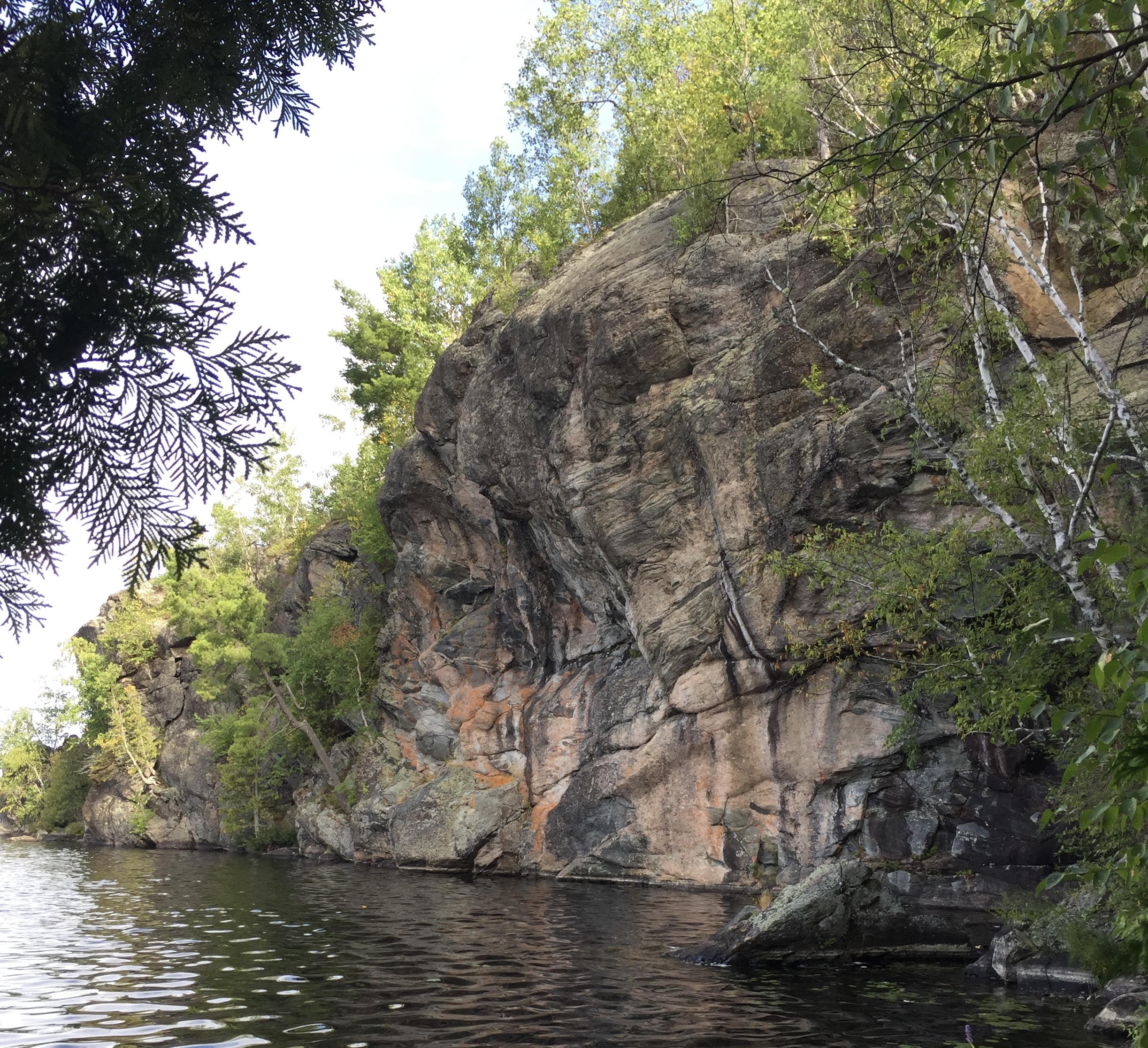
Mackenzie Lake: Located near Lake St. Peter Provincial Park in Ontario, this lake and region is a snowmobiler’s dream in the winter with trails galore. Surrounded by cliffs, there is one concave rockface on the southern end of the lake that becomes almost mystical towards the end of the day when the light hits it. Patterns of light dance across the rockface and the water. Alone in a canoe or kayak, it’s one of the most spiritual places I’ve ever been.
Lake of the Woods OR Lake Muskoka/Lake Joseph: Okay, since this is supposed to be a top ten list, I’m cheating and combining the lakes that make up the “Muskoka of the South” and the “Muskoka of the North”, even though they are 1,600 kms apart. Beautiful, stunning and expansive, these lakes have become prime real estate. Take a boat cruise and spend time gawking at the million dollar cottages. Hey, you can always dream!
Bonus pic: Desert Lake or any lake in South Frontenac. Dave and I moved to this area thirty years ago because of all the beautiful shield lakes and its proximity to Kingston. When you’re paddling on the north end of Desert Lake on a bright sunny day, watching eagles perching on the tips of pine trees swaying in the breeze and loons feeding their babies beside your canoe, you feel like you’re in paradise.
Of course, every lake is special. I’m reminded of this every time I’m out exploring our pretty little lake in my kayak. This week’s #HappyAct is to spend some time on the water.
The sunlight reflecting off this conclave rock face on Mackenzie Lake at the end of the day is very spiritual. I’ve yet to photograph it in the perfect light.
Pog light campground in Algonquin Park
My girls paddling at dusk on Big Hawk Lake.
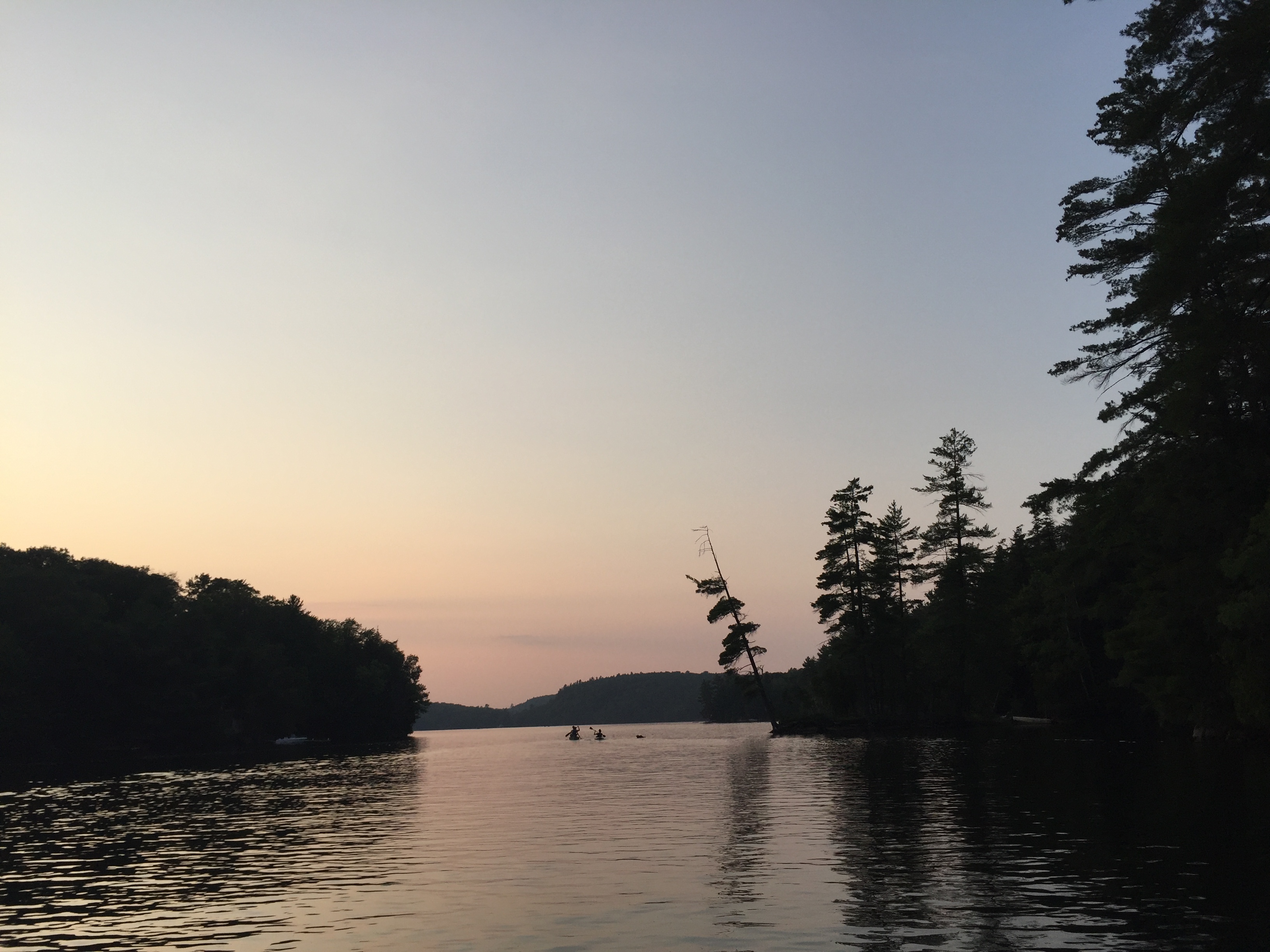
Featured photo above: Sydenham Lake at dusk in South Frontenac.
They say people come into your life for a moment, a day, or a lifetime. Sometimes it’s for a week.
In 2013, Dave and I took the trip of a lifetime to Tanzania. We spent a week in Arusha, the Ngorongora Crater and the Serengeti before flying to Zanzibar for four days in the Indian Ocean. The image of thousands of zebras and wildebeest migrating across the plains of the Serengeti is still seared in my mind.
Our local guide was Fulgence Kenedy, a sweet, soft-spoken young father with a beautiful smile, a twinkle in his eye and wicked sense of humour. We became fast friends, bonding over parenthood, our love of nature, and Justin Bieber (don’t ask). Over the years, we’ve kept in touch with Fulgence through Facebook and Facebook messenger.
Our trip to Tanzania was one of the things that inspired this blog. In a nation that had so little, we were struck by how warm, funny, and happy the people were and it made me reflect even more on what makes people happy.
Over the years, as we enjoyed the videos and pictures Fulgence shared online of him on safari, I noticed his posts were often accompanied by inspirational messages of love, hope and joy.
Here are some reflections on life, love and happiness from my Tanzanian philosopher friend Fulgence:
“Don’t plan too much, life has its own plans for you. Remember that some of the most beautiful moments of your life are unplanned.”
“Every sunset is an opportunity to reset and brings a new promise of dawn. You cannot stop the sunrise.”
“One day, I was surprised when I came home from church with my neighbour. When we had nearly reached home, she poured warm water* on me and wished me happy birthday. The question was, how did she keep the water warm all the time we were in church? It’s all because of love.” *I asked Fulgence why his neighbour poured water on him on his birthday—he says it’s like when a child is baptized and is an act of love and acceptance
“Life doesn’t allow us to go back and fix what we have done wrong in the past, but it does allow us to live each day better than the last.”
“To succeed in life you need two things: ignorance and confidence.”
“The hardest test in life is the patience to wait for the right moment.”
“Everyone has a reason why you’re in this world, but to be in this world you pass through several people and make them happy or leave a wound in their heart…the bridge to cross is just a few short words. Sorry. I forgive you. Most of us don’t know how to say that when we hurt others. It’s time to love and care for others like you love and care for yourself.”
And finally,
“Happiness is a medicine”
I’ll leave you with this classic Fulgence joke. He asked me, “Laurie, do you know how to tell a male zebra from a female zebra? The male zebra is black with white stripes. The female zebra is white with black stripes.”
Ed. note: If you’re thinking of going to Africa on safari, we highly recommend you book with Access2Tanzania. Casey and the team here in North America will customize a trip for you. Ask for Fulgence—he’s featured on their website.
One of my favourite photos: a pair of zebras in the Serengeti. Fulgence shared they will rest their heads on each others’ backs so they can see predators from any direction. Can you tell the male from the female?









 Happy Act