Findings from the 2025 World Happiness Report

man sharing a meal in Africa with others

The 2025 World Happiness Report was released on March 20, the International Day of Happiness. The first World Happiness Report was published in 2012 after Bhutan, a country that measures its success based on the happiness of its people urged the UN and national governments to “give more importance to happiness and well-being in determining how to achieve and measure social and economic development.”

Since then, the report has been measuring which countries in the world have the happiest citizens and exploring various themes related to global happiness including age, generation, gender, migration, sustainable development, benevolence, and the effects of the COVID-19 pandemic on global well-being.

As always, the results of this year’s report are fascinating (you can read the full report here.) The authors chose the theme “Caring and Sharing”, delving into how caring and sharing and specifically three benevolent acts, donating, volunteering and helping strangers can make people happier.

The Happiest Countries

Finland ranked #1 for the eighth year in a row while Canada ranked 18th. The US fell off the list of the top 20 happiest countries to #24. One troubling statistic is that in general, the western industrial countries are now less happy than they were between 2005 and 2010 with the US, Canada and Switzerland experiencing the biggest drops.

Here are the top 20 happiest countries in order:

Finland
Denmark
Iceland
Sweden
Netherlands
Costa Rica
Norway
Israel (if you’re wondering about Israel, it scored highest in several areas, including the quality of social connection amongst youth)
Luxembourg
Mexico
Australia
New Zealand
Switzerland
Belgium
Ireland
Lithuania
Austria
Canada
Slovenia
Czechia

Key findings

Beyond health and wealth, simple acts of caring and sharing can influence happiness, including sharing meals with others, having somebody to count on for social support, and household size.

  • While it’s well documented that people who live alone are unhappier, research shows that happiness rises with household sizes up to four people, but above that happiness declines.
  • We are too pessimistic about kindness in our communities, and this pessimism is contributing to our unhappiness. For example, when wallets were dropped in the street by researchers, the proportion of returned wallets was far higher than people expected.
  • One interesting piece of research and a positive from the global pandemic is we’ve seen a “benevolence” bump of 10% since COVID-19. The pandemic taught us to think and care for others more, and that benevolence has continued.
  • One disturbing trend is young people in North America and Western Europe now report the lowest well-being and happiness among all age groups. In 2023, 19% of young adults across the world reported having no one they could count on for social support, a 39% increase compared to 2006. In fact, the fall in the United States’ happiness ranking is largely due to the decline in well-being among Americans under 30.
  • When society is more benevolent, the people who benefit most are those who are least happy. As a result, happiness is more equally distributed in countries with higher levels of expected benevolence

So what does this year’s report tell us and what simple happy acts can we all do to promote caring and sharing?

  • Share meals together: people who eat frequently with others are happier
  • Be kind and don’t underestimate the kindness of others
  • Try not to live alone
  • Build social connections and don’t be afraid to reach out to people
  • Practice benevolent acts–do what you can to volunteer, donate or help a stranger (several African countries reported low scores for donating but scored very high for helping strangers which helped their happiness scores)

Finally remember that caring is “twice-blessed”: it blesses those who give and those who receive. Have a happy week.
Secrets to happiness from around the globe

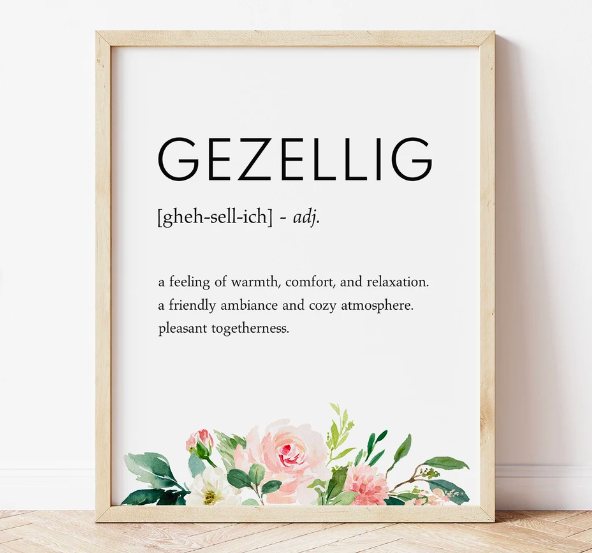
Sign with definition of Gezellig

Every country has its own unique belief system and language to describe happiness. Let’s take a quick trip around the world to see how other cultures seek and find happiness:

Joyous Icelanders embrace theta reddast, the belief that everything will work out in the end.

Italians believe dolce far niente, the sweetness of doing nothing.

In France, people exude joie de vivre, the joy of living.

Chinese xing fu is the art of finding your purpose.

The Dutch celebrate Gezellig, time spent with loved ones in a convivial and cozy atmosphere.

Germans believe in ruhe, finding peace and quiet.

And then there are the Scandinavians–the Danes known for hygge, the art of creating comfort and coziness and the Finns who value sisu, having the psychological strength to overcome extraordinary challenges.

Some countries have embedded happiness into their political and economic systems. Bhutan measures Gross National Happiness instead of GDP based on four pillars: ecological sustainability, preservation and promotion of a free and resilient culture, good governance and equality before the law, and sustainable and equitable socio-economic development.

I think North Americans could learn much about happiness from these other cultures. The ones that resonated most with me were the sweetness of doing nothing, finding peace and quiet, and believing everything will work out in the end. Which ones resonated most with you?

If you’d like to learn more about happiness around the globe, read The Atlas of Happiness: The Global Secrets of How to be Happy by Helen Russell. The common denominator in all these cultures? The power of positivity goes a long way. Have a happy week.

Measuring our Gross National Happiness

Bhutanese childrenWhat if, instead of measuring our Gross National Product, we measured our Gross National Happiness?

It’s not as crazy a concept as you think. In fact, there is one country that has made their Gross National Happiness a priority. Bhutan has been measuring its Gross National Happiness since 1972. The GNH is based on the philosophy that if the government cannot create happiness for its people, then there is no purpose for government to exist.

The GNH of Bhutan is based on four pillars: good governance, sustainable socio-economic development, cultural preservation, and environmental conservation and nine domains to ensure the happiness of its citizens: psychological wellbeing, health, education, time use, cultural diversity and resilience, good governance, community vitality, ecological diversity and resilience, and living standards.

A person is considered happy if they have sufficiency in six of the nine domains.

Here are a few interesting facts from the Bhutan GNH:

  • The happiest people by occupation in Bhutan include civil servants and monks.
  • Interestingly, the unemployed are happier than corporate employees, housewives, farmers or the national work force.
  • Unmarried people and young people are among the happiest.
  • Men tend to be happier than women

The 2015 GNH survey showed an increase from the 2015 in their overall GNH from 0.743 to 0.756 with 43.4 of the Bhutanese people being deeply or extensively happy, and 91.2% showing sufficiency in at least half of the domains.

I’m not sure I’m willing to leave my corporate job to become a monk, but there are many things we can learn from Bhutan’s GNH.

First, we need to put a priority on the happiness of people. As a nation, we need to measure how well we are doing at creating the right conditions for our citizens to be happy. And finally, North Americans need to relinquish our obsession with work and material things and go back to the basics. Things like spiritual wellbeing, being physically active and healthy, and developing strong communities.

Tomorrow, March 20th is the International Day of Happiness. This week’s #HappyAct is to measure your own GNH. Of the nine domains Bhutan measures, how do you score? Leave a comment.