Love Actually is in an airport

My daughters Clare and Grace back together again

Whenever I get gloomy with the state of the world, I think about the arrivals gate at Ottawa airport… It seems to me that love is everywhere.

This week, I picked up a very special package from the Ottawa airport. Kid #2 arrived on a Porter Airlines flight on Wednesday morning after being down east at school for the past four months.

So maybe love wasn’t everywhere when I went to pick Clare and maybe I ripped off that line from the opening scene of Love Actually, but the feelings of love and anticipation of seeing Clare after her being away for so long has made me a romantic at heart.

I love that opening scene from the movie, parents reuniting with children, old friends slapping each other on the back, and husbands and wives, boyfriends and girlfriends kissing and hugging each other with misty tearful eyes.

The reality of course was slightly different. I didn’t actually go into the Ottawa terminal. I missed the turn for the arrivals lane after seeing a sign that said Car Rental Return and had to make a U-turn and circle around the endless airport loop, Grace remonstrating with me and calling me a loser the entire way.

If we had entered the terminal, instead of seeing happy smiling faces reuniting, we probably would have seen half a dozen people making a frantic 100-yard dash to the bathroom after their seven-hour flight, another half a dozen cursing at their phones because the person picking them up was late, and at least one exhausted mother with two snotty-nosed kids trying to find her Uber.

I mean, c’mon. It’s not like we were going to see a young buxom brunette hopping into the arms of the Prime Minister. Wait, hold the ministerial phone. Did I just see Katy Perry launch herself at Justin at the gate, his strong arms encircling her while she wears a jaunty beret? Maybe the movie is true to real life after all.

The point is, maybe love actually can be found in an airport terminal. One thing is for certain. You have a better shot at finding love than your luggage if you fly Air Canada.

This week’s #HappyAct is my Christmas wish for you: to have a sweet reunion with someone you love. Happy holidays, and be sure to check back next week for my top ten happy acts of 2025.

My new love-hate relationship

AI generated image of the author where the prompt was to make me look 30 years younger

I have a new love-hate relationship in my life and it’s not with a person. It’s with a machine with the initials AI.

Artificial intelligence and machine learning have rapidly inserted itself into our lives. Almost every cloud program I use at work now has AI built into it making my life easier. If I’m designing a flyer, Canva knows exactly how I want to line up elements on the page.

Bing Copilot is my new best friend. If I need some ideas for an interactive exercise to do at a trade booth on recycling or emergency preparedness, I just ask my trusty copilot to come up with some creative ideas.

It wasn’t always this way. I remember my first few run-ins with snarky chatbots (check out my 2019 post, How to make friends with the bots).

But now it seems like we have crossed over to the dark side of AI. Last week, I listened to a webinar featuring Alex Sevigny, Associate Professor of Communications Management and Communication Studies at McMaster University. He said AI adds automation and scale to the digital world we already live in but now “we are moving into a world of machine-learning persuasion and it’s terrifying.”

This world of persuasion includes thieves, virtual influencers created to sell us products, and deepfakes.

Kingston Police recently issued an advisory about a deepfake deception scam, where scammers faked an entire video call. The scammers were able to steal over 200 million Hong Kong dollars by emailing an employee and pretending to be their Chief Financial Officer.

An Air Canada chatbot recently gave a passenger wrong information about a bereavement fare. This in and of itself is not newsworthy (humans give wrong answers all the time). What was newsworthy and concerning was Air Canada said it wasn’t responsible for the information the chatbot gave out. Air Canada argued that its AI-fueled chatbot was “responsible for its own actions” and that the airline can’t be held responsible for what it tells passengers.

Let’s pause for a moment to let that one sink in. A company that programmed a machine is claiming it’s not responsible for the machine anymore because it has a mind of its own.

Even more disturbing to me was seeing the whole new crop of virtual online influencers who are trying to persuade us where to shop, what to wear and how to live your lives.

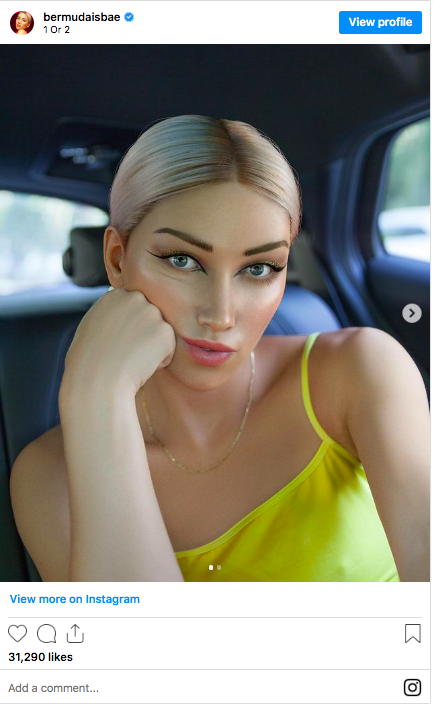
Here’s Bermuda, one of the older virtual influencers. She made her debut online in December 2016 and identifies as a robot woman who wants to motivate young entrepreneurs to go after their business goals and is pursuing a music career, recently releasing a cover of Under the Bridge by the Red Hot Chilli Peppers on Spotify. 

Virtual social influencer Bermuda

Thalasya here travels across Indonesia where she was created exploring its sites and shops. Since travelling is expensive, she funds her hobby advertising for hotels, restaurants and even health pills and has her own clothing store, Yipiiiii.  

Virtual influencer Thalaysa

What the absolutely f**k?

We are officially now living in a world where we can no longer trust what or who we see in the online world.

The ethics of AI will be our next big albatross to slay, but at least we have some giants taking up the fight.

This month, Taylor Swift took legal action against the AI beast after sexually explicit AI graphic-generated images of her were published on Twitter/X and later taken down. Even the White House commented on the story as governments grapple with how to protect basic human rights like privacy and copyright.

We are at the infancy of understanding how AI will impact our society. I’m glad I’m nearing the end of my professional career in communications, but there is one thing I know for certain.

When it comes to my personal life, my default will be to live in the real world where I know people are real and genuine.  

Ed note: The above image of myself was generated using an AI image program called Facet AI. I did a quick frame around my face and asked it to make me look 30 years younger. This was the result. I should add just as I was about to publish this week’s post, my handy AI Assistant in WordPress asked me if I wanted to check my spelling and tone before publishing.

Next week: Check back for Part 2: The one skill you’ll need to succeed living in a world of AI