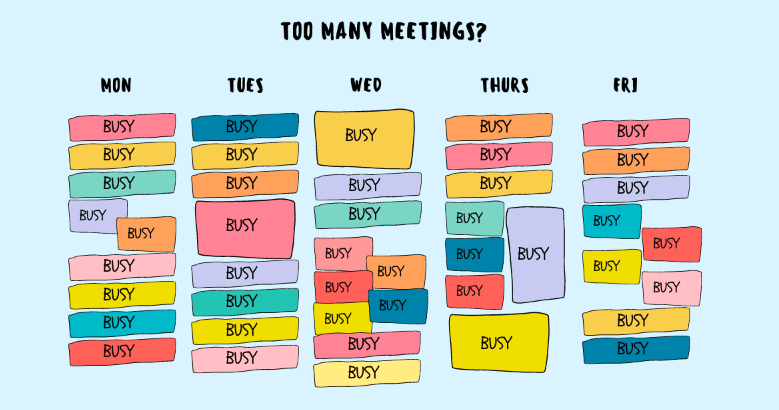
Don’t meet your life away

meeting schedule

Are meetings the bane of your existence? Recently, Shopify introduced a new policy that cancels all recurring meetings with more than two people in an effort to give employees time back in their day so they can actually do work.

The company has instituted a six-hour window on Thursdays for large meetings, and they’re encouraging employees to decline other meetings, and remove themselves from large internal chat groups.

Meeting mania has been sweeping workplaces for years, and only became worse during the pandemic when Zoom became a verb that became synonymous with fatigue and eye strain.

In my old job, I probably spent anywhere from 3-4 hours a day in meetings, and my meeting schedule was considered light compared to most other managers.

In my new bridge retirement job, I have very few meetings. I just work. What a novel concept.

Here are some tips on how you can reduce the number of meetings in your work day and increase your job satisfaction:

  • Book shorter meeting times: try 15-minute touch bases or half-hour meetings instead of a full hour
  • List all the meetings where you’re just mainly listening in and not really participating. Chances are, you don’t need to be there. Decline and clear your schedule.
  • Have 5 or 6 items you need to ask your boss? Book one 15-minute touch base or save your questions up for a regular weekly meeting
  • Call or video chat people. This is an interesting one given nobody uses the phone anymore, and some people are reluctant to video chat you if you don’t have a time booked on your calendar, but often a quick 5-minute chat can get you the answers you need without another meeting filling up your calendar
  • Set an ideal work to meeting ratio, then stick to it. This will be highly role dependent. The ratio for a web developer for example may be 10:1 (so in a 40 hour work week, 36 hours of work to 4 hours of meeting) whereas for a Vice-President, it may be more like 4:6 (16 hours of work to 24 hours of meetings a week)

This week’s #HappyAct is to try working for a change, instead of meeting your life away.

The Gorilla glue of an organization

kid with capeEmployee engagement continues to be at an all-time low globally. According to Gallup’s 2017 State of the Global Workplace report, 85% of employees are not engaged or actively disengaged at work. The economic consequences of this global “norm” are approximately $7 trillion in lost productivity a year.

I’ve shared my own views about declining employee engagement before. In Love in the Workplace, I said a pay cheque is what makes people show up for work every day, but what they do with their time depends on three key things: the degree to which the work they do aligns to their passions and strengths, the relationships they have at work, and what I called the “negative quotient” or “piss off” factor–the degree to which negative factors at work affect their ability to succeed.

I believe that more than ever, but I think there is a fourth key factor contributing to low employee engagement, and that is undervaluing a key segment of employees, the unsung heroes of every organization.

This group is highly knowledgeable and experienced but usually not as well known to senior leaders. They may not aspire to move up the corporate ladder, but prefer to fly under the radar and do their work without fanfare, quietly coming in every day and producing, solving problems, sharing their knowledge and helping team members out of jams. They are the glue that keeps the corporate machine running smoothly.

They also serve another incredibly indispensable purpose—they set the tone for the culture of a company.

I’m very lucky to work for a company that has these unsung heroes in spades, but we need to do a better job of recognizing them.

In my world of corporate and strategic communications, data, metrics, employee engagement numbers and strategic alignment, and yes, culture are buzzwords that rule the day. Some leaders believe the most valuable use of their time is crunching numbers and spreadsheets.

I take a contrarian view. I think I provide the greatest value by doing my part to develop and promote a positive and people-focused culture, by helping and recognizing the people who are the Gorilla glue of my organization.

So to the Mirandas, Randys, Sandras, Donnas, Karens, Lillians, Elaines, Amys, Kristas, Andreas, Garys, Jessicas and all the other unsung heroes I have the privilege working with every day, thank you.

This week’s #HappyAct is to recognize an unsung hero in your life or organization. Feel free to share your message to them below.

How to deal with an unreasonable boss

people quit because of bad bossesThere’s a new book I’ve put on my summer reading list: Colin Powell’s My American Journey. Here’s a great quote from it:

“The day the soldiers stop bringing you their problems is the day you stopped leading them. They have either lost confidence that you can help them or concluded that you do not care. Either case is a failure of leadership.” —Colin Powell

Oren Harari, a professor at the University of San Francisco says if this was a litmus test, most CEOs would fail. I couldn’t agree more.

Powell talks about busy bastard bosses, bosses that never rest, and as a result never let their staff rest. It’s sad, but I’ve heard of more busy bastard bosses making life hell for their employees in organizations and it’s time we put a stop to it.

Powell advises against being a BBB. He writes, “Be busy, work hard, but don’t become so busy that you cut out other things in life, like family and recreation and hobbies. And never be so busy that you’re not giving your staff and your followers enough time to do the same thing.”

Here are tips for dealing with an unreasonable boss:

  • Don’t check email at night unless it’s a crisis. Just because someone sends you an email at 10:30 at night doesn’t mean you have to answer it at 10:30 at night.
  • Watch and learn how they like to work. Some bosses want everything by email. Some want updates in a meeting. Learn their preferences and as long as they’re reasonable, change your habits to accommodate them.
  • Set limits. If you need to be home with your kids in the morning, but can stay late if needed at night, make them aware of this.
  • Be concise and to the point, and ask for clarity. Unreasonable bosses often think they communicate well, but they don’t. They’re so focused on being busy, and moving on to the next thing on their list, they gloss over instructions and fail to provide clear direction.
  • Figure out how to get what you need or get things done through other people so you don’t have to deal with them.
  • If they give you an unrealistic deadline, ask for more time. If they say no, ask which other work can be put on hold so you can meet the deadline.

Most bosses aren’t bastards, but they are busy. If you set limits, learn how they like to work, and do good work, you’ll have a good chance of establishing boundaries and a good work life balance.

And for those poor souls who work for a busy bastard boss who are hopeless—bosses who are so unreasonable or disorganized they make it impossible for you to do your job, who don’t care or even know about what’s going on in the lives of their employees, and only see employees as a head count or resource, find another job.