This past week, Fortune magazine published an interview with Matthew Saxon, the Chief People Officer of Zoom on the pending one-year anniversary since Zoom mandated employees who live 50 miles or less from headquarters to return to the office a minimum of two days a week.
Saxon characterized the decision to mandate a “structured hybrid” work model in August 2023 a “success” that has led to efficiencies and creative solutions.
The Chief People Officer, who once promised workers could work remotely indefinitely, justified the abrupt about-face, saying the hybrid work model was better for productivity, corporate culture and their customers.
The article has created ripples in an already turbulent and tenuous relationship between workers and employers.
It seems to me that employers who are issuing return-to-office mandates want it both ways. When it is critical or convenient to let employees remotely, as was the case during the pandemic or when there are bricks and mortar changes, it’s okay for employees to work from home and they trust them to do their jobs and be productive. But the minute those reasons fade, they want employees back in the office.
It’s hypocritical and a bit of a slap in the face if you ask me (and in case you were wondering, Saxon works primarily remotely).
Some say it’s the beginning of the end of remote work. One thing is for sure, it’s the height of irony.
As a communications professional, I’ve always believed my greatest skill was the ability to listen and ask questions.
It has served me well in my career. In the age of artificial intelligence, I predict the ability to ask good questions will become the most important skill crossing nearly every profession.
In case you haven’t experimented with ChatGPT or any of the AI programs yet, the way it works is you ask a question, and the program uses machine learning to generate information. Just like any program, the quality of the output is 100% determined by the quality of the input. The more detailed, descriptive and targeted the prompt, the more accurate and helpful the result.
The possibilities are endless, just like the number of results you can receive. I know colleagues who now keep detailed spreadsheets of prompts to ask ChatGPT and similar programs. Here is an example of career-based prompts from Chris Donnolly for job hunting, expanding your network or updating your resume, a good one to keep handy since many of us could be out of work soon thanks to AI.
The key is to be as detailed and specific as you can. OpenAI recently unveiled its new video AI generator called Sora. At the launch, CEO Sam Altman asked people to send in prompts for Sora to demonstrate their ability to create videos in seconds. Here is a Twitter/X post with one of the videos based on the prompt:
“Beautiful, snowy Tokyo city is bustling. The camera moves through the bustling city street, following several people enjoying the beautiful snowy weather and shopping at nearby stalls. Gorgeous sakura petals are flying through the wind along with snowflakes.”
Introducing Sora, our text-to-video model.
Sora can create videos of up to 60 seconds featuring highly detailed scenes, complex camera motion, and multiple characters with vibrant emotions. https://t.co/7j2JN27M3W
Scary isn’t it? And just like buyer beware, prompter beware. You can never completely trust the information you receive.
A lawyer in BC recently used ChatGPT to prepare legal briefs in a family law case. The brief cited cases that never existed. She was ordered to pay special costs in the case to opposing counsel and is under investigation by the law society for her actions.
Just like every new technology, we will need to navigate the ethics of AI and find the right balance and place for it in our lives. As I’ve been grappling with how to use it professionally and personally, I’ve decided not to use it for any creative projects unless it is to do research so my own thoughts, words and voice are represented in my work.
This blog is called the #HappyAct for goodness sake, so I thought I would end this week’s post on a positive note. I asked Bing Copilot, “I’m a communications specialist working in a small rural municipality. How much time before my job becomes obsolete due to AI?” I’ve shared the response it gave below.
The final line was “Remember, the future isn’t about humans vs. AI; it’s about humans collaborating with AI to achieve better outcomes. 🤝
Wait a minute. It didn’t answer my question. I guess machines are more like humans after all (time to brush up my resume…)
Bing Copilot response
“As a communications specialist working in a small rural municipality in Ontario, your role involves critical human skills that are not easily replicated by artificial intelligence. Let’s explore this further:
Contextual Understanding: Your job requires understanding the unique context of your municipality, its people, and their needs. AI can process data, but it lacks the empathetic understanding that comes from human experience.
Effective Communication: Your ability to convey information clearly, tailor messages to different audiences, and build relationships is invaluable. While AI can generate text, it often lacks nuance and emotional intelligence.
Creativity and Adaptability: As a communications specialist, you adapt to changing situations, create engaging content, and find innovative ways to connect with residents. AI can’t match human creativity and adaptability
Community Engagement: Building trust and engaging with the community is a core part of your role. AI can’t attend town hall meetings, listen to concerns, or build personal connections.
Ethical Decision-Making: You navigate ethical dilemmas, handle sensitive information, and make judgment calls. AI lacks moral reasoning and can’t weigh complex ethical considerations.
Local Knowledge: Your understanding of local history, culture, and politics is irreplaceable. AI lacks this context.
Predicting obsolescence is challenging, but here’s the optimistic view: AI can enhance your work by automating repetitive tasks, analyzing data, and suggesting content. However, your uniquely human skills will remain essential. As technology evolves, consider upskilling to stay relevant. 🌟
Remember, the future isn’t about humans vs. AI; it’s about humans collaborating with AI to achieve better outcomes. 🤝
A couple of years ago, I wrote a blog post called The key to job satisfaction in a post-pandemic world. My theory was it wouldn’t be hybrid work, a pay cheque, benefits or perks that would make people satisfied at work, it would be the work itself.
I now believe I had it half right. The other half of the equation is autonomy.
Autonomy at work can mean many things. It can mean the ability to direct your own work, manage your own schedule, and decide when and where you work.
Workers today are demanding more autonomy over their work. And if a company isn’t willing to meet them halfway, they’re leaving in droves.
It’s no surprise many companies return to work programs and mandates have been utter failures. In “Forget Flexibility, Your Employees Want Autonomy”, a Harvard Business Review study found that 59% of workers said they would not work for a company that required them to come into a physical office five days per week. The study researchers concluded, “Mandates feel like a violation of autonomy, which is one of the most important intrinsic drivers of threat and reward in the brain.”
Sadly, some companies have resorted to monitoring employees in an attempt to maintain control in remote working environments. But another study has shown that this can backfire, because employees resent the lack of trust and autonomy.
The article cited another Harvard Business Review study that found employees who otherwise would have been model employees were more likely to engage in various “rule-breaking behaviours” when monitored.
The message to employers is clear. Workers today want a say in the work we do and how we work in a work environment that values autonomy and trust over surveillance.
Beware the company that ignores the will of the masses.
I’ve always believed that North Americans are workaholics. As a society, we allow work to rule our lives, from our waking hours to our sleeping thoughts (see my recent blog on sleep). In my heart, I’ve always felt more European when it comes to work.
In the past five years, I’ve been encouraged to see a growing trend of countries and businesses shifting to a four-day work week.
What’s interesting is in the UK and Europe, companies adopting a four-day work week are generally working less hours than before: between 30 to 32 hours a week.
In North America, not surprisingly, companies experimenting with a four-day work week in some cases are simply proposing to eke the same number of working hours out of employees, but in four days instead of five.
The four-day work week movement 4dayweek.co.uk says it is campaigning “for a four-day, 32-hour work week with no loss of pay which would benefit workers, employers, the economy, our society, and our environment”.
The UK recently published the results of one of the largest pilot studies on a four-day work week. About 2,900 employees across the UK took part in the pilot. Calling it a “major breakthrough”, 56 of the 61 companies extended the pilot and 18 companies made the arrangement permanent.
Of employees surveyed before and after the pilot, 39% said they were less stressed, 40% were sleeping better and 54% said it was easier to balance work and home responsibilities.
The number of sick days taken during the trial fell by about two-thirds and 57% fewer staff left the firms taking part compared with the same period a year earlier.
“The vast majority of companies reported that they were satisfied with productivity and business performance over the trial period.”
In Ontario, a growing number of rural municipalities are starting to transition to a four-day week. There are now seven municipalities offering employees the option of working a four-day week, the latest being Algonquin Highlands.
The executive director of the Ontario Municipal Administrators Association says it’s easier for rural municipalities to adopt a four-day work week because they are smaller, more nimble, and have more difficulty attracting and retaining talent, so it’s to their benefit to offer more flexibility in the workplace.
In Algonquin Highlands, one group of employees works Monday to Thursday, with another group working Tuesday to Friday. All employees worked an extra hour a day. It’s been a success. As Mayor Liz Danielsen says, “There’s nothing better than having happy staff.”
This week’s #HappyAct is to start the conversation in your workplace. Ask your leaders about a four-day work week.
Recently I emailed a dozen friends and asked them three questions about how happy they were at work. The results were very revealing. The people who responded work in all sectors, government, private sector and self-employed. Here are the results of my unscientific poll on work and happiness:
My first question was, “Are you happy at work?”
More than half were not happy at work. Some said they were ashamed to admit it, because “they have a pretty good gig”; one person said they weren’t happy but planned to slog it out until retirement. A quarter of respondents said they were happy, and one person said at different times in their career they’ve been happy, and unhappy at other times.
When I asked what was the cause of their happiness or unhappiness at work,
On the plus side, the common themes were working with great people, loving what they do, and the variety of work. One person said they work in a low-stress environment and have an eight-minute commute, so they can come home for lunch every day if they want.
For those unhappy at work, here were some of the reasons they cited for their unhappiness:
Lack of involvement and inclusion and team camaraderie.
Being tired of dealing with some teams who don’t appreciate the work they do.
The inactivity associated with being on a computer eight hours a day.
One person said working within an environment where there are too many people in authority who “literally don’t have a clue what they are doing” and a “poisonous” atmosphere as a result of so many people being off on leave, creating more work for those left behind who are still working diligently.
One person who is self-employed said, “I’m bored, but I like the flexibility of what I do, so I stay at it. Also, the administration associated with being self-employed is a tough slog. I’m always behind on that, so that creates guilt that I’m not keeping on top of things.”
My final question was “What would make you happy or happier at work?”
Being valued and respected and having their work acknowledged was a common theme, along with being able to do more of what they love to do and having challenging projects.
Better work-life balance, and being compensated fairly and seeing more transparency in salary grids were cited as other key factors.
One person said they’d like to have a friend at work and work with a diverse team.
The one person who was unhappy at work in the “poisonous” environment said they cope by focusing on their family, volunteering and sports and outdoor activities to remind themselves of what’s important in life.
On a lighter note, one person wanted a Keurig machine, a fitness room with a treadmill or exercise bike and another an office cat (for me, it would be a dog!)
So what does this tell us and what can we do to be happier at work? Scientific studies show having at least one good friend at work is a key contributor to happiness. Making sure we choose a positive environment where we work with good people and where our work is respected is critical.
As we emerge from this pandemic, we have a unique opportunity to redefine our relationship with work. At the core of the discussion should be these three questions.
Special thanks to the people who participated in my unscientific poll.
The debate on the future of work rages on (you can read about my vision for it here). This fall, many companies announced they would start bringing people back in the office. With a fourth wave of the pandemic underway, many of those same companies have deferred their plans indefinitely, making remote work here to stay.
For those of us toiling away in our bedrooms and basements, we’ve had plenty of time to contemplate what’s missing in remote work.
The prevailing wisdom is what’s missing from remote work is the four C’s: collIaboration, connection, communication and culture. While all of these things have suffered a decline to varying degress, they are not missing from remote work. We’ve still managed to collaborate, communicate and stay connected with work colleagues.
No, the key ingredient missing in remote work is energy.
There is an undeniable energy in being around and working with people. When you meet or bump into people at the office or work together in person, you feel the energy level in the room rise. Ideas are born, connections are made. Energy fuels creativity, learning, innovation and propels action. We are driven to take action and succeed, which drives a sense of purpose and accomplishment.
It has been said for introverts, this pandemic has been a blessing. It has allowed them to work quietly on their own, focus on their passions and be happy. But for extroverts who rely on the energy of others to give them strength, and help them be the best version of themselves, the pandemic has been crippling.
The problem is introverts and extroverts alike need to be re-energized from time to time, and most remote workers are running on dangerously low batteries.
This week’s #HappyAct is to assess your energy level and needs. How are you doing? Share an idea on how to fill the void so we can all recharge.
Last week, I listened to an interesting webinar about our emotional connection to work, facilitated by Dr. Laura Hamill from Limeade.
For many of us, our relationship with work has been put to the test this past year. Some workers have grown closer to their employer, building a stronger relationship based on trust, some have struggled with feelings of separation, while others are considering breaking up with their employer.
While intuitively, we’ve always known we have an emotional connection to work, the pandemic has been a coming of age for our relationship with work. It has caused many people to reflect on what they want from their job, where they want to work, and how work contributes to their overall wellbeing.
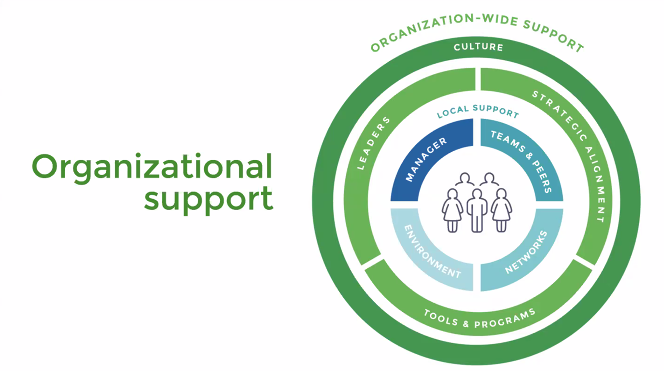
Dr. Hamill talked about the factors that affect our wellbeing. There are some factors we have little control over: our genetics, underlying health conditions, personality, and socioeconomic status. The factors we have more control over include our mindset, habits and behaviours, social supports and relationships, and the organizational supports companies put in place for their employees.
While many companies stepped up during COVID to provide supports for employees coping with the stressors of the pandemic, Dr. Hamill maintains tools and programs are not enough. In order for us to be happy at work and have a positive sense of wellbeing, we need to feel like we belong, valued, productive and contribute to the organization’s success.
For this reason, culture, employee engagement, diversity and inclusion and employee wellbeing are inextricably linked.
As we reimagine the future of work, it will be imperative to put employee wellbeing at the forefront. If we don’t, we could be in for a nasty break up.
There is a raging debate going on about the future of work. Companies are considering whether to continue to let employees work remotely, return to the office or adopt some form of hybrid model when the worst of the pandemic is over.
As I said last week, we’ve learned much in the past year. But I fear that as a society, we will let a precious opportunity slip through our fingertips: the opportunity to finally redefine our relationship with work, to seek a greater work-life balance and truly imagine a brighter future, one where we don’t just spend our days making a living, but living our best lives.
Here is my vision for the future of work.
First, employees would be able to choose how many hours they want to work a week. Imagine if you could say to your employer, I want to work 24 hours a week, 30, or 32 hours a week so I can pursue my passion, whether it’s painting, writing, running a side business, or volunteering.
Employees would have more flexibility to choose when they work. 6 a.m. to noon? No problem. I was reading one study where 15% of workers said they’d prefer to work in the evenings or at night so they could do things outside during the day. Depending on the role, why not? It could also help with child care challenges for working families.
We need to discover how to bring joy and fun back into our work world. The reality for many office workers is their day consists of never-ending emails and meetings, distractions and interruptions that is making us unhappy at work. When you feel like your day consists of putting out fires and you haven’t accomplished what you set out to do, it’s disheartening. Even before the pandemic, people were habitually checking email 74 times a day and switching tasks every 10 minutes.
There are many, innovative solutions to making work fulfilling again.
Let’s start by hiring more people. I believe too many companies are running too lean. There are simply not enough people to do the work. If some people opt for shorter work weeks, there could be the opportunity to hire people and distribute work a bit more equitably to help ease stress and workloads.
We also need to be smarter about how we spend our time during the workday. Companies could establish designated meeting times, and work times to help people concentrate and accomplish meaningful work, without disruption.
Several years ago, a Fortune 500 software company in India tested a simple policy: no interruptions Tuesday, Thursday and Friday before noon. The company experienced a 65 percent increase in productivity but also reported employees experienced an increase in work satisfaction. They discovered the most important factor in daily joy and motivation was a sense of progress.
We’ve also learned working from home this past year the importance of human connection. We miss our colleagues dearly.
The future of work needs to include being together again, but not dictated by arbitrary policies. Being able to collaborate, have fun together, celebrate successes are all great examples of when it will make sense to bring employees together in person. Training is another thing we’ve learned is a much more richer experience in person than remote learning.
Good workplaces will develop a do good culture. Providing opportunities for employees to get involved in their communities, and volunteer for worthy causes will add a new layer of purpose to work. Some companies already offer up to five days a year for employees to volunteer for local charities.
The future of work also includes more vacation. There will be a pent-up demand for travel when borders open up. North Americans could learn from other countries like the UK where residents get 28 days of vacation a year, France 25, and Germany and Australia, with 20 days.
Finally, companies need to adopt the ner way of business. Ner is the business philosophy where the most important aspect is people and leaders only need to create an environment where people can excel. Companies have no hierarchy, just self-managing teams. Ner companies donate 3% of their profits and 2% of employee time to contribute to social projects and top salaries can’t be more than 2.5X higher the lowest salary. The ner philosophy creates more human, meaningful and entrepreneurial workplaces. And it works. Watch this video to learn more about ner.
Yes, we have a unique opportunity before us: to reimagine the future of work. Companies that are short-sighted will focus on one aspect: place.
Companies that are progressive and visionary will focus on outcomes and a new, more human philosophy towards work.








 Happy Act