See past your thoughts

Dog walking in the woods

Have you ever gone for a walk or a drive, and arrived not remembering anything you’ve seen along the way because you were so lost in your thoughts?

It happens to me more than I would like to admit.

I’m conscious of it now, so when it happens, I stop in mid-stride if I’m walking, scold my brain, and start looking at the world around me. I make a conscious effort to be in the moment, listen to the wind in the trees, the birds, see the snow glistening on the pines and just take it all in.

It’s easy to become prisoners of our thoughts. It’s hard work to see past them.

1,000 days

People wearing masks in 1918 in California

Very early on in the pandemic, an older caretaker of a church told Dave, “It will be a 1,000 days, every pandemic takes a 1,000 days.”

The Spanish flu lasted from February 1918 to April 1920. The World Health Organization declared the COVID-19 pandemic on March 11, 2020. By my count, we are at 675 days which means we have about 10 months left of living with COVID.

For the first time in almost two years, I am quietly optimistic we are beginning to see the light at the end of the COVID tunnel.

Early on, the other catchphrase was herd immunity. The pandemic will subside when a large proportion of the population has either contracted the disease or developed enough antibodies through vaccines to protect themselves from contracting the disease. With the highly contagious Omicron variant, we are now seeing herd immunity in action.

This week’s #HappyAct is to allow yourself to hope. Stay strong during these last few critical weeks and months and let’s all continue doing what we need to do to support our beleaguered healthcare workers who have been the real heroes on the front lines.

I choose to hope the end is near, and I for one, can’t wait to see what’s on the other side.

Ed. Note: This post is not based on any scientific evidence. Please take it as it’s intended, hopeful musings that brighter days lay ahead.

Here’s to all the jolly old Saint Nicks

My daughter Clare with Santa

Last week, I took Friday off to do some Christmas shopping. I happened to walk past the mall Santa who was sitting alone on his red throne with his mask half-dangling beneath his snowy white beard.

A young family was just leaving, and I thought how sad it was that he was sitting there all alone. Usually there would be a line-up a mile long to see him, and I shouted, “Hi Santa” and gave him a big wave on the way by.

I started thinking about all the COVID Santas. Most of these guys are in their 70s, putting their health at risk letting tiny unvaccinated toddlers and babies sit on their lap to keep a time-honoured tradition alive and create special memories for their families.

We always knew Santa was a hero, but this year he’s earning his black buckled belt in kindness.

This week’s #HappyAct is to thank everyone who dons a red suit this time of year to make a child smile. Thanks Santa! (And if it’s not too much trouble, if you can add to your list an end to COVID in 2022, that would be great!)

The secret to driving up vaccination rates in Canada

Poster of Peterborough Public Health Unit marketing campaign, Get a Shot to Take a Shot

Every day, we track the numbers, both good and bad–the number of COVID cases and people in the ICU (our hearts go out to you friends in Alberta), and on the positive side, the percentage of people who have been vaccinated. In our region, we’re doing well, ahead of average at 82% fully vaccinated and on track to hit a 90% vaccination rate by November.

The Ontario government decision to introduce vaccination passports has had an impact on vaccination rates, but not necessarily in the way people anticipated. The philosophy was, make people show proof of vaccination for workplaces, bars, restaurants and concerts, and they’ll get the shot.

And while that has no doubt encouraged some people to roll up their sleeves, it was reported in our local paper this week that 136 healthcare workers at Kingston Health Sciences Centre are at risk of losing their jobs for not getting vaccinated. As for dining in restaurants, people have made out just fine eating at home, grabbing take-out or dining on patios this past eighteen months, so it’s unlikely a vaccine passport would be enough to make them change their mind.

Clearly Canadians need a jolt, something that would strike at the very fibre of their being, so critical to their daily lives to make them roll up their sleeves.

A few weeks ago, I was standing in Shopper’s Drug Mart looking for a birthday card when I overheard two guys talking. The one father said, “Yeah, we heard they had a clinic here today, he needed to get the COVID shot for hockey, they won’t let him on the ice without proof of vaccination.”

And then it hit me. Hockey will drive up vaccination rates in this country. Because every kid over 12, every parent, coach, brother, sister, aunt, uncle and grandparent who love to watch their kids play the game need to be vaccinated to enter an arena.

If there is one thing Canadians love and can’t live without, it’s hockey. The smart people at the Peterborough Health Unit figured this out. They’ve partnered with the Peterborough Petes hockey team, to offer Peterborough residents the chance to win free hockey tickets if they get a COVID shot in the next two months in their ‘Get a Shot to Take a Shot’ campaign.

Yes, hockey will be our salvation. Thank god for hockey.

So in the spirit of the greatest game on earth, be a team player, take your best shot, and stay off the COVID injured list.

This week’s blog post is dedicated to our good friends Keith and Betty-Jean who visited with us this past weekend. Keith and Betty-Jean were two of the first hospitalized COVID patients in Ontario in March 2020. This weekend, they shared their COVID story with us. They count themselves lucky to be alive today. Take this disease seriously, people. Get the shot.

Our friends Betty-Jean and Keith, COVID survivors

Four sayings to help you be at peace with your actions

Whenever I make a mistake or am having a rough day, there are some simple phrases I repeat to myself to help keep me going.

  • One day at a time. This is especially helpful if you’re feeling overwhelmed or stressed. Just focus on one day at a time, and chances are things will get better.
  • This too shall pass. Some people say “Time heals all wounds”. I don’t think that’s the case, but time does have the ability to dull painful memories.
  • Everything happens for a reason. If you believe this, it is far easier to accept things when they don’t go your way.
  • Forgive yourself. This is a new one I’ve adopted during COVID

I hope these sayings help you too. Have a happy week.

Our emotional connection to work

Last week, I listened to an interesting webinar about our emotional connection to work, facilitated by Dr. Laura Hamill from Limeade.

For many of us, our relationship with work has been put to the test this past year. Some workers have grown closer to their employer, building a stronger relationship based on trust, some have struggled with feelings of separation, while others are considering breaking up with their employer.

While intuitively, we’ve always known we have an emotional connection to work, the pandemic has been a coming of age for our relationship with work. It has caused many people to reflect on what they want from their job, where they want to work, and how work contributes to their overall wellbeing.

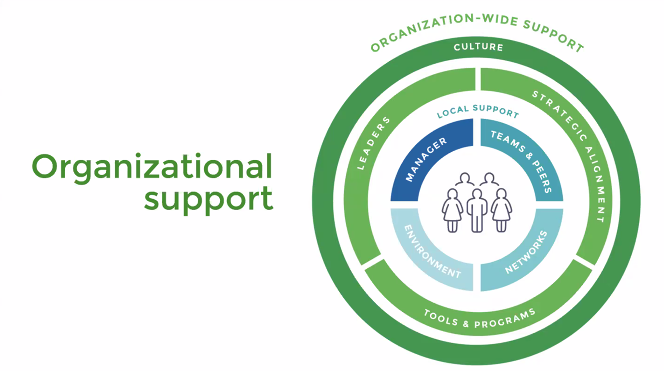
Dr. Hamill talked about the factors that affect our wellbeing. There are some factors we have little control over: our genetics, underlying health conditions, personality, and socioeconomic status. The factors we have more control over include our mindset, habits and behaviours, social supports and relationships, and the organizational supports companies put in place for their employees.

While many companies stepped up during COVID to provide supports for employees coping with the stressors of the pandemic, Dr. Hamill maintains tools and programs are not enough. In order for us to be happy at work and have a positive sense of wellbeing, we need to feel like we belong, valued, productive and contribute to the organization’s success.

For this reason, culture, employee engagement, diversity and inclusion and employee wellbeing are inextricably linked.

As we reimagine the future of work, it will be imperative to put employee wellbeing at the forefront. If we don’t, we could be in for a nasty break up.

Graphic source: Limeade, 2021

Ten things to avoid if you want to be happy

Road construction

I’ve often said on this blog, it’s just as important to know what doesn’t make you happy, as what does make you happy. Here are ten things that haven’t made me happy in the past year:

1) Talking to car salesmen. Seriously, do these guys go to school to learn how to be schmaltzy and schmarmy? In fairness, the team at Kingston Volkswagen were great and we love our new Tiguan.

2) Teenagers who roll their eyes at everything you say and whose favourite words to describe you are weird and embarrassing (and that’s on a good day).

3) Road construction. My road is a mess right now. It’s year two of what most likely will be three years of construction. We’ve given up trying to keep our cars clean and washed.

4) Real estate prices. What is going on? It makes me sad that home ownership has become out of reach for the younger generation.

5) Wasted food. Remember the teenagers I mentioned above? I wish I had a dime for every bruised banana, unopened granola bar or uneaten sandwich I’ve seen thrown in the garbage. It makes my blood boil.

6) Waiting in lines. This may be a necessary evil right now, but if I see a line longer than 10 people, I don’t bother.

7) Bad online shopping experiences. Online shopping has been a lifesaver for many of us during COVID, but some sites need a lot of work to create a better overall customer experience.

8) Mosquitoes and ticks. Get a bug zapper.

9) Hockey fans who whinge about unfair penalty calls and Leaf fans who think Auston Matthews is a god. Okay, the reffing was a bit blatant last night, but bad calls are part of the game.

10) COVID-19: Don’t underestimate it. Keep wearing a mask, wash your hands frequently and get vaccinated. I know we’re all tired of it, but we’re so close, let’s see it through so we can get back to some semblance of normal.

The future of work

future of work sign

There is a raging debate going on about the future of work. Companies are considering whether to continue to let employees work remotely, return to the office or adopt some form of hybrid model when the worst of the pandemic is over.

As I said last week, we’ve learned much in the past year. But I fear that as a society, we will let a precious opportunity slip through our fingertips: the opportunity to finally redefine our relationship with work, to seek a greater work-life balance and truly imagine a brighter future, one where we don’t just spend our days making a living, but living our best lives.

Here is my vision for the future of work.

First, employees would be able to choose how many hours they want to work a week. Imagine if you could say to your employer, I want to work 24 hours a week, 30, or 32 hours a week so I can pursue my passion, whether it’s painting, writing, running a side business, or volunteering.

Employees would have more flexibility to choose when they work. 6 a.m. to noon? No problem. I was reading one study where 15% of workers said they’d prefer to work in the evenings or at night so they could do things outside during the day. Depending on the role, why not? It could also help with child care challenges for working families.

We need to discover how to bring joy and fun back into our work world. The reality for many office workers is their day consists of never-ending emails and meetings, distractions and interruptions that is making us unhappy at work. When you feel like your day consists of putting out fires and you haven’t accomplished what you set out to do, it’s disheartening. Even before the pandemic, people were habitually checking email 74 times a day and switching tasks every 10 minutes. 

There are many, innovative solutions to making work fulfilling again.

Let’s start by hiring more people. I believe too many companies are running too lean. There are simply not enough people to do the work. If some people opt for shorter work weeks, there could be the opportunity to hire people and distribute work a bit more equitably to help ease stress and workloads.

We also need to be smarter about how we spend our time during the workday. Companies could establish designated meeting times, and work times to help people concentrate and accomplish meaningful work, without disruption.

Several years ago, a Fortune 500 software company in India tested a simple policy: no interruptions Tuesday, Thursday and Friday before noon. The company experienced a 65 percent increase in productivity but also reported employees experienced an increase in work satisfaction. They discovered the most important factor in daily joy and motivation was a sense of progress.

We’ve also learned working from home this past year the importance of human connection. We miss our colleagues dearly.

The future of work needs to include being together again, but not dictated by arbitrary policies. Being able to collaborate, have fun together, celebrate successes are all great examples of when it will make sense to bring employees together in person. Training is another thing we’ve learned is a much more richer experience in person than remote learning.

Good workplaces will develop a do good culture. Providing opportunities for employees to get involved in their communities, and volunteer for worthy causes will add a new layer of purpose to work. Some companies already offer up to five days a year for employees to volunteer for local charities.

The future of work also includes more vacation. There will be a pent-up demand for travel when borders open up. North Americans could learn from other countries like the UK where residents get 28 days of vacation a year, France 25, and Germany and Australia, with 20 days.   

Finally, companies need to adopt the ner way of business. Ner is the business philosophy where the most important aspect is people and leaders only need to create an environment where people can excel. Companies have no hierarchy, just self-managing teams. Ner companies donate 3% of their profits and 2% of employee time to contribute to social projects and top salaries can’t be more than 2.5X higher the lowest salary. The ner philosophy creates more human, meaningful and entrepreneurial workplaces. And it works. Watch this video to learn more about ner.

Yes, we have a unique opportunity before us: to reimagine the future of work. Companies that are short-sighted will focus on one aspect: place.

Companies that are progressive and visionary will focus on outcomes and a new, more human philosophy towards work.

Who would you rather work for?

Stop being your own worst enemy

skeleton looking at a computer

There’s an enemy we are all facing right now, and it’s the enemy within.

Too many people are working more hours working from home than when they were in the office.

Why are we doing this to ourselves?

Have we programmed ourselves to delete our off buttons, so we don’t know when to shut down at the end of the day? Is it because we can’t separate work life from home life working out of our bedrooms and basements? Is it because there is nothing else to do in lockdown, and things will return to normal when the world rights itself? Or is there simply too much work and never enough hours in the day to get it done so we just keep working?

I think it is all of these things and it’s extolling a price.

Each month, Morneau Shepell publishes their 2021 Mental Health Index Report. It’s no secret mental health across all age groups has taken a dive since COVID began last March, but the most recent report shows two segments: women and managers are particularly at risk of burnout as they struggle to deal with the demands of work, home life and worries about finances and health of family members.

The report indicated employees are finding it more difficult to feel motivated to work and to concentrate. A startling one-quarter of Canadians are considering a career change despite their employers handling the pandemic well.

We’ve learned much in the past year. I’ve had several friends retire or make the brave and bold decision to simply leave their jobs. We’ve realized humans were not meant to spend entire days in dark rooms on devices. It’s not natural. We’ve also learned there is more to life than work.

As we slowly emerge from the darkest days of this pandemic, we will all be faced with choices. Be brave in your choices, and whatever you do, stop being your own worst enemy.

Next week: part two on the Future of Work

Be a child genius

Child in shark costume with sunglasses on

Aldous Huxley once said, “The secret of genius is to carry the spirit of the child into old age which means never losing your enthusiasm.”

I would bet that many of us right now have lost some of our enthusiasm for life. Living in lockdown, not seeing friends and family, and filling our days with work, walks, books and chores without anything to look forward to is tough.

So how do we reignite joy and enthusiasm in our lives? Here are some thoughts, but I’m hoping everyone will leave a comment to help us all through this difficult time.

  1. Spend time with a child. Children help us see the world from a fresh perspective.
  2. Make a goal to try one new thing this week, whether it’s making a new dish, starting a new project, or learning a new hobby. When we learn new skills or focus on something fresh, our enthusiasm naturally emerges.
  3. Be curious and ask questions. The act of asking questions stimulates interest and enthusiasm. You can even ask questions of yourself like, “What do I want?”, “What am I grateful for”, or “What’s missing in my life?”
  4. Do something silly and that makes you laugh.
  5. Make a list of everything you love to do, and then take 15 minutes and do one of them a day.
  6. Plan a trip for when this is all over. It doesn’t have to be a big trip, maybe just an overnight getaway, but it will give you something to look forward to.

This week’s #HappyAct is to rediscover your zest for life. We can all be child geniuses. Now it’s your turn—what are your ideas?