In What if your best friend was a bot, we asked Siri what she looked like. She replied, “In the cloud, nobody cares what you look like”.
The height of irony? Maybe. But what a wonderful world it would be.

In What if your best friend was a bot, we asked Siri what she looked like. She replied, “In the cloud, nobody cares what you look like”.
The height of irony? Maybe. But what a wonderful world it would be.

Special guest post by Jill Yokoyama
Sharing a pot of tea is a ritual in many cultures. My family has a British-Australian background so I learned how to make a decent cup of tea early on, and our family often made a pot of tea after dinner. My husband’s family is Japanese and my late mother-in-law’s green tea set is a cherished possession in our house, a connection to someone very dear to us.
Morning tea in Australia and New Zealand is a daily tradition at 10:30 or 11:00 am. It is a break at school or work when everyone pauses for a cup of tea (or coffee) and a biscuit or small snack. It is a time to make announcements, welcome new employees, give a shout-out to someone who deserves it, or have a friendly chat with colleagues. Even on a road trip Australians will have a morning tea break with a thermos of tea at a roadside picnic table. No Tim Hortons drive-thru for the Aussies!
Tea is a beverage used to comfort others, a way of saying “everything will be alright”. The acts of boiling the kettle, warming the teapot, letting the tea steep, stirring the tea in the cup are comforting. Teatime reminds us of civility and of the late Queen Elizabeth II who many people viewed in a grandmotherly way. Problems big and small can be shared and solved over a cup of tea and a biscuit.
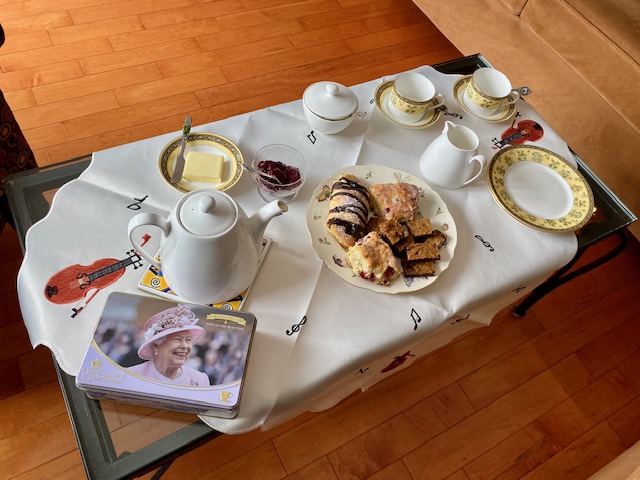
I have a friend who suffered a loss over the holidays. I wanted to offer her some comfort and a chance to sit and relax for a bit. It was fun for me to assemble a plate of sweet treats, get out all my finest teacups, saucers and spoons, and open up the tin of English tea that was a holiday gift.
We whiled away the afternoon with warm tea and conversation while the cold winter snow piled up outside the door. In a busy, chaotic world the tradition of sharing tea is just one way to maintain connections with friends. Consider it part of the shared effort that one puts into relationships that makes them cherished and lasting, and a way of showing that we care.


Special guest post by Alison Taylor
On these grey, dreary wintry days, I find I have to really work hard to keep smiling.
As I hunker down for the long wait for spring, I bake! Sure, the calorie count exceeds the daily recommended limit, but I try to offset it with morning winter walks.
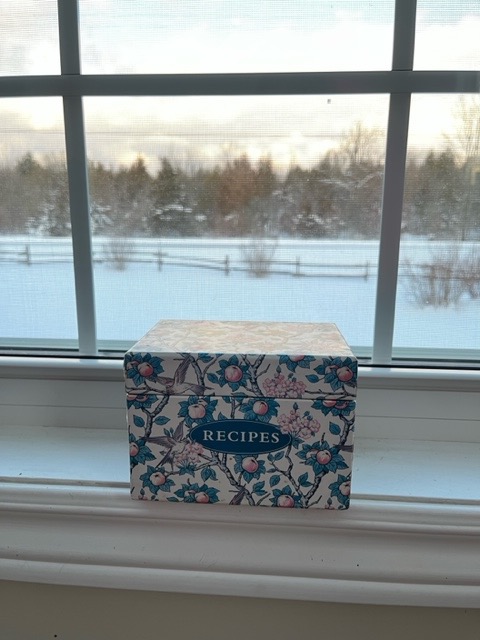
I love trying new recipes and my husband is happy to be the test taster. I search the internet for yummy recipes or go to my recipe box for the old faithfuls from my childhood.
Cookies, squares, cakes. All good! Sometimes that little hit of sugar gives you the boost you need to make it through the winter blues.
So preheat your oven to 350F, grease the cookie tray, and start mixing up some yummy goodness for you and your family to enjoy and get you through those long winter days.
Light as a Feather Gingerbread Cake
½ cup boiling water
½ cup shortening
½ cup brown sugar
½ cup light molasses
1 egg
1 ½ cup flour
½ tsp salt
½ tsp baking powder
½ tsp baking soda
¾ tsp ginger
¾ tsp cinnamon
Directions: Pour hot water over shortening. Add sugar, molasses, egg and beat well. Add sifted dry ingredients. Beat well until smooth. Bake in a 8” square pan at 350 degrees for 35 minutes. Serve with whipped cream and fresh strawberries (optional).


I’m into week six of living life indoors with a broken ankle.
Aside from the chronic nerve pain, I’ve been surprised that I’ve been able to keep my spirits up for the most part. And in a strange way, there have been some silver linings.
I’ve started on some writing projects I never seemed to have time for.
I’ve been able to spend days home with Bentley, although he mainly just looks at me with sad, accusing eyes.
I’ve spent time on the phone catching up with friends.
For the first time ever, I’m caught up with my bills, correspondence and filing.
I’ve learned that as long as you have the right system, you can be self-sufficient and do things on your own (although I still say you can’t drink a proper cup of tea from a Yeti).
And finally, I’ve learned that even if someday I am limited in my mobility, I’ll be OK. I used to think that if I didn’t get outside every day, I would literally wither away. I now understand how some seniors choose to stay indoors where it is warm and safe during the winter months.
As I gaze out my sunroom windows on this snowy morning, I’m looking forward to my first walk in the fresh snow, but I also know now that if someday, that walk isn’t possible, I can still be happy.
This week’s #HappyAct is to look for the silver lining.

What if I told you the secret to happiness and success is a line and a number?
The line is called the Losada line and the number is 2.9013 which is the ratio of positive to negative interactions you need to have to be happy and successful. Simply put, you need to have at least three positive interactions to every negative one to be happy.
The Losada line and ratio came out of a study done in 2005 by two psychologists, Marcial Losada and Barbara Fredrickson who analyzed the interactions of management teams and how successful they were. The mathematical formula they used was subsequently challenged and discredited by some experts, but many psychologists still cite their work and adopt the principles of the Losada line in sport, business, and to help individuals achieve positive mental health.
They found if teams generate more than 2.9013 positive feelings, emotions or interactions to every 1 negative feeling, emotion or interaction, the team has positive energy needed to feel good about themselves and flourish. A 5:1 ratio is a culture everyone wants to be part of. Teams below the Losada line of 2.9013 have a deteriorating culture, and at 0.73 to 1, the team culture destructs.
In another study, Dr. John Gottman looked at similar research in marriages. Gottman claims he can predict divorce with 90% accuracy by counting the number of positive versus negative interactions a couple has.
In marriage, the magic ratio is 5:1 (why the ratio is higher in marriage is an interesting question, presumably because marriage is hard and there are two individuals’ happiness at stake!)
Happy couple have at least 5 positive interactions for every negative one. You can read more about Gottman’s study and the types of positive interactions between happy couples here.
This week’s #HappyAct is to take the personal positivity test and strive to increase your personal to negative interactions to 3:1 or higher. Gottman also has a quiz on his website called “How Well Do You Know Your Partner” (note you have to provide your email address to get the results emailed to you but a summary pops up on the screen as soon as you provide your email).
And don’t worry if you score low initially on the personal positivity test. I expected to because I’m at home nursing a broken ankle right now. Think of it more as a check in with how you’re feeling, then start working towards improving your positive interactions and on a path to better mental health and happiness.

“Do things for people not because of who they are or what they do in return, but because of who you are.”
– Harold S. Kushner, prominent American rabbi, and author.
Today is World Kindness Day, a day to celebrate and promote good deeds and kindness. Last week I reflected on the state of kindness in the world in “Take the high road”. This week, I’m adjuring all of us to do one #KindAct to spread happiness and kindness in the world. Here are some ideas on how you can kind it forward:
Ways to kind it forward
Kindness isn’t a day. It isn’t a single act. It defines who we are as individuals and a society and who we aspire to be.
The best way we can make the world more kind is simply engaging, listening and caring for others.
What will your act of kindness be today? More importantly, what will it be tomorrow, and the next day, and the day after that? Leave a comment—I’d love to hear about how your day went.

Is it just me, or does it feel like nobody takes the high road anymore?
Last week, I was out for my lunchtime walk, and I came across an altercation at the local high school. There was an older student on the one side of the road screaming at two kids across the road. The language was deplorable but it was the intensity and hatred that made me stop in my tracks.
I wasn’t sure whether I should intervene, or just mind my own business and keep walking. I was concerned it could escalate into something far more serious. I hesitated for about half a minute, then walked up to the girl who was yelling and swearing and her friends, asking if there was a problem and whether I could help.
The girl glared at me and said, “Those two have been staring at me non-stop for the past three days. They needed to be put in their place.” She had other choice words for the two kids that I won’t repeat here.
Now, I don’t know what transpired between these two groups of kids, and I know it’s high school, but I will say this whole incident really disturbed me.
First, I can tell you I never once spoke to anyone like that in high school. Sure, there were cliques and kids who didn’t like each other and didn’t get along, but you mainly stuck with your own friends and avoided them. No one ever stood in a street and hurled vitriole and swear words at the top of their lungs for the whole world to witness.
Second, this girl said these kids had been “staring” at her for the past three days. If that was their biggest crime, I can only imagine how this girl will cope some day when she experiences real conflict at home, with her friends or in the workplace.
I think what upset me the most though was this girl thought it was OK to act and speak like that. In fact, not only did she defend herself and her actions, she took pride in her response, saying someone had to stand up to them, they deserved it.
I just couldn’t stop thinking, if this is what our kids think is normal and acceptable behaviour, what hope do we have as a society of being kind to each other and battling the divisiveness that seems to be permeating our culture?
To me, it’s simple. You never know what people are dealing with in their lives. That’s why you should always take the high road and turn the other cheek.
It comes down to two basic tenets: treat others with kindness and respect.
This week’s #HappyAct is to always take the high road. Have a kind week.

A few months ago, I made a decision that didn’t make me smile.
The worst part was, I knew it right away. As soon as I made it, I had that sinking feeling in my gut, but I knew I needed a change, and I resolved once I had committed to a course of action, to make the most of it and apply all my energies to making it work.
Of course it was the wrong decision. The serious reservations I had going in transpired, and it took an immediate toll on my happiness.
Luckily, I was able to extricate myself from the situation and am now in a much happier place.
Sometimes the path forward isn’t always clear. But you will always discover the right path if you make decisions that make you smile.
Have a happy week…

When life is challenging, it’s important to have an escape, something that helps take your mind off things and help you face what’s to come. For me, it’s always been swimming.
Last Saturday was a particularly difficult day. I was in Westport helping my brother-in-law. I knew it was going to be a long, stressful day. In between chores and calls, I slipped down to Westport Beach for 45-minutes and went for a long swim in Sand Lake.
The minute I splashed into the water, all the stresses and sadness began to wash away. My weary eyes concentrated on the beautiful sunshine sparkling on the water and dreamy white clouds floating up above. With each stroke, I swam away from my troubles, towards what I thought was a white buoy bobbing in the water, but on closer inspection was a very large gull. I felt cleansed, refreshed and at peace with what would come.
For my neighbour Kim, her once a day is her garden. As long as she can spend 30 minutes a day in her garden, she feels happy, balanced, ready to face what life brings.
Dave says his once a day is to look at our beautiful lake and remind himself every day how lucky we are, knowing there are so many people in the world who are not so fortunate.
What’s your once a day? Leave a comment.

There are no words to describe the comfort of a friend. Friends console us when we’re down. They are a sympathetic ear when troubles weigh heavy on your heart and the first person to say I believe in you. You will overcome this.
They share in life’s joys, sorrows and celebrations. They are the person you turn to when you need a hug, or someone to listen without judgement, or just want to share a laugh or what’s on your mind. They love you unconditionally, warts and all. Without them, we’d be lost.
It’s a scientific fact that having one good friend has a significant impact on happiness. It’s not surprising having a friend increases your happiness in good times, but it’s been proven that having a friend is critical during times of stress when you need help.
In his New York University course The Science of Happiness, Dr. Alan Schlechter lectures about the “tend and befriend” response. The cousin to the fight or flight response, the tend and befriend response is when the hormone oxytocin, induced by stress tells us to reach out for help. When we reach out to a friend, our cortisone level goes down and we feel better.
They say you’re lucky to have at least one true friend in your lifetime. I’ve been fortunate enough to have two, my best friend Leslie and my husband Dave. Thanks for being my rock, guys. I love you both.
This week’s #HappyAct is to tell your best friend how much they mean to you.