It’s an anxious world we live in. According to Anxiety Canada, 1 in 4 Canadians suffer from anxiety.
It’s normal to feel anxious sometimes. Anxiety can plague even the most positive of people. But for some, especially people who struggle with positive mental health or depression, it can become a death spiral.
What triggers anxiety can differ from person to person. Maybe it’s a job change, or the feeling of being stuck in your job. It could be worrying about money, or feeling unhappy in a relationship. I think most people are experiencing some degree of anxiety seeing what’s happening in the world today.
Recently, someone shared with me this simple five-step technique to clear your mind and be in the moment when you are feeling anxious. Focus on
5 things you can see
4 things you can hear
3 colours
2 things you can smell
1 positive feeling
Finish by taking three deep breaths.
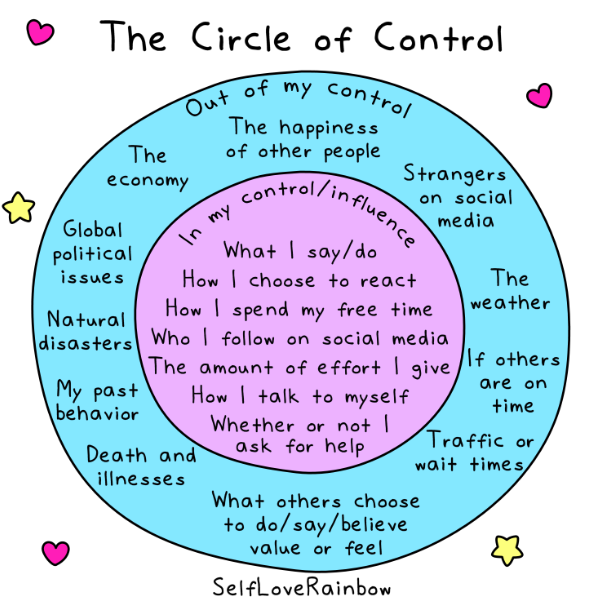
I’ve always found this graphic of two circles helpful as well. There are many variations of this graphic–this one is geared towards teenagers, but I’ve seen the same concept in corporate circles when trying to help employees through change. The first circle is everything happening in the world that you have no control over. The second circle is things you have direct control over. When your brain is feeling overwhelmed, remember the two circles and focus on the things in your life you can control.
This week’s #HappyAct is to try this simple technique the next time you’re feeling anxious.
Ed. note: This five-step technique is often referred to as a grounding technique focusing on the five senses. I prefer this variation. Studies show that anxiety plagues women more than men. If your anxiety is getting in the way of living, talk to your doctor.
I’ve been thinking a lot about narratives and filters lately, both on a global scale but also on a micro level and how people can create their own narrative based on filters that skew how they see things.
I’ve seen this in some of the relationships in my personal life—people seeing things very differently based on their experiences and filters. It’s led to some interesting conversations.
It’s only natural to derive our opinions and views based on the experiences and influences in our life. We all do this. But it seems to me there are more people concocting disturbing and trenchant narratives, often based on misinformation or their warped view of the world and this is causing seismic rifts in our personal lives and in the world.
The scary thing is when people see the world through artificial filters and false narratives, the narrative becomes justification for their actions. They stop caring about what others think, and believe what they want, often despite the facts. The narrative becomes their truth.
So how do we resist creating false narratives in our minds?
Actively seek differing opinions.
Don’t rely on a single news source. I had a conversation with one person recently who gets all their news from The Epoch Times. They took every word as gospel.
Try to see things from other people’s perspectives and filters to build understanding, compassion and forgiveness.
Don’t be afraid to question someone else’s narrative. If something doesn’t add up, do your own research.
At the same time, challenge narratives you’ve created in your own mind. Are you seeing things clearly? What have you fabricated? What filters are you applying?
Know there can be truth on both sides sometimes.
Accept that most things aren’t black and white.
Remember, actions always speak louder than words: Live your life in such a way that if someone was to ever speak badly of you, no one would believe them.
These are interesting times. We are more divided than ever. If we are going to rise above our own human frailty and fragility, we need to seek the true narrative.
In compiling this annual list, I noticed a distinct trend this year: macro events influencing my weekly thoughts on happiness. It’s understandable. In a year dominated by Trump, the wars in Gaza and the Ukraine, not to mention all the political shenanigans here in Canada, it was hard to escape the events shaping our times that penetrated our consciousness and impacted our happiness this year.
Here’s the top 10 HappyActs of 2025 (plus a bonus one, because it’s 11, one better):
10: A letter to my American friends: when I wrote this post back on February 16, 2025, it was the early days of Trump. Little did we know just how bad it would get. Still real, still relevant, and my most-read blog post of last year.
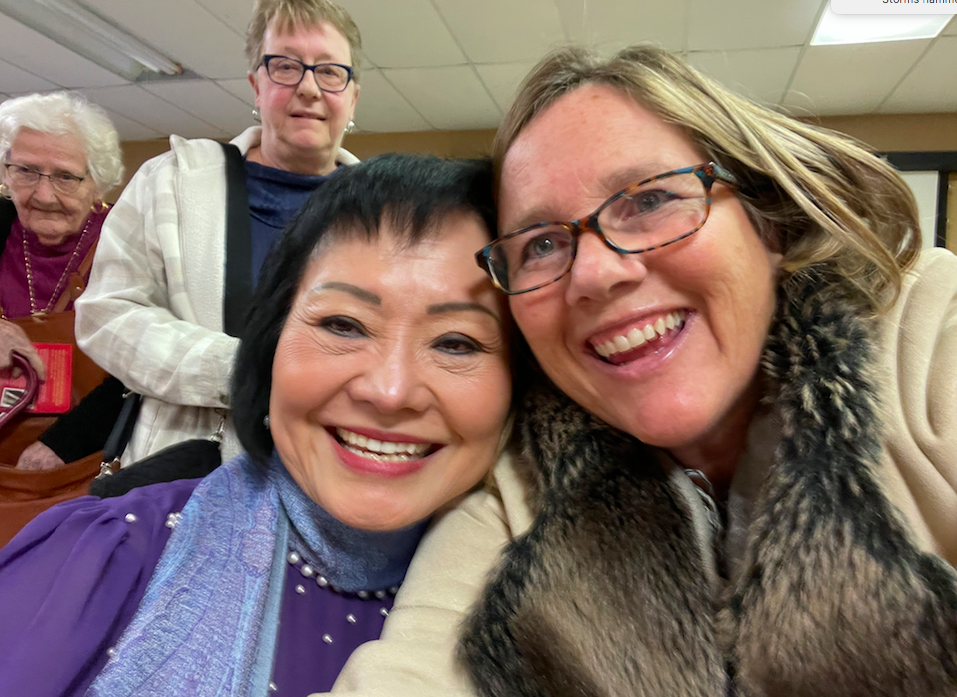
9: Golden happiness: the story of the napalm girl. When I attended a talk by Kim Phuc earlier this fall (pictured above), I expected to hear about the horrors of war and importance of peace. What I didn’t expect was to hear a survivor’s inspirational philosophy on faith, happiness and forgiveness.
7. Humans by nature are social beings, yet moments of solitude can restore the soul. In my blog posts, Battling the epidemic of loneliness and Spend time in solitude, I explore the dichotomy of the human condition: when to be with others, and when to be alone.
6. It’s okay to be sad: a good reminder in a world hyper-focused on mental health
If you’re looking for a New Year’s resolution for 2026
5. Hit delete: in this post I ask people, if you could delete one thing in your life to be happier, what would it be? I had some interesting responses online, including religion (the source of many conflicts), the internet, and WWW!
4. Learn when to say yes and no: one of the greatest skills in life is to learn when to say yes and when to say no.
3. Never lose faith: true on every level, whether it’s the state of the world, having faith in others, your team, or yourself
Whenever I get gloomy with the state of the world, I think about the arrivals gate at Ottawa airport… It seems to me that love is everywhere.
This week, I picked up a very special package from the Ottawa airport. Kid #2 arrived on a Porter Airlines flight on Wednesday morning after being down east at school for the past four months.
So maybe love wasn’t everywhere when I went to pick Clare and maybe I ripped off that line from the opening scene of Love Actually, but the feelings of love and anticipation of seeing Clare after her being away for so long has made me a romantic at heart.
I love that opening scene from the movie, parents reuniting with children, old friends slapping each other on the back, and husbands and wives, boyfriends and girlfriends kissing and hugging each other with misty tearful eyes.
The reality of course was slightly different. I didn’t actually go into the Ottawa terminal. I missed the turn for the arrivals lane after seeing a sign that said Car Rental Return and had to make a U-turn and circle around the endless airport loop, Grace remonstrating with me and calling me a loser the entire way.
If we had entered the terminal, instead of seeing happy smiling faces reuniting, we probably would have seen half a dozen people making a frantic 100-yard dash to the bathroom after their seven-hour flight, another half a dozen cursing at their phones because the person picking them up was late, and at least one exhausted mother with two snotty-nosed kids trying to find her Uber.
I mean, c’mon. It’s not like we were going to see a young buxom brunette hopping into the arms of the Prime Minister. Wait, hold the ministerial phone. Did I just see Katy Perry launch herself at Justin at the gate, his strong arms encircling her while she wears a jaunty beret? Maybe the movie is true to real life after all.
The point is, maybe love actually can be found in an airport terminal. One thing is for certain. You have a better shot at finding love than your luggage if you fly Air Canada.
This week’s #HappyAct is my Christmas wish for you: to have a sweet reunion with someone you love. Happy holidays, and be sure to check back next week for my top ten happy acts of 2025.
Let me clarify. A “stupid friend” is not someone who is stupid. A “stupid friend” is a friend who knows you and loves you well enough to tell you when you are doing something stupid.
Mine was a silly little thing. My best friend Leslie and I were buying souvenirs in Scotland. I wanted to get a tartan pencil and grabbed one at the cash to include with Leslie’s purchase. We asked how much it was as the sales clerk was ringing it in and the clerk said “Two pound 99”, which would be just shy of $6 in Canadian funds. For a pencil! I nodded my head and handed Leslie the money.
On the way out of the store, Leslie said that was stupid, you shouldn’t have bought that. She was right of course. Later that day, I saw a set of four pencils for 75 pence, about $1.50.
I wish I had been a better stupid friend the other day when a friend of mine who wasn’t feeling well decided to play golf in this sweltering heat. He had to leave the course when he started feeling dizzy and weak. If I had known what he was going to do, I would have told him he was stupid to play golf in this weather.
A stupid friend will always look out for you and want what’s best for you. They can be a voice of reason, the perfect foil, or a person who balances you out, the yin to your yang. They are the very best and truest of friends because they are always there when you need them, especially when you are your own worst enemy.
Tomorrow, Canadians will go to the polls in what could be one of the most historically significant elections of our generation.
Trump aside, I’ve been thinking of the key issues most Canadians are concerned about in 2025: the cost of living, affordable housing, mental health and health care, climate change, and the economy. I’ve been very fortunate to consider these issues from a new lens, thanks to a group of young PhD international students I’ve been working with as a proctor this past month at Queen’s University.
Two of the graduate students I worked with were from Ethiopia, one doing his PhD in rehabilitation research and the other in nursing. Another was from Syria, doing his PhD in nuclear engineering. They had all done their undergraduate and Masters degrees in different countries around the world and were extremely kind, bright, perceptive, and willing to share their thoughts and experiences of their time in Canada.
They all agreed Canada is a very beautiful, safe country and they particularly loved Kingston. They appreciated the hard work ethic of Canadians and the fact that we are a law abiding country. They did not like our winters!
Some of the things that surprised them is how expensive it is to live here, especially housing. (The one fellow told me he paid $900 a month for a two bedroom apartment in Germany where he did his Masters degree in a city the same size as Kingston. His rent here is $1,700. According to Studying in Germany.org, housing prices are 47% lower than in the US). They’ve also been surprised to see the number of homeless people and people with mental health and drug problems in Canada.
This led to a discussion on the shrinking middle class, a phenomenon that seems to be happening in all countries (my new friends said it was the case in Ethiopia and Egypt too).
However, the biggest culture shock and negative they’ve encountered is the individualistic aspect of Canadian society. We talked at length about child care, since my one new friend just had a baby and the other had two children and a wife here in Canada. They said at home in Ethiopia, child care is not an issue. If you need to work or go somewhere, there is someone—a relative, neighbour, or friend who will look after the children.
That led to discussions about seniors. Older people in their country are cared for and live with their extended families, unlike here in Canada where many seniors live alone or in nursing homes, and suffer from loneliness (see my blog post from a few weeks ago, “Battling the epidemic of loneliness”).
As we were discussing all of these issues, it occurred to me that if we simply went back to having multi-generational families living together, it would solve many of the problems in our society. There would be more available and affordable housing, and the cost of living would be offset by potentially multiple incomes in one household. People would be financially better off and happier, alleviating the strain on health care systems and improving people’s mental health.
If you study the famous “blue zones” in the world where people live longer, multigenerational living is part of their cultural fabric.
Where and when did we go wrong in North America?
In 2015, one of the best selling business books was a book called Weology: When Everybody Wins When We Becomes Before Me, by Peter Aceto, CEO of Tangerine bank. It was a book on the philosophy of leadership in business, but the concept of Weology is one I think we need to start embracing as a society to address these critical issues. Clearly what we’ve been doing up until now isn’t working.
A new party, let’s call it the Weology Party, committed to implementing policy that fosters a philosophy of taking greater care of each other and multi-generational living might just be the solution. From a tax perspective, this could take the form of tax deductions or income splitting for multi-generational households, not just spouses. There are currently tax breaks for people who have eligible dependents over the age of 18 and a tax credit if you are a caregiver for a spouse or senior, but we could do more. To foster this philosophy in our communities, the government could also offer tax breaks and incentives for volunteering.
Municipalities have started to make strides to make it easier for people to live together, allowing and promoting additional dwelling units on lots.
In business, the government could introduce policy to make it attractive for new start-ups to form as employee-owned cooperatives. There is a large corporation in Spain called Mondragon Cooperation that has 70,000 employees, annual sales of 11 billion euros and is highly profitable. They are committed to putting people before profits (for instance during COVID, instead of laying off employees, they reduced salaries across the board by 5%). The ratio of pay between employees and executives is just 6:1 (in Canada, the ratio is 210:1 for our highest paid CEOs and in the States, it’s even higher). This model is one way to distribute wealth more equitably in society, within the framework of a free market economy.
My new proctor friend who was a research fellow in rehabilitation was working with a professor who was researching the impact and effectiveness of formal versus informal supports for people with disabilities. Their theory is that informal supports are far more important in helping people with disabilities live full and rewarding lives. They are still in the research and data collection phase, but my guess is the data will show that informal supports, people supporting people, will be more important.
Which brings us back to election day. Make sure you vote. You won’t see the Weology party on the ballot this election, but perhaps some day we will. In the meantime, we need to all start thinking about what small changes we can make in our lives to move Canada towards a healthier (both financially and physically), happier, and connected society.
Quick Poll: Would you rather friends call or text in advance before they come for a visit or just drop by? Leave a comment with your answer.
Personally, I love it when people just drop by for a visit. Here are my reasons:
I love the joy and surprise of a spontaneous visit—it makes it more fun
If I know in advance people are coming, I feel obligated to clean and I hate cleaning—I prefer to visitors to just pop in and not worry about how the house looks
I like the sense of people coming and going—it makes for a joyful, happy house
Now for those of you who voted call or text in advance, I get it: you can make sure you’re home, have supplies in the house (beer, wine, munchies—but at our house there’s always beer and wine in the fridge), and you can suggest a time convenient for your schedule.
I’ll always prefer the spontaneous visit. Down east, where my friend Danette’s parents live in Antigonish, all the neighbours pop in anytime. You never know who you’re going to see each day and there’s always a laugh to be had. It makes for a wonderful community.
This week’s #HappyAct is to throw caution to the wind and drop in on someone unannounced. And remember, you can always bring the beer!
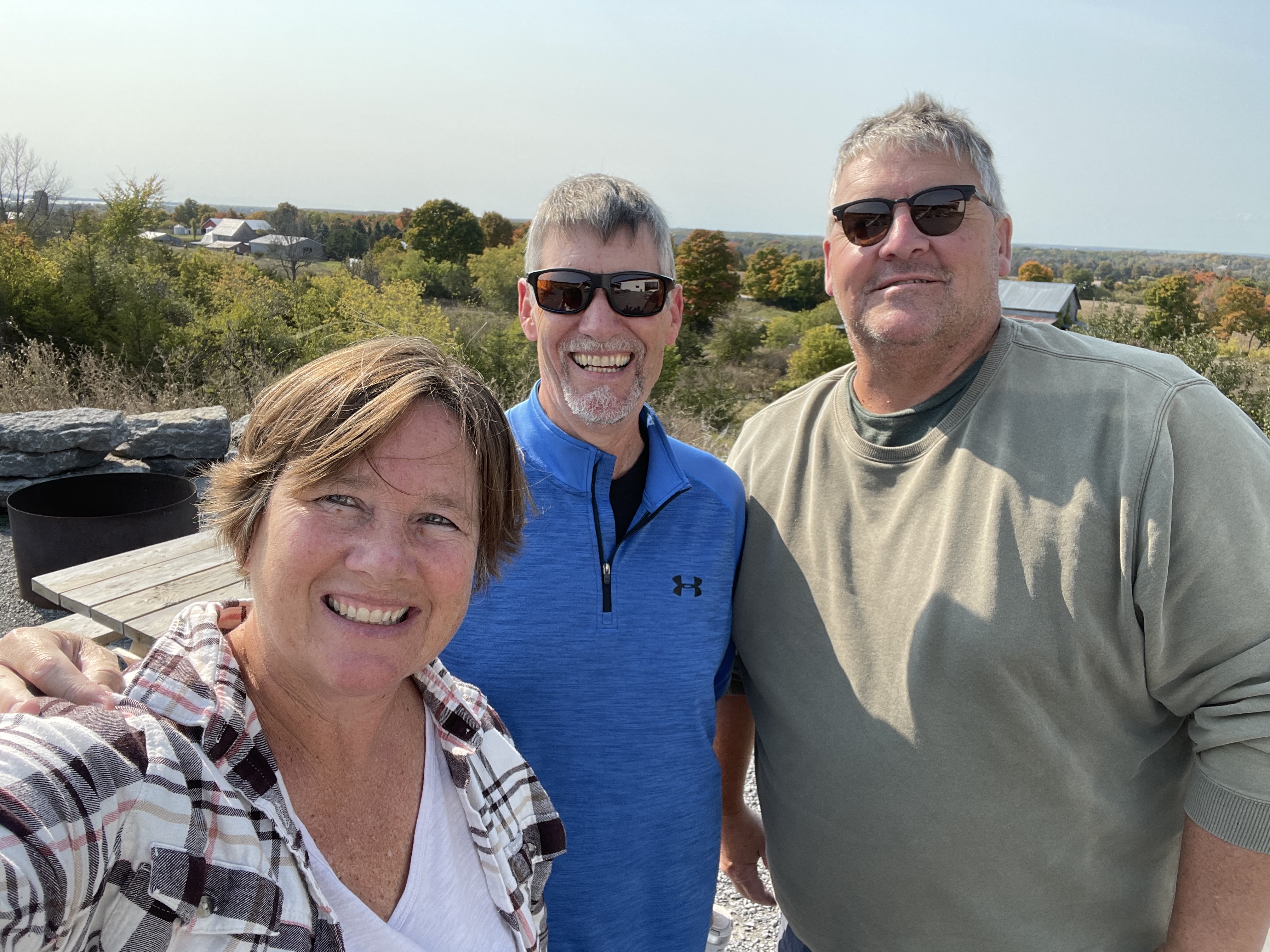
(The photo above is of me, Dave and my brother Don, one of our most frequent visitors. He doesn’t just drop in, but that’s because he lives three hours away!)
There is an epidemic sweeping our country—the epidemic of loneliness.
In our grandparents’ day, the average detached home in Canada had six people in it. For my generation, it was four people. Today it’s 2.1. One of the fastest growing sub-segments in the housing industry today is single homeowners in their 20s. For the first time in modern history, we also have an entire generation of seniors living alone in isolation.
The two age brackets most at risk of being lonely are youth and seniors. According to Statistics Canada’s Canadian Social Survey: Loneliness in Canada, more than 1 in 10 people aged 15 or older say they “always or often” feel lonely. A 2024 study of seniors estimated between 19-24% of Canadians over the age of 65 feel isolated from others and wished they could participate in social activities in their community.
The impacts of loneliness in seniors especially are well known. In addition to depression, emotional distress, and dementia, loneliness can result in increased risks of chronic illness and falls, poor general health and premature death.
Humans were not meant to live alone. We were meant to live in tribes.
So what can we do to battle the epidemic of loneliness? Here are some words of advice people shared in a recent Quora post:
“Have a pet and walk them every day. You’ll meet people on your walks”
“Join a club or activity…check out the nearest seniors centre for programs services” (I’ve really enjoyed the activities I participate in at the Seniors Association of Kingston and have found my tribe there)
“Volunteer”
“Find people you can text every day”
“Check out the website meetup.com for a list of groups and activities that may appeal to you” (I looked to see what was listed for my area of Kingston, Ontario and there was everything from guided hikes, to toastmasters groups, to meditation and church groups)
“Nobody is going to come to you. Go out and find a church family, join a gym, go for walks, talk to your neighbours. Don’t spend your senior years being sad. Enjoy every day you have left. If you lived near me I would be your friend.”
“Every time you find yourself thinking about your own loneliness and state, think about someone in the world you can help. A neighbour who needs help, bake some cookies, whatever”
“To have a friend you need to be a friend.”
“I remember this documentary on finding happiness. The director at the beginning of the film said he would sum up the secret of happiness with one 4 letter word. I assumed it would be “love” but was surprised when he said it was risk. It’s all about taking calculated risks and steps to make opportunities happen for yourself and it will pay off. Good luck your future happiness is within you.”
This week’s #HappyAct is to do something to battle the epidemic of loneliness. Reach out to a friend, join a group, visit a senior who lives alone. It’s all about caring and sharing—more on that next week!
Coming up…March 20 is World Happiness Day. This year’s theme is Caring and Sharing. Be sure to check back next week when I dive into the results of the 2025 Report on World Happiness.
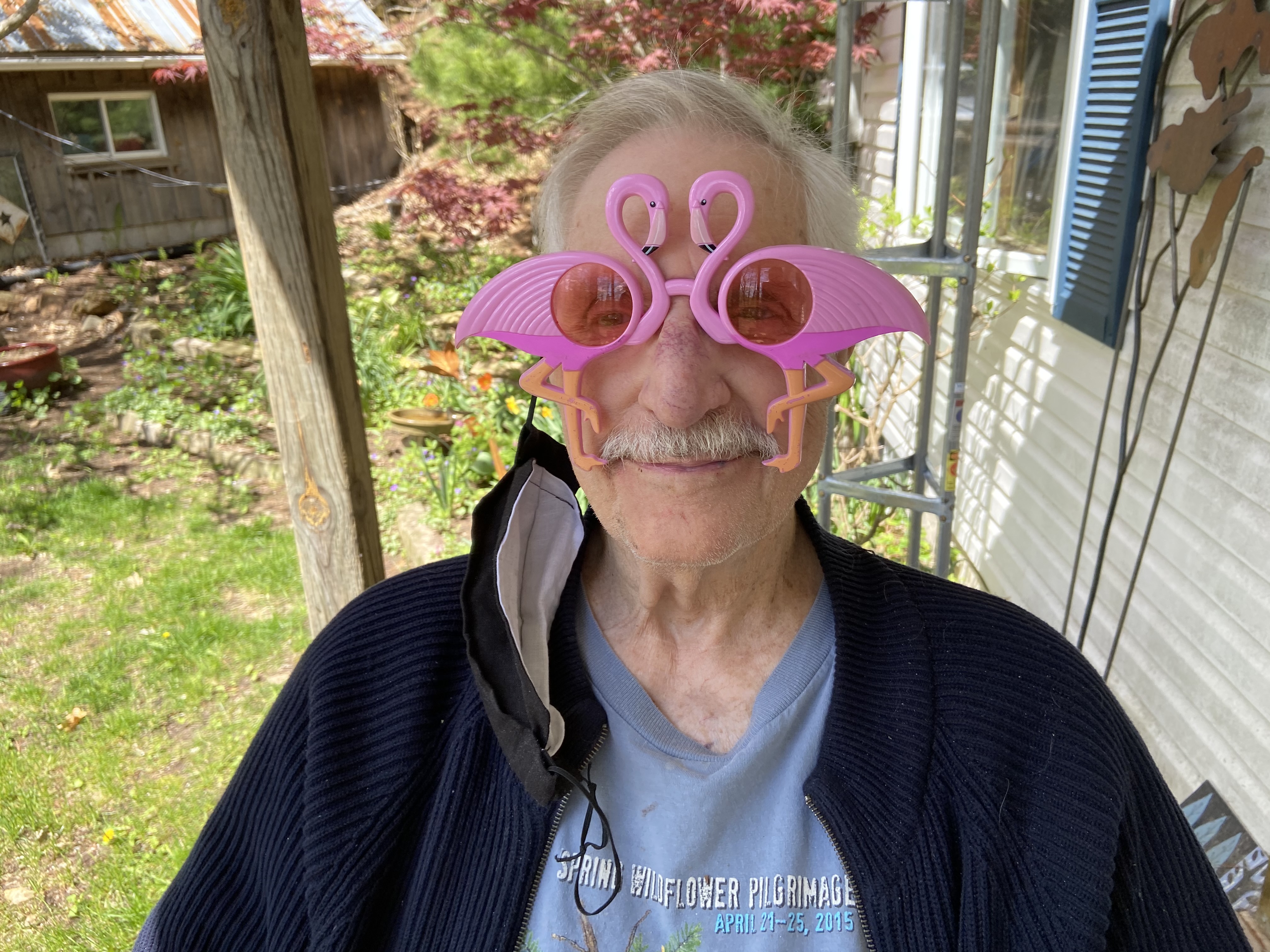
Photo: One of my favourite photos of Dave’s Dad who is living proof a youthful heart and spirit will always keep you young at heart and happy.He texts his friends and family every day.
Several years ago, I was on a business trip with some colleagues. We’d had a long travel day and after checking in to our hotel around 8 pm, wandered down to the hotel bar for a late dinner. We sat for at least ten minutes without any service, so one of my co-workers got up and approached the waitress. He said she was quite surly when he talked to her, but she eventually came over with some menus.
I’ve always been fascinated by how a person’s actions can affect the actions of others, even more so since starting this blog, so I decided to embark on a little experiment. I wondered if I smiled broadly and was overly nice to our server, asking her questions about her day and thanking her every time she came to the table, whether by the end of our dinner, she would provide better service.
We ordered our drinks, and I kept smiling, laughing and making small talk when she brought us our meals. By the end of the evening, she still seemed stressed and unhappy, but was a bit more friendly and attentive.
There are many takeways from this night. The first is if someone is having a bad day, chances are it has nothing to do with you. Our waitress was probably on her feet for eight hours by the time our group strolled in. No doubt she was exhausted and wanting to go home. Who knows what she was dealing with at work or at home—a sick parent or child, mounting bills, an argument with her husband or friend. Since she never shared anything personal, we’ll never know.
The second is our actions did result in her being a bit nicer and attentive, so there was a positive correlation between our efforts to be nice and her actions.
The third takeaway is our group did get better service so it pays to be kind. As one of my old bosses used to say, “You can catch more flies with honey than vinegar”.
Everyone can have a bad day. It seems to me people have short fuses these days and are starting to lose their capacity to show empathy and understanding. Even if you can’t turn someone’s frown upside down, you can give them grace and compassion.
I made a new friend last night. His name was Alan.
Alan was sitting alone reading the Globe and Mail and sipping a pint of Stella when Dave and I wandered into the Toucan pub in Kingston last night, killing time between two movies at the Kingston Canadian Film Festival.
We got to talking, as strangers are wont to do in a bar, the conversation starting with Trump and the situation in the US, then veering into Alan’s fascinating life.
A son of a diplomat, Alan spent his childhood living around the world in countries like Afghanistan, Pakistan, the Belgian Congo, Lebanon, Portugal, Spain, and Sweden. He shared one story from the time when he was a boy in Pakistan of one of the British dignitaries’ wives separating the children into teams of colonials versus locals for games at a British garden party.
When he graduated from university, he became a land technician with the Ministry of Natural Resources, a job he said he absolutely adored. One project he led was researching all the treaties to create Petroglyphs Provincial Park in Peterborough. He shared how for thousands of years, the various Indigenous peoples of that region took turns scraping the moss from the Teaching Rocks, passing down the teachings from generation to generation.
When I had jokingly said we’d be better off if women were in leadership positions around the world when we were talking about Trump, he smiled and leaned in and talked more about the belief of Indigenous Peoples in Gitche Manitou, the “goddess of supreme being” and how women in Indigenous cultures were tasked with the most important role, taking care of the home and children.
After his time with the MNR, Alan founded his own communications company and started doing documentary work. He travelled to the Congo in 1995 to document the outbreak of Ebola. The stories he shared were fascinating. He said both the US and Russian armies were present, but not to help the dying and suffering. They were there to see if they could weaponize the virus. That never made it into the film.
Over the course of a few hours and pints, we talked about fishing, travelling, our children, the Montreal Canadiens, Canada-US relations and how lonely it can be living alone.
As we paid our bill and gathered up our coats to head out into the chilly February night, I gave Alan a big hug and said I hope we meet again. Two barflys, no longer strangers, now friends after sharing a special bond in a bar.
This week’s #HappyAct is to wander into a bar and make a new friend. Here are a few bar jokes to leave you smiling:
Three vampires walk into a bar. The first one says, “I’ll have a pint of blood.” The second one says, “I’ll have one, too.” The third one says, “I’ll have a pint of plasma.” The bartender says, “So, that’ll be two Bloods and a Blood Lite?”
A bartender says, “We don’t serve time travelers in here.” A time traveler walks into a bar.
A three-legged dog walks into a saloon, his spurs clinking as he walks, his six-shooter slapping at his furry hip. He bellies up to the bar, stares down the bartender, and proclaims, “I’m looking for the man who shot my paw.”







 Happy Act