The one skill you’ll need to succeed in an AI world

robot looking at blackboard

As a communications professional, I’ve always believed my greatest skill was the ability to listen and ask questions.

It has served me well in my career. In the age of artificial intelligence, I predict the ability to ask good questions will become the most important skill crossing nearly every profession.

In case you haven’t experimented with ChatGPT or any of the AI programs yet, the way it works is you ask a question, and the program uses machine learning to generate information. Just like any program, the quality of the output is 100% determined by the quality of the input. The more detailed, descriptive and targeted the prompt, the more accurate and helpful the result.

The possibilities are endless, just like the number of results you can receive. I know colleagues who now keep detailed spreadsheets of prompts to ask ChatGPT and similar programs. Here is an example of career-based prompts from Chris Donnolly for job hunting, expanding your network or updating your resume, a good one to keep handy since many of us could be out of work soon thanks to AI.

The key is to be as detailed and specific as you can. OpenAI recently unveiled its new video AI generator called Sora. At the launch, CEO Sam Altman asked people to send in prompts for Sora to demonstrate their ability to create videos in seconds. Here is a Twitter/X post with one of the videos based on the prompt:

“Beautiful, snowy Tokyo city is bustling. The camera moves through the bustling city street, following several people enjoying the beautiful snowy weather and shopping at nearby stalls. Gorgeous sakura petals are flying through the wind along with snowflakes.”

Scary isn’t it? And just like buyer beware, prompter beware. You can never completely trust the information you receive.

A lawyer in BC recently used ChatGPT to prepare legal briefs in a family law case. The brief cited cases that never existed. She was ordered to pay special costs in the case to opposing counsel and is under investigation by the law society for her actions.

Just like every new technology, we will need to navigate the ethics of AI and find the right balance and place for it in our lives. As I’ve been grappling with how to use it professionally and personally, I’ve decided not to use it for any creative projects unless it is to do research so my own thoughts, words and voice are represented in my work.

This blog is called the #HappyAct for goodness sake, so I thought I would end this week’s post on a positive note. I asked Bing Copilot, “I’m a communications specialist working in a small rural municipality. How much time before my job becomes obsolete due to AI?” I’ve shared the response it gave below.

The final line was “Remember, the future isn’t about humans vs. AI; it’s about humans collaborating with AI to achieve better outcomes. 🤝

Wait a minute. It didn’t answer my question. I guess machines are more like humans after all (time to brush up my resume…)

Bing Copilot response

“As a communications specialist working in a small rural municipality in Ontario, your role involves critical human skills that are not easily replicated by artificial intelligence. Let’s explore this further:

  1. Contextual Understanding: Your job requires understanding the unique context of your municipality, its people, and their needs. AI can process data, but it lacks the empathetic understanding that comes from human experience.
  2. Effective Communication: Your ability to convey information clearly, tailor messages to different audiences, and build relationships is invaluable. While AI can generate text, it often lacks nuance and emotional intelligence.
  3. Creativity and Adaptability: As a communications specialist, you adapt to changing situations, create engaging content, and find innovative ways to connect with residents. AI can’t match human creativity and adaptability
  4. Community Engagement: Building trust and engaging with the community is a core part of your role. AI can’t attend town hall meetings, listen to concerns, or build personal connections.
  5. Ethical Decision-Making: You navigate ethical dilemmas, handle sensitive information, and make judgment calls. AI lacks moral reasoning and can’t weigh complex ethical considerations.
  6. Local Knowledge: Your understanding of local history, culture, and politics is irreplaceable. AI lacks this context.

Predicting obsolescence is challenging, but here’s the optimistic view: AI can enhance your work by automating repetitive tasks, analyzing data, and suggesting content. However, your uniquely human skills will remain essential. As technology evolves, consider upskilling to stay relevant. 🌟

Remember, the future isn’t about humans vs. AI; it’s about humans collaborating with AI to achieve better outcomes. 🤝

Read part 1 on AI from last week: My new love-hate relationship

The second key to job satisfaction in a post-pandemic world

person busting out of a cage

A couple of years ago, I wrote a blog post called The key to job satisfaction in a post-pandemic world. My theory was it wouldn’t be hybrid work, a pay cheque, benefits or perks that would make people satisfied at work, it would be the work itself.

I now believe I had it half right. The other half of the equation is autonomy.

Autonomy at work can mean many things. It can mean the ability to direct your own work, manage your own schedule, and decide when and where you work.

Workers today are demanding more autonomy over their work. And if a company isn’t willing to meet them halfway, they’re leaving in droves.  

It’s no surprise many companies return to work programs and mandates have been utter failures. In “Forget Flexibility, Your Employees Want Autonomy”, a Harvard Business Review study found that 59% of workers said they would not work for a company that required them to come into a physical office five days per week. The study researchers concluded, “Mandates feel like a violation of autonomy, which is one of the most important intrinsic drivers of threat and reward in the brain.”

Sadly, some companies have resorted to monitoring employees in an attempt to maintain control in remote working environments. But another study has shown that this can backfire, because employees resent the lack of trust and autonomy.

In “Your Employer is Watching: How surveillance of employees by their employers is undermining the future of work, the Toronto Star reported on a Glassdoor survey of 2,300 North American professionals that found 41% reported feeling less productive when monitored.  Surveillance exacerbated stress, eroded trust and hindered performance.

The article cited another Harvard Business Review study that found employees who otherwise would have been model employees were more likely to engage in various “rule-breaking behaviours” when monitored.

The message to employers is clear. Workers today want a say in the work we do and how we work in a work environment that values autonomy and trust over surveillance.

Beware the company that ignores the will of the masses.

Revisiting the four-day work week

Me and my friend Barbara in front of the Thornbury sign

Recently, I’ve moved to a four-day work week. Dave started working four days a week a year ago. It’s all part of our plan to eventually transition into retirement.

I’ve worked a four-day week one other time during my career. It was a short span of three months when the kids were little and we had many doctors and other medical appointments. It was a lifesaver—the perfect mix of having a rewarding, vibrant career, but having enough time to focus on my family and friends and get things done at home.

I can tell you I already feel a difference in both my mental and physical health.

I feel more well-rested, my brain feels like it has more space to breathe, and I’m taking time more slowly.

I’m no longer rushing through the weekend, trying to squeeze in a million things before Sunday night arrives and I have to steel myself up to do it all over again.

I’m making more plans to do the things I want to do, whether it’s having a coffee on a Friday with a friend (a luxury!), tackling a project, a long weekend away, or just spending time with Dave on little day trips here and there.

I’m getting more exercise and already feeling the positive benefits of not sitting at a desk 8 hours a day which has increasingly become more difficult and painful over the past several years.

Yes, I’m liking this four day a week thing.

Now if only more employers would wake up and realize the benefits of a four-day work week and make it happen. The world would be a happier place.

The photo above is a picture of me and my girlfriend Barbara on one of my first three-day weekends this summer when I went to visit her in Thornbury. Read about our day at the Thornbury Cider Company to see the Clark Drag Show

Don’t meet your life away

meeting schedule

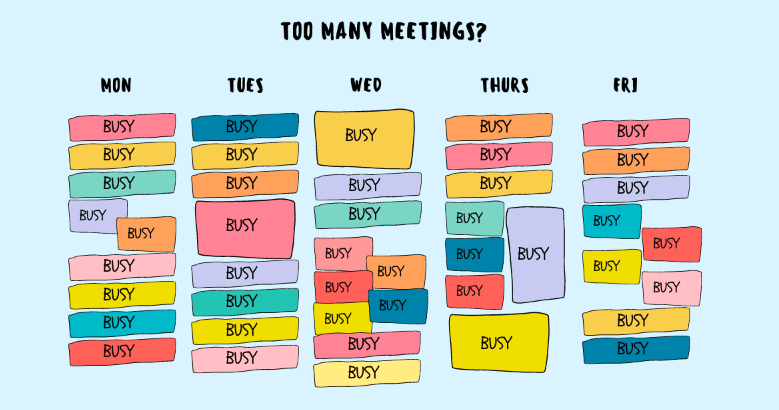
Are meetings the bane of your existence? Recently, Shopify introduced a new policy that cancels all recurring meetings with more than two people in an effort to give employees time back in their day so they can actually do work.

The company has instituted a six-hour window on Thursdays for large meetings, and they’re encouraging employees to decline other meetings, and remove themselves from large internal chat groups.

Meeting mania has been sweeping workplaces for years, and only became worse during the pandemic when Zoom became a verb that became synonymous with fatigue and eye strain.

In my old job, I probably spent anywhere from 3-4 hours a day in meetings, and my meeting schedule was considered light compared to most other managers.

In my new bridge retirement job, I have very few meetings. I just work. What a novel concept.

Here are some tips on how you can reduce the number of meetings in your work day and increase your job satisfaction:

  • Book shorter meeting times: try 15-minute touch bases or half-hour meetings instead of a full hour
  • List all the meetings where you’re just mainly listening in and not really participating. Chances are, you don’t need to be there. Decline and clear your schedule.
  • Have 5 or 6 items you need to ask your boss? Book one 15-minute touch base or save your questions up for a regular weekly meeting
  • Call or video chat people. This is an interesting one given nobody uses the phone anymore, and some people are reluctant to video chat you if you don’t have a time booked on your calendar, but often a quick 5-minute chat can get you the answers you need without another meeting filling up your calendar
  • Set an ideal work to meeting ratio, then stick to it. This will be highly role dependent. The ratio for a web developer for example may be 10:1 (so in a 40 hour work week, 36 hours of work to 4 hours of meeting) whereas for a Vice-President, it may be more like 4:6 (16 hours of work to 24 hours of meetings a week)

This week’s #HappyAct is to try working for a change, instead of meeting your life away.

The case for the four-day work week

comic showing person relaxing Friday, Saturday, Sunday

I’ve always believed that North Americans are workaholics. As a society, we allow work to rule our lives, from our waking hours to our sleeping thoughts (see my recent blog on sleep). In my heart, I’ve always felt more European when it comes to work.

In the past five years, I’ve been encouraged to see a growing trend of countries and businesses shifting to a four-day work week.

What’s interesting is in the UK and Europe, companies adopting a four-day work week are generally working less hours than before: between 30 to 32 hours a week.

In North America, not surprisingly, companies experimenting with a four-day work week in some cases are simply proposing to eke the same number of working hours out of employees, but in four days instead of five.

The four-day work week movement 4dayweek.co.uk says it is campaigning “for a four-day, 32-hour work week with no loss of pay which would benefit workers, employers, the economy, our society, and our environment”.

The UK recently published the results of one of the largest pilot studies on a four-day work week. About 2,900 employees across the UK took part in the pilot. Calling it a “major breakthrough”, 56 of the 61 companies extended the pilot and 18 companies made the arrangement permanent.

Of employees surveyed before and after the pilot, 39% said they were less stressed, 40% were sleeping better and 54% said it was easier to balance work and home responsibilities.

The number of sick days taken during the trial fell by about two-thirds and 57% fewer staff left the firms taking part compared with the same period a year earlier.

“The vast majority of companies reported that they were satisfied with productivity and business performance over the trial period.”

In Ontario, a growing number of rural municipalities are starting to transition to a four-day week. There are now seven municipalities offering employees the option of working a four-day week, the latest being Algonquin Highlands.

The executive director of the Ontario Municipal Administrators Association says it’s easier for rural municipalities to adopt a four-day work week because they are smaller, more nimble, and have more difficulty attracting and retaining talent, so it’s to their benefit to offer more flexibility in the workplace.

In Algonquin Highlands, one group of employees works Monday to Thursday, with another group working Tuesday to Friday. All employees worked an extra hour a day. It’s been a success. As Mayor Liz Danielsen says, “There’s nothing better than having happy staff.”

This week’s #HappyAct is to start the conversation in your workplace. Ask your leaders about a four-day work week.

Make decisions that make you smile

Poster on decisions

A few months ago, I made a decision that didn’t make me smile.

The worst part was, I knew it right away. As soon as I made it, I had that sinking feeling in my gut, but I knew I needed a change, and I resolved once I had committed to a course of action, to make the most of it and apply all my energies to making it work.

Of course it was the wrong decision. The serious reservations I had going in transpired, and it took an immediate toll on my happiness.

Luckily, I was able to extricate myself from the situation and am now in a much happier place.

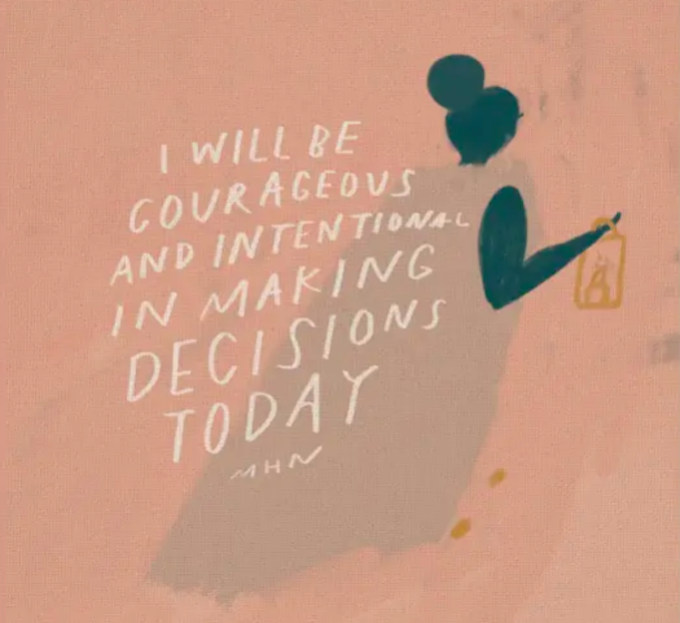
Sometimes the path forward isn’t always clear. But you will always discover the right path if you make decisions that make you smile.

Have a happy week…

Take a trip down memory lane

Author with friends at Kingston's waterfront
Our Welli Boot Toss team in 1999. Kingston Brew Pub used to host a charity event in support of Hospice Kingston where you throw a Welli boot as far as you can. I threw my back out shortly after!

I’ve been awash in memories these past few weeks. After 27 years at Empire Life, I am taking early retirement and will begin a new job as Director of Development with the United Way of Kingston, Frontenac, Lennox and Addington in May.

I’m sure most people on the verge of retirement find themselves taking a trip down memory lane, but for me, it’s been a constant flood of memories since I’ve also been going through my company’s archives these last few months.

I’ve found pictures of me doing crazy things for charity, like jumping in Lake Ontario on December 31, 1999 for Y2K in the Polar Bear Plunge, dressing up for skits as part of our annual United Way campaign, and uncovering every lame Halloween costume I ever pulled together at the last minute. (I was notorious for lame Halloween costumes; it became a bit of a running gag between Dave and me.)

Two girls jumping in Lake Ontario
Jumping in Lake Ontario for charity on New Year’s Eve, Y2K

I also came across photos of people who have passed away, friends young and old who I still think about and miss to this day.

What I didn’t find were any pictures of me working. While I had an interesting and varied career, it won’t be memories of work that I’ll take away from my time at Empire; it will be the memories of the different events, fun times and people who made work-life happy and rich.

This week’s #HappyAct is to rifle through an old yearbook, photo album or drive and take a trip down memory lane. Here are some more of the favourite pictures I found.

Acting in a play
Playing Dr. Evil in one of our United Way skits.
Serving cake at my company's 75th anniversary
Helping serve cake at our company’s 75th-anniversary celebrations almost 25 years ago
Dressed up to judge our Halloween contest
Judging our annual Halloween contest–our President Doug is wearing Dave’s kilt!
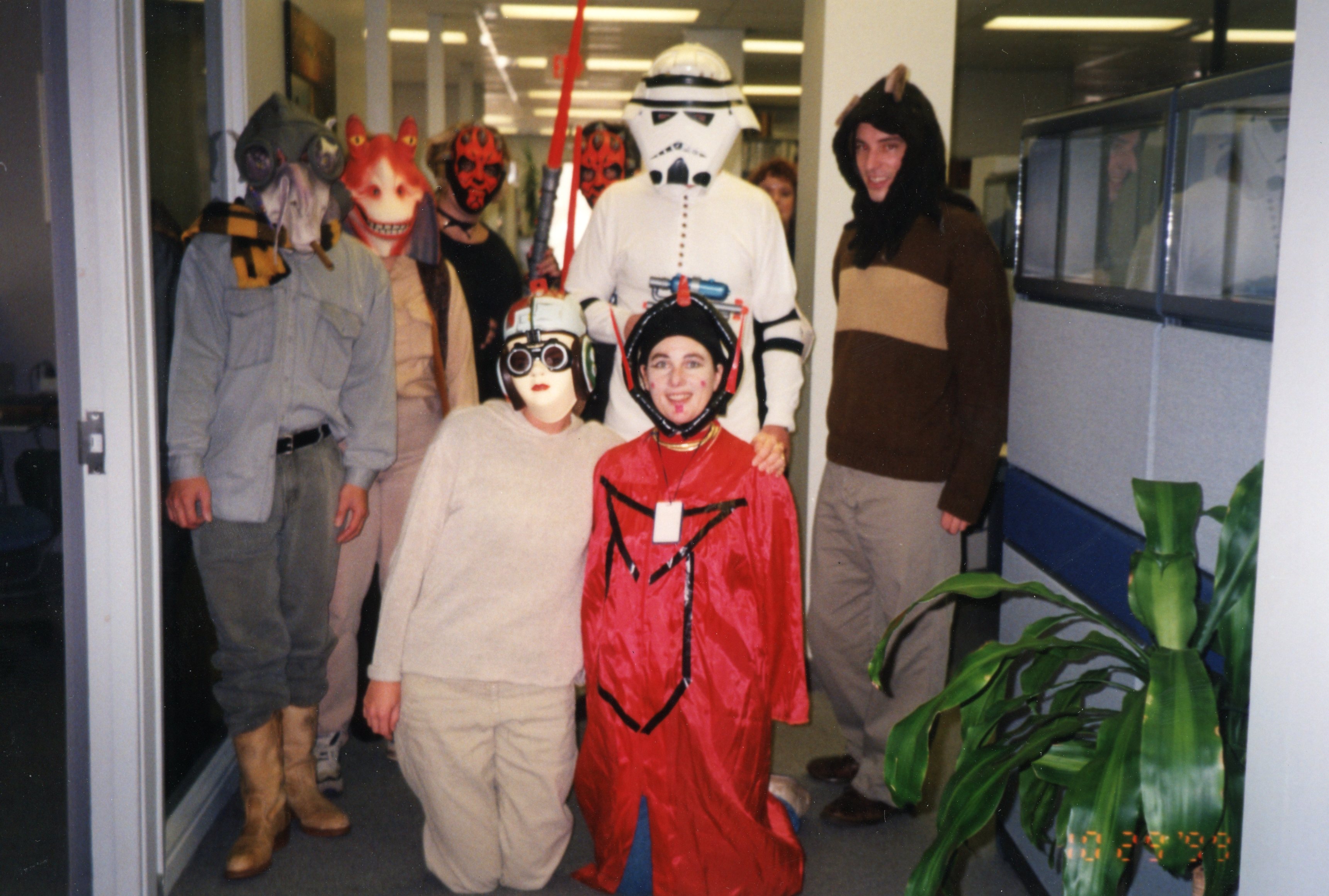
Dressed up as Queen Amidala from Star Wars
One of my lame Halloween costume pics, Queen Amidala from Star Wars
Dressed up as KISS for Halloween
One of my best Halloween costumes of all time, KISS with fellow bandmates Jon Begg, Chris Seymour and Tracey Hunt. Any time I had a good Halloween costume it was because my co-workers took pity on me and helped with my costume and make-up

My unscientific poll on work and happiness

happy co-workers

Recently I emailed a dozen friends and asked them three questions about how happy they were at work. The results were very revealing. The people who responded work in all sectors, government, private sector and self-employed. Here are the results of my unscientific poll on work and happiness:

My first question was, “Are you happy at work?”

More than half were not happy at work. Some said they were ashamed to admit it, because “they have a pretty good gig”; one person said they weren’t happy but planned to slog it out until retirement. A quarter of respondents said they were happy, and one person said at different times in their career they’ve been happy, and unhappy at other times.

When I asked what was the cause of their happiness or unhappiness at work,

On the plus side, the common themes were working with great people, loving what they do, and the variety of work. One person said they work in a low-stress environment and have an eight-minute commute, so they can come home for lunch every day if they want.

For those unhappy at work, here were some of the reasons they cited for their unhappiness:

  • Lack of involvement and inclusion and team camaraderie.
  • Being tired of dealing with some teams who don’t appreciate the work they do.
  • The inactivity associated with being on a computer eight hours a day.
  • One person said working within an environment where there are too many people in authority who “literally don’t have a clue what they are doing” and a “poisonous” atmosphere as a result of so many people being off on leave, creating more work for those left behind who are still working diligently.
  • One person who is self-employed said, “I’m bored, but I like the flexibility of what I do, so I stay at it. Also, the administration associated with being self-employed is a tough slog. I’m always behind on that, so that creates guilt that I’m not keeping on top of things.”

My final question was “What would make you happy or happier at work?”

  • Being valued and respected and having their work acknowledged was a common theme, along with being able to do more of what they love to do and having challenging projects.  
  • Better work-life balance, and being compensated fairly and seeing more transparency in salary grids were cited as other key factors.
  • One person said they’d like to have a friend at work and work with a diverse team.
  • The one person who was unhappy at work in the “poisonous” environment said they cope by focusing on their family, volunteering and sports and outdoor activities to remind themselves of what’s important in life.
  • On a lighter note, one person wanted a Keurig machine, a fitness room with a treadmill or exercise bike and another an office cat (for me, it would be a dog!)

So what does this tell us and what can we do to be happier at work? Scientific studies show having at least one good friend at work is a key contributor to happiness. Making sure we choose a positive environment where we work with good people and where our work is respected is critical.

As we emerge from this pandemic, we have a unique opportunity to redefine our relationship with work. At the core of the discussion should be these three questions.

Special thanks to the people who participated in my unscientific poll.

More reading on work and happiness

The key to job satisfaction in a post-pandemic world

I love my job sign

You can’t read a business article these days without some reference to The Big Quit or The Great Resignation. According to a report by Morneau Shepell, one of the country’s biggest HR consulting firms, 25% of Canadians are considering leaving their jobs. Companies are scrambling to try to figure out how to hold on to their top performers and lure the brightest minds to their organization. We’ve entered a new war for talent.

Flexible and hybrid work and employee wellbeing seem to be the two top themes, with competitive compensation and benefits programs now being table stakes.

I believe while providing flexible work and focusing on employee wellbeing will be important, they will not be enough to create true job satisfaction in a post-pandemic world.

There’s an obvious answer to this pressing problem that everyone seems to be missing: the key to job satisfaction in a post-pandemic world will be in the work itself.

Let me explain.

The Friday before my birthday, I started working on a project around 3:30 in the afternoon. Fridays tend to be quieter days for me at work: there are less meetings and interruptions. It was a project where I needed concentrated time to think and focus. I worked away at it, and when I looked up at the time, it was after 5 p.m. So much for knocking off a few minutes early on my birthday weekend. But for the first time in a long time, I felt good about work. I was able to think creatively, immerse myself in a problem and logged off feeling an immense spurt of satisfaction.

I had achieved what the work experts call “flow”. Flow is a state of focused attention so intense it doesn’t allow you to have cognitive bandwidth to do or think of anything else. It is an intersection of optimal being and optimal doing and when we achieve it, it creates inner harmony and happiness since we feel engaged, productive and in control.

Flow is like REM sleep, but for work. To be healthy and productive, our body needs to experience deep REM sleep every night. If you don’t, you feel tired, irritable, and you can’t concentrate or focus.

For many knowledge workers, work has become a constant barrage of emails, zoom calls and interruptions which is affecting our wellbeing and happiness at work. We are not achieving REM at work.

In this article in positivepsychology.com, researcher Mihály Csíkszentmihályi summarized it this way: “The happiest people spend much time in a state of flow – the state in which people are so involved in an activity that nothing else seems to matter; the experience itself is so enjoyable that people will do it even at great cost, for the sheer sake of doing it.”

One of the biggest benefits of flow is that it amplifies performance. Author Malcolm Gladwell claimed in his book Outliers that a person needs to do something for 10,000 hours to master a skill. In a 2014 study called the Flow Genome Project, author Steven Kotler estimated this time can be cut in half by achieving flow.

The interesting thing about flow is knowledge workers to some degree have control over flow. We can intentionally structure our workday to build in concentrated 60-90 minute sessions of work, we can turn off notifications, establish no meeting windows, and purposefully not check email. But I firmly believe companies need to wake up and create a more conducive environment to create flow in work and greater job satisfaction for their employees.

Some companies are already doing this. In my blog post The Future of Work, I talked about a Fortune 500 software company in India which tested a simple policy: no interruptions Tuesday, Thursday and Friday before noon. The company experienced a 65 percent increase in productivity but also reported employees experienced an increase in work satisfaction. They discovered the most important factor in daily joy and motivation was a sense of progress.

Hiring more employees, and cultivating a culture that encourages time spent on creative and strategic thinking and innovation are two more things companies should be doing to help employees do their best work and achieve job satisfaction.

This week’s #HappyAct is to achieve flow in your work this week. Leave a comment. How did it make you feel and did it increase your job satisfaction?

I’m an Eeyore and I’m OK with that

Eeyore

When it comes to work, I’m an Eeyore, and I’m OK with that.

When someone proposes a new idea, I immediately begin to think of all the problems or things that would prevent it from succeeding. It’s not that I don’t support the idea, most times I do, but my brain kicks into logistical overload and I think through all the obstacles and challenges that would need to be overcome to make it happen.

It’s a blessing and curse…especially when you’re known as the happy act blogger.

But I’ve come to embrace my Eeyore and I believe it has helped me in my communications work.

It allows me to anticipate problems, think things through, and make better decisions.

It has helped me to develop emotional intelligence and a risk lens, so when the time comes to execute, we’ve done a good job planning and preparing for most contingencies.

It has also helped me to accept the things I cannot change, courage to try to change the things I can, even if I haven’t mastered the wisdom to know the difference.

Dan Rockwell in his Leadership Freak blog says you can be negative and still succeed. Overly optimistic leaders minimize challenges, fail to anticipate problems and are more likely to throw in the towel when success doesn’t happen quickly.

Being optimistic is great, but blind optimism is dangerous.

This week’s #HappyAct is to embrace your Eeyore but never lose the faith.

Serenity prayer