
Findings from the 2026 World Happiness Report

Istanbul at sunset

In North America and Western Europe, young people are much less happy than they were a year ago.

That’s the startling first sentence in this year’s World Happiness Report, issued on March 20, World Happiness Day.

This year’s report sheds a light on the alarming use of social media, especially among young people and its negative impact on happiness.

Canada fell to 25th place in in this year’s report, continuing a decade long decline. Finland ranked #1 again for the ninth year in a row. The US ranked 23rd and Britain 29th. For the second year in a row, no English speaking countries appear in the top ten.

Social media use was cited as a troubling factor especially for teenage girls in English speaking countries and teenagers.

Some disturbing findings from this year’s report.

  • In general, most Western industrial countries are now less happy than they were between 2005 and 2010. Fifteen of them have had significant drops, compared to four with significant increases.
  • In a ranking of happiness changes for under-25s, the United States, Canada, Australia, and New Zealand (the NANZ region) rank between 122 and 133 in the list of 136 countries.
  • In a sample of US college students, the majority wish social media platforms didn’t exist. They use them because others are using them, but they would prefer it if no one did.
  • In regards to social media, “there is now overwhelming evidence of severe and widespread direct harms (such as sextortion and cyberbullying), and compelling evidence of troubling indirect harms (such as depression and anxiety).”

The report found that the nature of internet use and which age group and gender use it has a direct correlation to happiness and wellbeing. It is strongly negative for Gen Z, moderately negative for Millennials, near zero for Gen X, and slightly positive for Baby Boomers. 

One of the studies the report cited was of 15-year olds in 45 countries, where they found life satisfaction is highest at low rates of social media use and lower at higher rates of use.

Platforms designed to facilitate social connections show a clear positive association with happiness, whereas those driven by algorithmically curated content tend to demonstrate a negative association at high rates of use.

Communications, news, learning, and content creation are associated with higher life satisfaction. Social media, gaming, and browsing for fun are associated with lower life evaluations.

Last year, Australia banned social media for youth under the age of 16. Other countries say they are considering following their lead.

There was some good news in this year’s report.

  • Looking at changes in happiness from 2006–2010 compared to 2023–2025, nearly twice as many countries have had significant gains (79) than significant losses (41), the biggest winners being in Central and Eastern Europe and the biggest losers being in or near zones of conflict.
  • In eight of the ten global regions covering roughly 90% of the world’s population, those in the youngest age group have higher life evaluations now than in 2006–2010, either in absolute terms or relative to those over 25.
  • Positive emotions continue to be twice as frequent as negative emotions.
  • Outside the English-speaking world and Western Europe, the links between social media use and wellbeing are more positive, and depend greatly on the platforms used. Data from Latin America for example show that platforms with algorithmic feeds and featuring influencers are more likely to be negatively linked to life satisfaction than platforms that mainly facilitate communication.

Congratulations to Costa Rica, who jumped to fourth place (the report’s editors surmised this could be due to the quality of their social lives). Here is the list of top 10 happiest countries in the world.

  1. Finland
  2. Iceland
  3. Denmark
  4. Costa Rica
  5. Sweden
  6. Norway
  7. Netherlands
  8. Israel
  9. Luxembourg
  10. Switzerland

This week’s #HappyAct is to take a page from this year’s study and spend less time on social media. Delete an app or two. Stay happy.
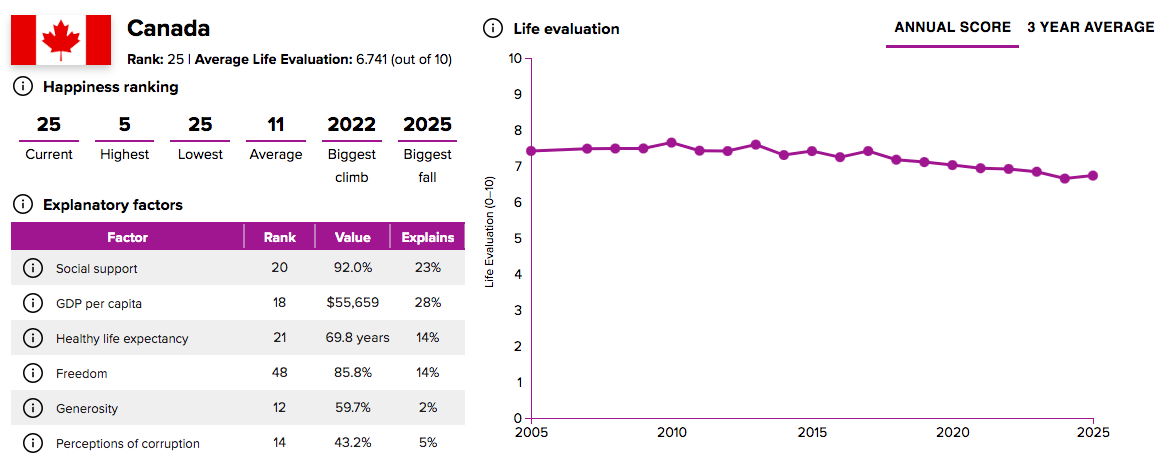

Canada's ranking in 2026 World Happiness Report

Take the Finnish Masterclass on happiness

Wilderness guide Petri Kokkonen, one of the instructors

It’s 10 degrees and raining right now in Finland, and yet those crazy Finns are all probably happily curled up inside in their cozy houses in front of a roaring fire with their thick, brightly-coloured woolen socks, sipping a cup of hot coffee or glogi.

Finland has been named the happiest country in the world for the last eight consecutive years in a row, according to the World Happiness Report.

Now you too can channel your inner finn and learn the Finnish methods of happiness by taking Finland’s free Masterclass of Happiness course online this fall.

After watching five online videos narrated by expert coaches on four central themes, you’ll be tasked with an assignment. The four central themes are connection to nature, health and balance, design and the everyday, and food and wellbeing.

After you complete each lesson, you’ll receive a certificate.

To give you a flavour of what to expect, in the first lesson, Petri Kokkonen, a wilderness guide who lives in the remote Vätsäri region, will help you experience the peace and tranquility of nature in daily life and help you become one with nature.

In the segment on design, design professional Taina Snellman-Langenskiöld talks about how much our homes and the spaces we visit affect our well-being.

Full disclosure: this course and site is run by Visit Finland, the country’s tourism operator and it will suggest how you can further your happiness journey with travel suggestions at the end. I became aware of it when they ran a contest the first year it was offered and held in person in Finland. The success of the course and contest made Visit Finland realize they were on to something, and they made it available to everyone online. Now the tagline “Visit Finland—the happiness country in the world” features predominantly in their advertising.

This week’s #HappyAct is to find your inner Finn and take the Masterclass in Happiness.

Related: Read about hygge, the ancient Danish tradition of creating a warm atmosphere to relax in with friends and family.

Climbing the ladder of happiness

world happiness report

If you imagine a ladder whose rungs are numbered zero to 10, and zero represents your worst possible life and 10 represents your best, which rung would you be on? 

This is the question asked of people around the world every year for the World Happiness Report. Last year marked the tenth anniversary of the report which uses global survey data to report how people evaluate their happiness in more than 150 countries. The study researchers will reveal the results of the 2023 report at noon tomorrow, March 20, the International Day of Happiness.

What’s interesting is Finland has ranked #1 for the past five years in a row, followed by Denmark and Iceland in second and third place in last year’s report. Switzerland, Netherlands, Luxembourg, Sweden, Norway, Israel and New Zealand all ranked among the top 10 ‘happiest’ countries in the world. Canada ranked 15th and the US 16th.

I dug a little deeper to understand why Finns have ranked #1 for the past five years. I’ve never been to Finland, and have only had a few Finnish friends over the years.  

Finns are not exactly known for their exuberance. There is a Finnish saying, ‘If you’re happy, you should hide it”. Their happiness manifests itself as more of a deep contentment, part of their hygge culture.

One thing the study illuminates, and is true in all the northern European nations who rank the happiest every year, is having access to the basics is a strong baseline for happiness.

In Finland, everyone has access to guaranteed health care, tuition-free school, a living wage, affordable housing, and free universal daycare from eight months until the start of formal education at age seven. It also doesn’t hurt that all Finns get five weeks of vacation every year.

But a key reason why Finland ranks #1 each year is their emphasis on family, friends, relationships and not on accumulating wealth or material possessions. They have their priorities straight.

This week’s #HappyAct is to watch for tomorrow’s report and ask yourself the question, which rung would you be on?

Ed note: If you’d like to read the full report, go to worldhappiness.report. I highly recommend taking 20 minutes to read a few of the sub-reports which are fascinating. For instance, in the report “Exploring the biological basis of happiness”, the researchers concluded that genetics does play a role in happiness. In fact, one study that tracked the lives of identical and fraternal twins found remarkably, that identical twins who were reared apart (100% genetically identical, no shared environmental influences or experiences) turned out to be more similar with respect to their well-being than fraternal twins who grew up together.

Another study on optimism during the pandemic found that while most participants experienced decreases in their optimism and meaning in life during COVID-19, for more than a third of the participants, their levels of optimism and meaning in life remained stable. Fascinating stuff.