Find your happiness sweetspot in 2026

sign saying The Happiness Sweetspot

It’s a New Year and as always, I wish you my loyal readers, much joy, success and most of all happiness in 2026.

One thing I’ve learned after blogging about happiness for more than a decade is we don’t always know what we want or need to do to be happier. We get caught up in the daily hamster wheel of cooking, cleaning, going to work, taking our kids to activities or rushing out to our own commitments leaving us feeling drained, exhausted and defeated. Or worse, we suffer from a general malaise, where it’s hard to see the happy in our lives.

So in the spirit of the eternal optimism a new year brings, here is a simple little exercise to help you discover what actions to take this year to be happier. I call it the Happiness Sweetspot Table.

  1. On a blank sheet of paper or in a spreadsheet, make a table with six columns across the top. In the first three columns, write
    • Things that make me happy
    • Importance (on a scale from 1-5, 5 being most important to you)
    • Frequency (on a scale from 1-5, 5 being you do them frequently and 1 being you do them rarely)
  2. In the next three columns, do the same for Things that make me unhappy
  3. Start filling out the Things that make me happy and Things that make me unhappy columns. Examples could include playing a favourite sport, spending time with friends, spending time in nature, playing guitar, etc. Try to be specific as possible. Examples of things that make you unhappy could include commuting, eating alone, cleaning the house, a volunteer commitment, etc.
  4. Next, rank how important and how frequently you do each activity on a scale from 1-5.
  5. Multiply the importance and frequency columns to get a total score for each activity.
  6. Add one final column at the end called “Things I’ve Always Wanted to Do/Try but never made time for”.
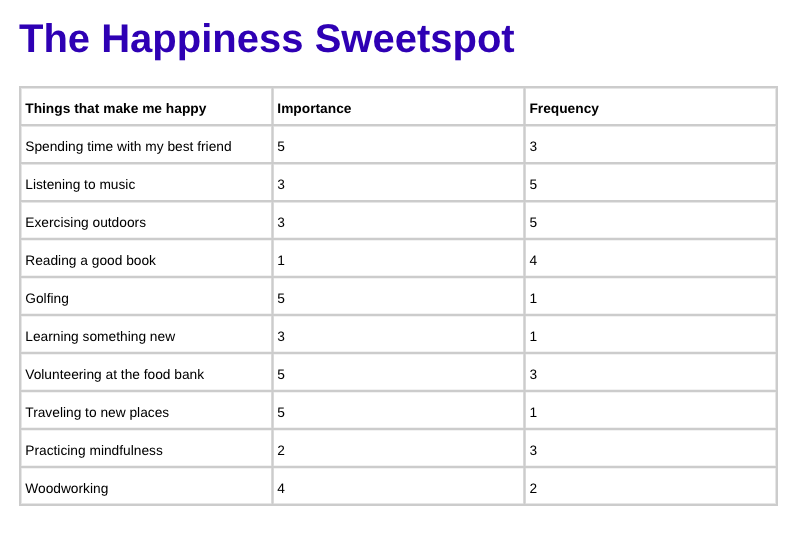
  7. Analyze your list. Your table should look something like this.
Table ranking things that make you happy

Here are some questions to ask yourself:

  1. What items received the highest score on the unhappy list and how can you reduce or eliminate them? For instance, if you hate cleaning the house, can you lighten up on the cleaning or afford a housekeeper once a month?
  2. What items on your happy list did you rank highest for importance but lowest for frequency. How can you make time for these going forward?
  3. What surprised you?
  4. What items did you add to the things you’ve always wanted to do but never made time for? What’s stopping you?

Try to be introspective and as brutally honest with yourself. While we all enjoy watching Netflix, ask yourself does it truly make you happy, or is it just a default for something to do on a cold winter night? If it doesn’t make you happy or unhappy, leave it off the list. The goal is to identify the things in your life that give you the most joy and fulfillment and the things that are acting as a drag on your happiness.

Of course, it isn’t an exact science. If you ranked “playing golf” as a 5 for importance, but 1 for frequency because it’s January, for an overall score of 5, that may not reflect how much golf makes you happy. Feel free to adjust the numbers, but also maybe think outside the box. Play some indoor golf this month, or book a golf trip if you can afford it.

Finally, identify two to three specific actions you can take this year to do more of what makes you happy, and less of what makes you unhappy. For instance, if you discovered that eating alone makes you unhappy and you eat alone seven nights a week, see if any of your friends are interested in starting a rotating potluck supper night one night a week, or suggest meeting a friend in the park for lunch once the weather gets nice.

This week’s #HappyAct is to discover your happiness sweetspots. May 2026 be your happiest year yet.

Take the Finnish Masterclass on happiness

Wilderness guide Petri Kokkonen, one of the instructors

It’s 10 degrees and raining right now in Finland, and yet those crazy Finns are all probably happily curled up inside in their cozy houses in front of a roaring fire with their thick, brightly-coloured woolen socks, sipping a cup of hot coffee or glogi.

Finland has been named the happiest country in the world for the last eight consecutive years in a row, according to the World Happiness Report.

Now you too can channel your inner finn and learn the Finnish methods of happiness by taking Finland’s free Masterclass of Happiness course online this fall.

After watching five online videos narrated by expert coaches on four central themes, you’ll be tasked with an assignment. The four central themes are connection to nature, health and balance, design and the everyday, and food and wellbeing.

After you complete each lesson, you’ll receive a certificate.

To give you a flavour of what to expect, in the first lesson, Petri Kokkonen, a wilderness guide who lives in the remote Vätsäri region, will help you experience the peace and tranquility of nature in daily life and help you become one with nature.

In the segment on design, design professional Taina Snellman-Langenskiöld talks about how much our homes and the spaces we visit affect our well-being.

Full disclosure: this course and site is run by Visit Finland, the country’s tourism operator and it will suggest how you can further your happiness journey with travel suggestions at the end. I became aware of it when they ran a contest the first year it was offered and held in person in Finland. The success of the course and contest made Visit Finland realize they were on to something, and they made it available to everyone online. Now the tagline “Visit Finland—the happiness country in the world” features predominantly in their advertising.

This week’s #HappyAct is to find your inner Finn and take the Masterclass in Happiness.

Related: Read about hygge, the ancient Danish tradition of creating a warm atmosphere to relax in with friends and family.

Fake it til you make it

Cartoon with four ducks and a rubber duckie saying Fake it til you make it

Dave asked me a funny question the other day. He asked what my followers are called.

Gaga has her little monsters. Taylor Swift has her Swifties.

Now I realize my little blog isn’t exactly on the same scale as these music legends, but it got me to thinking my followers deserve a moniker too, so I’ve decided to call you, my loyal readers, The Happy Actors.

There is something to be said for faking it til you make it, or in this case, pretending to be happy to achieve happiness.

In fact, in response to last week’s blog on what people’s personal mantras were, a friend of mine who was away replied hers was “Fake it til you make it”. She said,You probably know more than you give yourself credit for. At work, in other situations, smile and give it your best shot and you’ll probably do just fine!”

I believe the same applies to happiness to an extent. If you pretend you’re happy, you are far more likely to achieve happiness.

Here’s my theory. When we pretend we’re happy, our mood is lighter and our brain is tricked into seeing things in a more positive light. We are apt to be open to new things, and take in the beauty and goodness around us. Through this mindset and our actions, we become happier.

American philosopher and psychologist William James first propounded this theory in the late 1800s, believing that our behaviours create our emotions. Known as the theory of pragmatism, it touts that the practical consequences of ideas and actions evolve through our experiences and interactions with the world. Truths are not fixed, and through our actions, we can find meaning and happiness if we choose.

This week’s #HappyAct is to conduct a little experiment: on a day when you might be feeling a bit down, pretend for the whole day you’re happy, then report back on whether you actually felt happier or had a happy day.

Until next time my Happy Actors.

What’s your personal mantra?

Sign that says Everything happens for a reason

I saw a profile on LinkedIn where someone included their personal mantra. It was, “Passionate for making every day, a good day.”

I asked several friends what their personal mantra was and why they chose it. Here were their answers.

One day at a time. Sometimes it changes to “one hour at a time”. It helps me through tough times when you have to be strong to support those around you that are struggling. This year I have not only had to support my husband with a progressive disease, but also deal with a death in the family and two friends who are struggling with health issues that live alone and need help.

Sticking to this mantra gives me the encouragement I need, as well remembering that this is just one moment in time and if it is a tough one, maybe in a few hours or the next day it will be better. Take the moments as they come and cherish them.”

Lead with love.”

It’s just as easy to be nice. This was the refrain of my childhood. It was my father’s mantra. If I heard it once, I heard it a million times. It was helpful to me over the years in many situations at work. I am trying to remember this now as a menopausal woman. It’s ok to disengage–I don’t have to respond if I can’t be positive.”

Idiopathic. This word is often used in medical circles ‘to relate to any disease or condition which arises spontaneously or for which the cause is unknown.’ But I like to take it further than that. I like to relate idiopathic to life in general. In a world of left and right, good and bad, sickness and health, sometimes we just need to be present for all of it. Life is more than the hand you are dealt (past). It’s how you deal (present).”

Think big and you may get something, think small and you will get nothing.”

“I don’t really have a mantra, but I recently heard the following quote which I think is from Anne of Green Gables. “Tomorrow is a day with no mistakes in it..yet”. When I was going through my divorce and everything that came with it, I tried to live by ‘I forgive you, not because you deserve it, but because I deserve it.’ It was helpful to start moving forward and not continue to be angry and resentful about the situation.”

As for mine, it is “Everything happens for a reason.” This belief has helped me accept life’s twists and turns and has provided comfort when the headwinds of life have seemed to have blown me off course.

What’s your personal mantra? And many thanks to my amazing friends who provided such insightful, heartfelt, deeply personal and inspirational responses. Thank you for your willingness to share to help others.

How long does it take to let go

picture of waves at a beach and the words, "One of the happiest moments in life is when you find the courage to let go of what you can't change"

How long does it take to let go of…

A career spanning decades
Accumulated stress from years of working
Secrets from your past

A relationship that drains you instead of filling your cup
Regrets, many or few
Self-doubt

Lying awake in bed worrying about your children when they’re out late at night instead of home safe in their beds
Missing your children when they’ve left the nest to conquer the world on their own

So many feelings (the hard ones the hardest to let go)
Pent-up guilt or resentment
Inhibitions holding you back

Caring too much what people think of you
Not caring enough to take action when action is warranted.
Being envious of riches others have

Bitterness
Grief and loss
The past

The timeline is up to you.

Read more: Let it go

A funny thing happened on the way to my improv class

Group of people from improv class

Special guest post by Jon Begg

Our bus hit a polar bear. Someone was giving the bear CPR and my head was stuck in its jaws and no one was helping me. Seriously.

Fear. Absolute fear. How did I get myself into this situation?

Well, I signed up for it, a Level One improv class at the Tett Centre in Kingston.

I was a longtime fan of Whose Line is it Anyway so when I saw the ad for improv classes pop up on my Facebook feed I thought ‘Why not’?

I sent the payment, put all the dates on my calendar, told my wife I would be busy Tuesday nights, poured myself a tall glass of red wine and thought to myself “What have I done….?’

The class will probably be filled with quick-thinking Queen’s students… and me. I’m almost 62. I forget people’s names, I can’t think of the right word now and then, I never remember where I put my wallet and keys and the list goes on.

Now I’m going to be put in odd situations with people I don’t know, with no prep time, and have to make a 3-4 minute scene flow seamlessly by blurting what comes to mind first! “Don’t think” they tell you, the gold is what comes out first. Oh, and it helps if you get a few laughs along the way. No pressure at all.

It turns out there was no pressure.

I wasn’t the oldest in the class which for some reason made me feel good.

And there was laughter. Every class. We laughed with others and we laughed at ourselves.

Reader’s Digest had a section called Laughter is the Best Medicine. Turns out it’s true. Laughter is a wonderful thing. Studies around the world have shown laughter boosts immunity, lowers stress hormones, decreases pain, relaxes your muscles, and can help prevent heart disease. Those are just the physical benefits. Mentally, laughter eases anxiety, tension and stress, and can improve your mood. It checked a lot of boxes for me.

Improv was a great way for me to challenge myself, but more importantly, a great way to laugh at myself and at others sweating it out on stage!

For two hours a week I gave no thought to divisive politics, inflation, how to survive retirement, or the long list of social issues we hear about on our daily news feeds. I just laughed. I highly recommend it.

I hope that polar bear is doing okay.

Jon Begg

Jon Begg is a communications specialist, husband, father, grandfather, and fisherman who’s been telling jokes and laughing all his life.

The party you won’t see on the ballot we should all be voting for

elections canada vote sign

Tomorrow, Canadians will go to the polls in what could be one of the most historically significant elections of our generation.

Trump aside, I’ve been thinking of the key issues most Canadians are concerned about in 2025: the cost of living, affordable housing, mental health and health care, climate change, and the economy. I’ve been very fortunate to consider these issues from a new lens, thanks to a group of young PhD international students I’ve been working with as a proctor this past month at Queen’s University.

Two of the graduate students I worked with were from Ethiopia, one doing his PhD in rehabilitation research and the other in nursing. Another was from Syria, doing his PhD in nuclear engineering. They had all done their undergraduate and Masters degrees in different countries around the world and were extremely kind, bright, perceptive, and willing to share their thoughts and experiences of their time in Canada.

They all agreed Canada is a very beautiful, safe country and they particularly loved Kingston. They appreciated the hard work ethic of Canadians and the fact that we are a law abiding country. They did not like our winters!

Some of the things that surprised them is how expensive it is to live here, especially housing. (The one fellow told me he paid $900 a month for a two bedroom apartment in Germany where he did his Masters degree in a city the same size as Kingston. His rent here is $1,700. According to Studying in Germany.org, housing prices are 47% lower than in the US). They’ve also been surprised to see the number of homeless people and people with mental health and drug problems in Canada.

This led to a discussion on the shrinking middle class, a phenomenon that seems to be happening in all countries (my new friends said it was the case in Ethiopia and Egypt too).

However, the biggest culture shock and negative they’ve encountered is the individualistic aspect of Canadian society. We talked at length about child care, since my one new friend just had a baby and the other had two children and a wife here in Canada. They said at home in Ethiopia, child care is not an issue. If you need to work or go somewhere, there is someone—a relative, neighbour, or friend who will look after the children.

That led to discussions about seniors. Older people in their country are cared for and live with their extended families, unlike here in Canada where many seniors live alone or in nursing homes, and suffer from loneliness (see my blog post from a few weeks ago, “Battling the epidemic of loneliness”).

As we were discussing all of these issues, it occurred to me that if we simply went back to having multi-generational families living together, it would solve many of the problems in our society. There would be more available and affordable housing, and the cost of living would be offset by potentially multiple incomes in one household. People would be financially better off and happier, alleviating the strain on health care systems and improving people’s mental health.

If you study the famous “blue zones” in the world where people live longer, multigenerational living is part of their cultural fabric.

Where and when did we go wrong in North America?

In 2015, one of the best selling business books was a book called Weology: When Everybody Wins When We Becomes Before Me, by Peter Aceto, CEO of Tangerine bank. It was a book on the philosophy of leadership in business, but the concept of Weology is one I think we need to start embracing as a society to address these critical issues. Clearly what we’ve been doing up until now isn’t working.

A new party, let’s call it the Weology Party, committed to implementing policy that fosters a philosophy of taking greater care of each other and multi-generational living might just be the solution. From a tax perspective, this could take the form of tax deductions or income splitting for multi-generational households, not just spouses. There are currently tax breaks for people who have eligible dependents over the age of 18 and a tax credit if you are a caregiver for a spouse or senior, but we could do more. To foster this philosophy in our communities, the government could also offer tax breaks and incentives for volunteering.

Municipalities have started to make strides to make it easier for people to live together, allowing and promoting additional dwelling units on lots.

In business, the government could introduce policy to make it attractive for new start-ups to form as employee-owned cooperatives. There is a large corporation in Spain called Mondragon Cooperation that has 70,000 employees, annual sales of 11 billion euros and is highly profitable. They are committed to putting people before profits (for instance during COVID, instead of laying off employees, they reduced salaries across the board by 5%). The ratio of pay between employees and executives is just 6:1 (in Canada, the ratio is 210:1 for our highest paid CEOs and in the States, it’s even higher). This model is one way to distribute wealth more equitably in society, within the framework of a free market economy.

My new proctor friend who was a research fellow in rehabilitation was working with a professor who was researching the impact and effectiveness of formal versus informal supports for people with disabilities. Their theory is that informal supports are far more important in helping people with disabilities live full and rewarding lives. They are still in the research and data collection phase, but my guess is the data will show that informal supports, people supporting people, will be more important.

Which brings us back to election day. Make sure you vote. You won’t see the Weology party on the ballot this election, but perhaps some day we will. In the meantime, we need to all start thinking about what small changes we can make in our lives to move Canada towards a healthier (both financially and physically), happier, and connected society.

Findings from the 2025 World Happiness Report

man sharing a meal in Africa with others

The 2025 World Happiness Report was released on March 20, the International Day of Happiness. The first World Happiness Report was published in 2012 after Bhutan, a country that measures its success based on the happiness of its people urged the UN and national governments to “give more importance to happiness and well-being in determining how to achieve and measure social and economic development.”

Since then, the report has been measuring which countries in the world have the happiest citizens and exploring various themes related to global happiness including age, generation, gender, migration, sustainable development, benevolence, and the effects of the COVID-19 pandemic on global well-being.

As always, the results of this year’s report are fascinating (you can read the full report here.) The authors chose the theme “Caring and Sharing”, delving into how caring and sharing and specifically three benevolent acts, donating, volunteering and helping strangers can make people happier.

The Happiest Countries

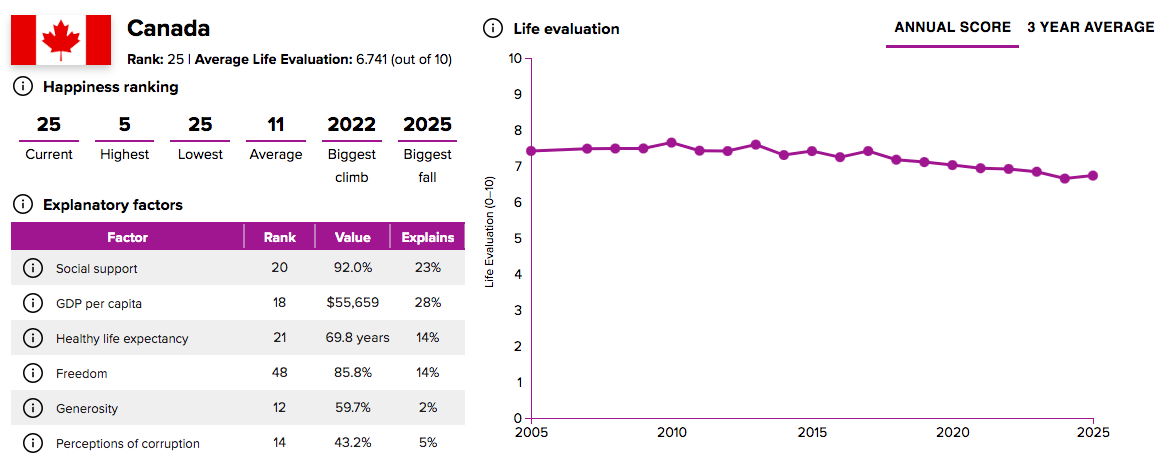
Finland ranked #1 for the eighth year in a row while Canada ranked 18th. The US fell off the list of the top 20 happiest countries to #24. One troubling statistic is that in general, the western industrial countries are now less happy than they were between 2005 and 2010 with the US, Canada and Switzerland experiencing the biggest drops.

Here are the top 20 happiest countries in order:

Finland
Denmark
Iceland
Sweden
Netherlands
Costa Rica
Norway
Israel (if you’re wondering about Israel, it scored highest in several areas, including the quality of social connection amongst youth)
Luxembourg
Mexico
Australia
New Zealand
Switzerland
Belgium
Ireland
Lithuania
Austria
Canada
Slovenia
Czechia

Key findings

Beyond health and wealth, simple acts of caring and sharing can influence happiness, including sharing meals with others, having somebody to count on for social support, and household size.

  • While it’s well documented that people who live alone are unhappier, research shows that happiness rises with household sizes up to four people, but above that happiness declines.
  • We are too pessimistic about kindness in our communities, and this pessimism is contributing to our unhappiness. For example, when wallets were dropped in the street by researchers, the proportion of returned wallets was far higher than people expected.
  • One interesting piece of research and a positive from the global pandemic is we’ve seen a “benevolence” bump of 10% since COVID-19. The pandemic taught us to think and care for others more, and that benevolence has continued.
  • One disturbing trend is young people in North America and Western Europe now report the lowest well-being and happiness among all age groups. In 2023, 19% of young adults across the world reported having no one they could count on for social support, a 39% increase compared to 2006. In fact, the fall in the United States’ happiness ranking is largely due to the decline in well-being among Americans under 30.
  • When society is more benevolent, the people who benefit most are those who are least happy. As a result, happiness is more equally distributed in countries with higher levels of expected benevolence

So what does this year’s report tell us and what simple happy acts can we all do to promote caring and sharing?

  • Share meals together: people who eat frequently with others are happier
  • Be kind and don’t underestimate the kindness of others
  • Try not to live alone
  • Build social connections and don’t be afraid to reach out to people
  • Practice benevolent acts–do what you can to volunteer, donate or help a stranger (several African countries reported low scores for donating but scored very high for helping strangers which helped their happiness scores)

Finally remember that caring is “twice-blessed”: it blesses those who give and those who receive. Have a happy week.

Battling the epidemic of loneliness

man wearing pink flamingo glasses

There is an epidemic sweeping our country—the epidemic of loneliness.

In our grandparents’ day, the average detached home in Canada had six people in it. For my generation, it was four people. Today it’s 2.1. One of the fastest growing sub-segments in the housing industry today is single homeowners in their 20s. For the first time in modern history, we also have an entire generation of seniors living alone in isolation.

The two age brackets most at risk of being lonely are youth and seniors. According to Statistics Canada’s Canadian Social Survey: Loneliness in Canada, more than 1 in 10 people aged 15 or older say they “always or often” feel lonely. A 2024 study of seniors estimated between 19-24% of Canadians over the age of 65 feel isolated from others and wished they could participate in social activities in their community.

The impacts of loneliness in seniors especially are well known. In addition to depression, emotional distress, and dementia, loneliness can result in increased risks of chronic illness and falls, poor general health and premature death.

Humans were not meant to live alone. We were meant to live in tribes.

So what can we do to battle the epidemic of loneliness? Here are some words of advice people shared in a recent Quora post:

“Have a pet and walk them every day. You’ll meet people on your walks”

“Join a club or activity…check out the nearest seniors centre for programs services” (I’ve really enjoyed the activities I participate in at the Seniors Association of Kingston and have found my tribe there)

Volunteer

“Find people you can text every day”

 “Check out the website meetup.com for a list of groups and activities that may appeal to you” (I looked to see what was listed for my area of Kingston, Ontario and there was everything from guided hikes, to toastmasters groups, to meditation and church groups)

“Nobody is going to come to you. Go out and find a church family, join a gym, go for walks, talk to your neighbours. Don’t spend your senior years being sad. Enjoy every day you have left. If you lived near me I would be your friend.”

“Every time you find yourself thinking about your own loneliness and state, think about someone in the world you can help. A neighbour who needs help, bake some cookies, whatever”

“To have a friend you need to be a friend.”

“I remember this documentary on finding happiness. The director at the beginning of the film said he would sum up the secret of happiness with one 4 letter word. I assumed it would be “love” but was surprised when he said it was risk. It’s all about taking calculated risks and steps to make opportunities happen for yourself and it will pay off. Good luck your future happiness is within you.”

This week’s #HappyAct is to do something to battle the epidemic of loneliness. Reach out to a friend, join a group, visit a senior who lives alone. It’s all about caring and sharing—more on that next week!

Coming up…March 20 is World Happiness Day. This year’s theme is Caring and Sharing. Be sure to check back next week when I dive into the results of the 2025 Report on World Happiness.

Photo: One of my favourite photos of Dave’s Dad who is living proof a youthful heart and spirit will always keep you young at heart and happy. He texts his friends and family every day.

Turn a frown upside down

smile and saying "a smile is the shortest distance between two people"

Several years ago, I was on a business trip with some colleagues. We’d had a long travel day and after checking in to our hotel around 8 pm, wandered down to the hotel bar for a late dinner. We sat for at least ten minutes without any service, so one of my co-workers got up and approached the waitress. He said she was quite surly when he talked to her, but she eventually came over with some menus.

I’ve always been fascinated by how a person’s actions can affect the actions of others, even more so since starting this blog, so I decided to embark on a little experiment. I wondered if I smiled broadly and was overly nice to our server, asking her questions about her day and thanking her every time she came to the table, whether by the end of our dinner, she would provide better service.

We ordered our drinks, and I kept smiling, laughing and making small talk when she brought us our meals. By the end of the evening, she still seemed stressed and unhappy, but was a bit more friendly and attentive.

There are many takeways from this night. The first is if someone is having a bad day, chances are it has nothing to do with you. Our waitress was probably on her feet for eight hours by the time our group strolled in. No doubt she was exhausted and wanting to go home. Who knows what she was dealing with at work or at home—a sick parent or child, mounting bills, an argument with her husband or friend. Since she never shared anything personal, we’ll never know.

The second is our actions did result in her being a bit nicer and attentive, so there was a positive correlation between our efforts to be nice and her actions.

The third takeaway is our group did get better service so it pays to be kind. As one of my old bosses used to say, “You can catch more flies with honey than vinegar”.

Everyone can have a bad day. It seems to me people have short fuses these days and are starting to lose their capacity to show empathy and understanding. Even if you can’t turn someone’s frown upside down, you can give them grace and compassion.