It’s an anxious world we live in. According to Anxiety Canada, 1 in 4 Canadians suffer from anxiety.
It’s normal to feel anxious sometimes. Anxiety can plague even the most positive of people. But for some, especially people who struggle with positive mental health or depression, it can become a death spiral.
What triggers anxiety can differ from person to person. Maybe it’s a job change, or the feeling of being stuck in your job. It could be worrying about money, or feeling unhappy in a relationship. I think most people are experiencing some degree of anxiety seeing what’s happening in the world today.
Recently, someone shared with me this simple five-step technique to clear your mind and be in the moment when you are feeling anxious. Focus on
5 things you can see
4 things you can hear
3 colours
2 things you can smell
1 positive feeling
Finish by taking three deep breaths.
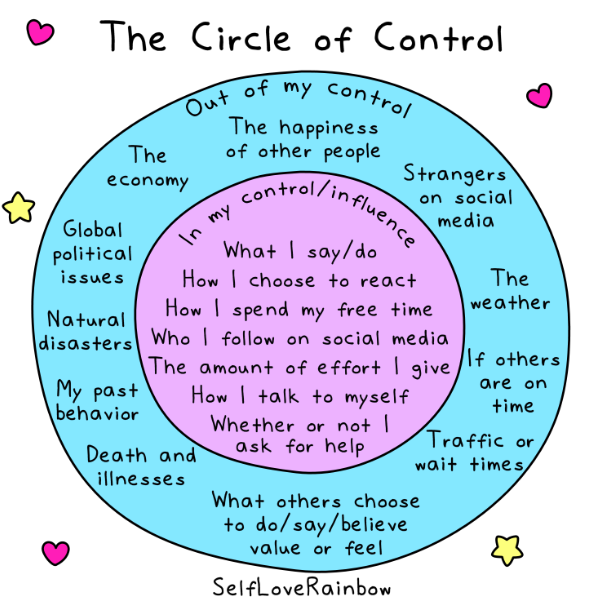
I’ve always found this graphic of two circles helpful as well. There are many variations of this graphic–this one is geared towards teenagers, but I’ve seen the same concept in corporate circles when trying to help employees through change. The first circle is everything happening in the world that you have no control over. The second circle is things you have direct control over. When your brain is feeling overwhelmed, remember the two circles and focus on the things in your life you can control.
This week’s #HappyAct is to try this simple technique the next time you’re feeling anxious.
Ed. note: This five-step technique is often referred to as a grounding technique focusing on the five senses. I prefer this variation. Studies show that anxiety plagues women more than men. If your anxiety is getting in the way of living, talk to your doctor.
In March 2025, The Hudson’s Bay Company filed for creditor protection, marking the demise of this country’s oldest retailer and the end of the department store era in Canada.
As schoolchildren, we learned about the early history and legacy of The Hudson’s Bay Company. Founded in 1670, the company was granted a royal charter by the King of England to conduct sole trade and commerce in the area known as Hudson’s Bay, giving them a monopoly on the lucrative fur trade throughout much of English Canada.
For centuries, The Bay has been a part of our cultural fabric. Now, you too can own a piece of this storied company’s past.
Heffel Auction House is holding an online auction of Hudson’s Bay memorabilia and assets with bidding open until January 27, 2026. You can see all the items up for auction here.
I assumed most of the items would be rare and expensive works of art in the hundreds of thousands of dollars, but was pleasantly surprised to find most of the items were affordable.
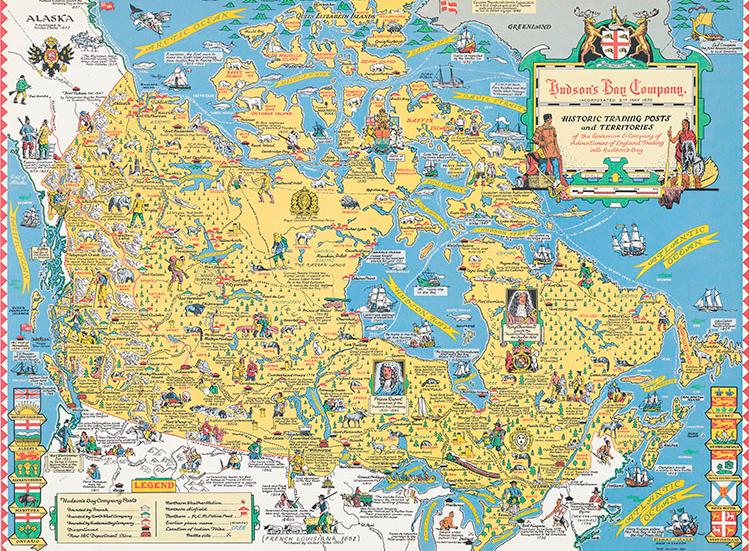
Interested in an HBC decorative canoe paddle with the SS Beaver emblazoned on it? It can be yours for $700 (all bids stated are at the time of writing). Or how about a model of the tallship Nonesuch for $1,500? These are just some of the treasures you can find in the HBC Ephermera section. Or maybe you would prefer a decorative pocket watch for $400, commemorative sword for $1,600, a beaver pelt cheque for $500, or the map pictured above for $1,600.
The lots include coins, soapstone carvings and an entire collection of iconic Hudson Bay blankets, ranging from $50 to $3,750.
There are also two art sections, one of Inuit art and one of fine art, featuring works by well-known Canadian artists like Kenojuak Ashevak, Robert Bateman, and Alex Colville. I’m tempted to bid on this piece below called “He Guards the Peace” by David M. General, current bid of $50.
One thing you won’t find on the online auction is the original Royal Charter. It was auctioned off in late 2025, bought by the Thomson and Weston families for a cool $18 million. The families plan to donate it to a Canadian museum so all Canadians can see it.
This week’s #HappyAct is to take buying Canadian to heart and own a piece of Canadian history. Happy bidding!
Ed. note: if you are a fan of Indigenous art, be sure to make a trip to the McMichael Gallery in Kleinburg before March 29, 2026 to catch the exhibit, Early Days: Indigenous Art at the McMichael.
It’s been a year since I retired, and other than taking on a few gig jobs, I’ve fully embraced my new life of leisure.
I know some people struggle with the decision. I remember years ago sitting in a retirement seminar with some colleagues. One of my friends said, “I don’t think I’ll retire anytime soon—I just don’t know what I’d do with my days.” This is a common refrain and fear. The experts all say the same thing, you need to retire to something, not just from work.
I thought it might be helpful to share what I’ve learned about retirement to help anyone thinking about taking the big leap.
If you think you will miss work, think again. Unless you’re an artist or have a super cool job like a back-country ski instructor, pilot, or amusement park ride inspector (we have a friend who does this for a living and is constantly posting pictures of riding awesome rollercoasters), you won’t miss the work. I stopped thinking about the office about 10 seconds after leaving it. I still miss some of the people though.
Structure is good. Most people need some structure in their lives. Choose some regular weekly activities that get you out of the house and give you structure in your day.
On the flip side, don’t overbook yourself, especially in the first year. You want to have the flexibility to explore, do fun things, and try new activities.
Try not to worry about money. This was one of the best pledges I made to myself in retirement. Nearly every retiree, unless you’re uber rich worries about money. It just comes with the territory. Be aware of your spending, have a budget and try to stick to it, but know that there are options, like taking part-time jobs, looking at your investment income, or downsizing your home if need be.
Time moves on a different continuum when you’re retired. Before if you were packing for a trip, you might only have an evening free to get ready. Now you might have two or three days and it still doesn’t seem like enough. Embrace the slower pace—you’ve been rushing all your life.
Don’t be surprised if you don’t do some of the activities or things you thought you wanted to do. I always pictured myself golfing once a week in a ladies league, but I’ve discovered I’m not as passionate about golf as I thought I was.
You may get bored from time to time. What a wonderful problem. Seize the opportunity to go somewhere and see or do something new, or just veg for the day. Call or meet up with a friend or family member you haven’t seen in awhile. I know it sounds corny, but I have a jar with ideas for day trips, overnight trips and bigger trips. When we have a free day, and feel like doing something, we grab an idea from the jar and off we go. The world is your oyster.
Women tend to transition better to retirement than men. One of my friends attended a retirement planning session and the facilitator said to the women in the room, “Go get a coffee, this segment doesn’t apply to you, you’ll be fine, but men listen up. You will struggle more.” That has certainly been the experience for Dave and me and many of our friends. I’m not sure if it’s because a man’s identity is more closely linked to his work, or that women are more social, but men struggle more with what to do and how to fill their days. Go back to point two: have a structure.
For me, retirement has been a huge blessing. I’ve enjoyed having the freedom to do the things I’ve wanted to do, get more active, and help out in my community. The one thing that has been difficult is we transitioned to empty nesters at the same time we retired. We miss the kids terribly sometimes, but then we look out and see the sun shimmering on the lake, and hear the loons and fish calling our names, and we head out, grateful for the gift of time to enjoy each day.
Are you retired and have advice to share, or is there anything that has surprised you in retirement? Leave a comment.
Photos: Above: me in Scotland this July and below, on the Ranney Gorge Suspension Bridge in Campbellford. The suspension bridge was one of the ideas in my day trip jar, so I stopped to check it out on the way home from Peterborough one day.
Tomorrow, Canadians will go to the polls in what could be one of the most historically significant elections of our generation.
Trump aside, I’ve been thinking of the key issues most Canadians are concerned about in 2025: the cost of living, affordable housing, mental health and health care, climate change, and the economy. I’ve been very fortunate to consider these issues from a new lens, thanks to a group of young PhD international students I’ve been working with as a proctor this past month at Queen’s University.
Two of the graduate students I worked with were from Ethiopia, one doing his PhD in rehabilitation research and the other in nursing. Another was from Syria, doing his PhD in nuclear engineering. They had all done their undergraduate and Masters degrees in different countries around the world and were extremely kind, bright, perceptive, and willing to share their thoughts and experiences of their time in Canada.
They all agreed Canada is a very beautiful, safe country and they particularly loved Kingston. They appreciated the hard work ethic of Canadians and the fact that we are a law abiding country. They did not like our winters!
Some of the things that surprised them is how expensive it is to live here, especially housing. (The one fellow told me he paid $900 a month for a two bedroom apartment in Germany where he did his Masters degree in a city the same size as Kingston. His rent here is $1,700. According to Studying in Germany.org, housing prices are 47% lower than in the US). They’ve also been surprised to see the number of homeless people and people with mental health and drug problems in Canada.
This led to a discussion on the shrinking middle class, a phenomenon that seems to be happening in all countries (my new friends said it was the case in Ethiopia and Egypt too).
However, the biggest culture shock and negative they’ve encountered is the individualistic aspect of Canadian society. We talked at length about child care, since my one new friend just had a baby and the other had two children and a wife here in Canada. They said at home in Ethiopia, child care is not an issue. If you need to work or go somewhere, there is someone—a relative, neighbour, or friend who will look after the children.
That led to discussions about seniors. Older people in their country are cared for and live with their extended families, unlike here in Canada where many seniors live alone or in nursing homes, and suffer from loneliness (see my blog post from a few weeks ago, “Battling the epidemic of loneliness”).
As we were discussing all of these issues, it occurred to me that if we simply went back to having multi-generational families living together, it would solve many of the problems in our society. There would be more available and affordable housing, and the cost of living would be offset by potentially multiple incomes in one household. People would be financially better off and happier, alleviating the strain on health care systems and improving people’s mental health.
If you study the famous “blue zones” in the world where people live longer, multigenerational living is part of their cultural fabric.
Where and when did we go wrong in North America?
In 2015, one of the best selling business books was a book called Weology: When Everybody Wins When We Becomes Before Me, by Peter Aceto, CEO of Tangerine bank. It was a book on the philosophy of leadership in business, but the concept of Weology is one I think we need to start embracing as a society to address these critical issues. Clearly what we’ve been doing up until now isn’t working.
A new party, let’s call it the Weology Party, committed to implementing policy that fosters a philosophy of taking greater care of each other and multi-generational living might just be the solution. From a tax perspective, this could take the form of tax deductions or income splitting for multi-generational households, not just spouses. There are currently tax breaks for people who have eligible dependents over the age of 18 and a tax credit if you are a caregiver for a spouse or senior, but we could do more. To foster this philosophy in our communities, the government could also offer tax breaks and incentives for volunteering.
Municipalities have started to make strides to make it easier for people to live together, allowing and promoting additional dwelling units on lots.
In business, the government could introduce policy to make it attractive for new start-ups to form as employee-owned cooperatives. There is a large corporation in Spain called Mondragon Cooperation that has 70,000 employees, annual sales of 11 billion euros and is highly profitable. They are committed to putting people before profits (for instance during COVID, instead of laying off employees, they reduced salaries across the board by 5%). The ratio of pay between employees and executives is just 6:1 (in Canada, the ratio is 210:1 for our highest paid CEOs and in the States, it’s even higher). This model is one way to distribute wealth more equitably in society, within the framework of a free market economy.
My new proctor friend who was a research fellow in rehabilitation was working with a professor who was researching the impact and effectiveness of formal versus informal supports for people with disabilities. Their theory is that informal supports are far more important in helping people with disabilities live full and rewarding lives. They are still in the research and data collection phase, but my guess is the data will show that informal supports, people supporting people, will be more important.
Which brings us back to election day. Make sure you vote. You won’t see the Weology party on the ballot this election, but perhaps some day we will. In the meantime, we need to all start thinking about what small changes we can make in our lives to move Canada towards a healthier (both financially and physically), happier, and connected society.
A couple of weeks ago, I was doing some work on my MacBook Air when suddenly everything stopped saving. I was getting out of memory errors even though the diagnostics showed I still had plenty of memory left and Microsoft Office wouldn’t work properly.
I packed up my Mac and popped into Best Buy on my way to my Friday afternoon writers’ group.
For the past ten years, we’ve bought all our computers and phones from Best Buy. As big retailers go, I think they are one of the best with excellent service, knowledgeable and friendly staff, and competitive prices. I went to their Geek Squad desk, and within twenty minutes I was on my way, my Mac issue resolved. When I asked how much I owed them, the guys smiled and said no charge.
With the crazy holiday shopping season soon upon us, I thought I’d share my list of best brands to buy from this holiday season, with an emphasis on Canadian, their willingness to go the extra mile for their customers, and cost since inflation is through the roof.
Canadian Tire: still one of my favourite Canadian retailers, with one of the best return policies around and items on everyone’s Christmas list. They’ll also go the extra mile to help their customers and the community. During the ice storm of ’98, when we bought a blue water jug from the Canadian Tire in Kingston, the manager filled the jug for us. And just last week when I started my holiday shopping there, I saw an employee out front helping a customer fix their bike.
Simons: Keeping on the department store theme, Simons is a Quebec-based fashion mecca for anyone looking for stylish, inexpensive fashion. Their roots date as far back as 1840 and they now have 17 stores across the country and are opening two more in the GTA this winter. I discovered Simons when I used to go to Montreal for business and make it a regular stop every time I’m in Montreal.
Dollarama: Another Quebec success story, everyone knows this beloved dollar store where your buck goes a long way. Fantastic for stocking stuffers, cards, gift wrap and more.
Winners and HomeSense: No matter what time of day you go into a Winners or HomeSense, there’s a lineup to check out which speaks to the popularity of these discount stores. What I like the most is it feels like a treasure hunt every time you visit—you never know what you are going to find.
Giant Tiger, aka the “GT Boutique”: A local low-cost favourite (the first Giant Tiger stores opened in Ottawa and Napanee in the 1960s and are owned by a local family), if you’ve never set foot in a Giant Tiger, you may be surprised you can find some of the biggest brands at reasonable prices, including Spyder, Disney, RealTree and NHL, CFL and NFL merchandise.
Any local craft fair: I still say the most special gifts are anything you can buy locally made with love. I’ve already started scouring some of my local craft fairs for gifts. Bonus: there’s usually always a bake table to stock up on treats!
This holiday shopping season, make sure your shopping experience is a positive one and you leave a happy customer. What are your favourite retailers and why? Leave a comment. Happy shopping!
In 2010, Gallup published a study asking Americans what amount of income would make them happy. The answer was $75,000 (USD).
In a new study released this summer, Americans were asked what amount of money would make them feel content, as measured by their liquid net worth. 56% of Americans responded $200,000.
This amount would give them enough of a safety net, peace of mind, and presumably extra funds to pursue their interests and passions.
Millennial respondents said that they would be more content with a higher salary job, whereas Gen Z respondents preferred having a higher liquid net worth. The average salary in the United States at the end of 2023 was $59,384.
So what’s our takeaway here?
As families grapple with the higher cost of living, it’s getting harder and harder to maintain a financial cushion, and yet having that cushion helps alleviate stress, anxiety, and contributes to our overall happiness.
To maintain that cushion, we may need to change our spending habits. It’s more than about dollars and cents. It’s about happiness and common sense.
I’m retiring this week. After working for the past two years for my local municipality, I’m hanging up my keyboard (well, at least my work keyboard) and making plans for a future that doesn’t involve paid work.
It’s exciting and daunting at the same time and I realize how lucky I am.
I’ve made some pledges to myself, and because I am a firm believer that if you write down your goals or say them out loud, you’re more likely to stick to them, I am sharing them with you here today. Here are my retirement pledges.
I pledge to…
Not feel guilty if I feel like doing nothing Embrace each day as a gift Spend more time in my garden and at my lake Get more exercise
Help my community Take advantage of all the events during the day on weekdays I couldn’t attend when I was working Never spend another minute in a meeting or on Zoom Spend more time with the people I love
Listen to more live music Spend less time on my phone Pursue my passion of writing Not worry about money
Go outside every day Visit friends who I haven’t seen in awhile and make some new ones Travel and embark on new adventures near and far Take better care of my health
This week’s #HappyAct is to make your own pledge, even if retirement is still a distant dream. What would you pledge to yourself?
Last week, during my regular lunchtime walk, I stopped at a little lending library outside one of the old beautiful limestone homes that grace this area.
I don’t always stop when I see little lending libraries, but sometimes I do. I looked inside and saw more than 50 packets of seeds in addition to the regular array of books.
I decided to help myself to some watermelon and malva seeds and found two books on my reading wish list: The Art of Racing in the Rain by Garth Stein and The Beautiful Mystery by Louise Penny.
Next week I’ll replenish my neighbour’s little lending library with a couple of books from my own bookcase I’ve read.
The origins of the original Little Free Library begain in 2009 when a Wisconsin fellow by the name of Todd Bol built a model of a one-room schoolhouse and put it on a post on his front yard and filled it with books with a sign, “Take a book, share a book” .
He built more, and soon it became a movement with others doing the same. According to littlefreelibrary.org, today there are more than 150,000 registered little free lending libraries in the world. There’s even a mobile app so you can find the one nearest you. In many communities, little lending food pantries have appeared, stocking canned goods or even fresh vegetables from people’s gardens.
The story of the little lending library that could is a tale of inspiration and hope. It embodies all that is good in a world where sometimes it’s hard to see the good: people helping others and their community through an action as small as sharing a book or a packet of seeds.
This week’s #HappyAct is to take a book or share a book. If you’re really ambitious and want to build your own, check out these 10 designs from familyhandyman.com.
Photos: I didn’t have my phone with me during my walk, but here’s a picture of a little lending library we visit in Clark’s Summit, Pennsylvania on our trips down south. Above: my treasures from my latest haul from my little lending library near my work.
Black Friday and the holiday shopping season is upon us. Canadians are being lured by savvy marketers with promises of up to 70% off, Black Friday Deals and Super Savings you can’t pass up.
While some people refuse to cave to the consumerism of the season, most of us succumb to varying degrees to the shopping craze this time of year.
Which begs the question. Does retail therapy make people happy? The science shows the answer is yes.
Even just the anticipation of making a purchase or treating ourselves to something we desire releases dopamine, the hormone neurotransmitter in our brain that makes us feel good.
The choices we make when shopping can restore a feeling of personal control and autonomy which helps in fighting feelings of sadness and anxiety over the things that are outside of our control in the world.
In another 2014 study by University of Michigan, researchers showed that purchasing things you personally enjoy can be up to 40 times more effective at giving you a sense of control than not shopping, and those who actually purchased items were three times less sad when compared to those who only browsed.
Shopping also stimulates our senses, creating pleasure, especially this time of the year when the stores have festive displays and merry music playing.
But before you go filling up your virtual or actual shopping cart, remember these caveats. For every instant hit of pleasure, there is a corresponding pang of potential regret when it comes time to pay the bills. You need to calculate whether the pleasure from the purchase would exceed the pain from the cost, and whether you can afford the purchase at all.
The Journal of Consumer Psychology study showed that even just the act of filling up your online shopping cart, then abandoning it, can create the same pleasure as if you had actually made the purchase.
In the end, spending less money may be more rewarding.
This week’s #HappyAct is to be a smart, savvy and happy Black Friday shopper. Find a few bargains and enjoy the small hit of dopamine, but don’t do anything you’re going to regret later.
Special #HappyAct Experiment: Go online this week to one of your favourite retailers and fill up your shopping cart with a bunch of items, then close down your browser without making the purchase. Did you feel happier just browsing? Leave a comment!
I’ve been obsessed lately with the cost of living. I just got back from a girls’ weekend and I’m sure my friends were heartily sick of hearing me go on about prices and how expensive things are.
So I’ve decided to stop talking about money, and take action instead. Here are eight tips for saving money:
Cash in rewards points.
Look for special promotions and deals. For instance, in honour of National Movie Day, Cineplex, Landmark Cinemas and some independent movie theatres are offering $4 movie tickets this Sunday, August 27.
Use up gift certificates sitting in your wallet.
Review your streaming packages and tech and see if you can streamline your services. We haven’t made the leap yet to get rid of our landline and satellite TV, but with services now like Stack TV, now may be the time.
Forage for food. This may sound drastic, but a few years ago, I made a pledge to start eating more off the land. In July I pick raspberries, in August, I make garlic scape pesto with my garlic scapes, and in the fall I pick apples from the local fields and make crisps and apple sauce. It’s not as crazy as it sounds.
Look for “free” days and times at museums and exhibits. For instance, in Ottawa, the National Gallery of Canada, The Canadian War Museum, The Canadian Museum of History, The Canadian Museum of Nature and The Bytown Museum are all free on Thursday evenings from 5pm – 8pm
Reduce food waste. Buy less perishable food, and get creative with leftovers. Stir fries, soups, quesadillas, burritos and bowls are all great ways to use up leftover meats and vegetables.
If you need to buy something, consider used, which is also environmentally friendly. Fall is a great time for garage sales, or shop on Facebook marketplace. Luckily vintage clothing shops have come back into fashion.








 Happy Act