If you read last week’s post, you’ll know this weekend marks my first days of being officially retired.
I made some retirement pledges last week, but forgot one very important one: I pledge to never set an alarm again unless it is to catch a plane or train.
You don’t need to be retired to make this pledge.
I’m not a morning person. Either is Clare. Our morning routine was to eat silently together at the breakfast table, then barely say a word to each other during the car ride to work and school.
I learned years ago I was much happier when my life wasn’t being ruled by an alarm so I stopped setting one.
It’s easier to do than you think if you go to bed roughly around the same time each night and get up at the same time each morning. (If you’re on irregular shifts, I’m guessing it would be far more difficult).
Your body naturally self-regulates and on weekdays, I would wake up within a 15-minute window each morning.
There will be days when you sleep in and have to rush around a bit, but for me it was worth it to never hear that blasted alarm go off.
This week’s #HappyAct is to stop setting an alarm. You’ll be happier for it.
Photo: Enjoying my first coffee retired in my beautiful new mug my friend Allison gave me as a retirement gift.
I’m retiring this week. After working for the past two years for my local municipality, I’m hanging up my keyboard (well, at least my work keyboard) and making plans for a future that doesn’t involve paid work.
It’s exciting and daunting at the same time and I realize how lucky I am.
I’ve made some pledges to myself, and because I am a firm believer that if you write down your goals or say them out loud, you’re more likely to stick to them, I am sharing them with you here today. Here are my retirement pledges.
I pledge to…
Not feel guilty if I feel like doing nothing Embrace each day as a gift Spend more time in my garden and at my lake Get more exercise
Help my community Take advantage of all the events during the day on weekdays I couldn’t attend when I was working Never spend another minute in a meeting or on Zoom Spend more time with the people I love
Listen to more live music Spend less time on my phone Pursue my passion of writing Not worry about money
Go outside every day Visit friends who I haven’t seen in awhile and make some new ones Travel and embark on new adventures near and far Take better care of my health
This week’s #HappyAct is to make your own pledge, even if retirement is still a distant dream. What would you pledge to yourself?
This past week, Fortune magazine published an interview with Matthew Saxon, the Chief People Officer of Zoom on the pending one-year anniversary since Zoom mandated employees who live 50 miles or less from headquarters to return to the office a minimum of two days a week.
Saxon characterized the decision to mandate a “structured hybrid” work model in August 2023 a “success” that has led to efficiencies and creative solutions.
The Chief People Officer, who once promised workers could work remotely indefinitely, justified the abrupt about-face, saying the hybrid work model was better for productivity, corporate culture and their customers.
The article has created ripples in an already turbulent and tenuous relationship between workers and employers.
It seems to me that employers who are issuing return-to-office mandates want it both ways. When it is critical or convenient to let employees remotely, as was the case during the pandemic or when there are bricks and mortar changes, it’s okay for employees to work from home and they trust them to do their jobs and be productive. But the minute those reasons fade, they want employees back in the office.
It’s hypocritical and a bit of a slap in the face if you ask me (and in case you were wondering, Saxon works primarily remotely).
Some say it’s the beginning of the end of remote work. One thing is for sure, it’s the height of irony.
It’s always a lovely moment when you get to celebrate a special milestone in a person’s life. Whether it’s a graduation, wedding or retirement party, it’s an honour and privilege to share their special day and celebrate their achievements and accomplishments.
This past week we attended three celebrations, the retirement party of someone I had worked with for almost three decades, Clare’s high school graduation and a pre-prom gathering with some parents to take photos of our kids before they headed out for their big night on the town.
Each celebration left me smiling and feeling joyous. My friend Edward’s retirement was a gathering of old friends and co-workers. We were all so genuinely happy for Edward and it was wonderful to see so many friendly faces I hadn’t seen in some time.
My favourite part of retirement celebrations is always watching the reactions and expressions on the faces of the children of the person retiring as they realize their parent is more than just their dorky Mom or Dad, but an accomplished professional, beloved by their co-workers.
This wasn’t the case for Edward since three of his four kids actually worked at our company for a period of time, but it was still nice to see them all there honouring their Dad.
The next celebration was Thursday afternoon, when hundreds of proud parents gathered in our local high school auditorium to watch our kids receive their high school diplomas.
It was the 150th graduation ceremony of Sydenham High School, and while we knew parents and students had stood before us for the past 149 years, we still felt like our kids were the most special of all, having survived COVID, octomesters (ours was one of the few high schools during COVID where the students took one course, 6 hours a day), and more.
The third milestone was watching this same group of kids get ready for prom. The girls were stunning in their long dresses and up-dos, and the boys donned their best black suits. We all snapped photo after photo as they posed with their friends and boyfriends, without a care in the world, for one day at least, before heading out for the formal dinner and dance. If your heart could pound out of your chest with pride, it did yesterday for us parents.
This week’s #HappyAct is to cherish and celebrate the milestones in your life. There are a few more milestones ahead for our household this summer. Soon we’ll be empty nesters as Clare goes off to university this fall, and I’m retiring fully in August to join Dave.
As a communications professional, I’ve always believed my greatest skill was the ability to listen and ask questions.
It has served me well in my career. In the age of artificial intelligence, I predict the ability to ask good questions will become the most important skill crossing nearly every profession.
In case you haven’t experimented with ChatGPT or any of the AI programs yet, the way it works is you ask a question, and the program uses machine learning to generate information. Just like any program, the quality of the output is 100% determined by the quality of the input. The more detailed, descriptive and targeted the prompt, the more accurate and helpful the result.
The possibilities are endless, just like the number of results you can receive. I know colleagues who now keep detailed spreadsheets of prompts to ask ChatGPT and similar programs. Here is an example of career-based prompts from Chris Donnolly for job hunting, expanding your network or updating your resume, a good one to keep handy since many of us could be out of work soon thanks to AI.
The key is to be as detailed and specific as you can. OpenAI recently unveiled its new video AI generator called Sora. At the launch, CEO Sam Altman asked people to send in prompts for Sora to demonstrate their ability to create videos in seconds. Here is a Twitter/X post with one of the videos based on the prompt:
“Beautiful, snowy Tokyo city is bustling. The camera moves through the bustling city street, following several people enjoying the beautiful snowy weather and shopping at nearby stalls. Gorgeous sakura petals are flying through the wind along with snowflakes.”
Introducing Sora, our text-to-video model.
Sora can create videos of up to 60 seconds featuring highly detailed scenes, complex camera motion, and multiple characters with vibrant emotions. https://t.co/7j2JN27M3W
Scary isn’t it? And just like buyer beware, prompter beware. You can never completely trust the information you receive.
A lawyer in BC recently used ChatGPT to prepare legal briefs in a family law case. The brief cited cases that never existed. She was ordered to pay special costs in the case to opposing counsel and is under investigation by the law society for her actions.
Just like every new technology, we will need to navigate the ethics of AI and find the right balance and place for it in our lives. As I’ve been grappling with how to use it professionally and personally, I’ve decided not to use it for any creative projects unless it is to do research so my own thoughts, words and voice are represented in my work.
This blog is called the #HappyAct for goodness sake, so I thought I would end this week’s post on a positive note. I asked Bing Copilot, “I’m a communications specialist working in a small rural municipality. How much time before my job becomes obsolete due to AI?” I’ve shared the response it gave below.
The final line was “Remember, the future isn’t about humans vs. AI; it’s about humans collaborating with AI to achieve better outcomes. 🤝
Wait a minute. It didn’t answer my question. I guess machines are more like humans after all (time to brush up my resume…)
Bing Copilot response
“As a communications specialist working in a small rural municipality in Ontario, your role involves critical human skills that are not easily replicated by artificial intelligence. Let’s explore this further:
Contextual Understanding: Your job requires understanding the unique context of your municipality, its people, and their needs. AI can process data, but it lacks the empathetic understanding that comes from human experience.
Effective Communication: Your ability to convey information clearly, tailor messages to different audiences, and build relationships is invaluable. While AI can generate text, it often lacks nuance and emotional intelligence.
Creativity and Adaptability: As a communications specialist, you adapt to changing situations, create engaging content, and find innovative ways to connect with residents. AI can’t match human creativity and adaptability
Community Engagement: Building trust and engaging with the community is a core part of your role. AI can’t attend town hall meetings, listen to concerns, or build personal connections.
Ethical Decision-Making: You navigate ethical dilemmas, handle sensitive information, and make judgment calls. AI lacks moral reasoning and can’t weigh complex ethical considerations.
Local Knowledge: Your understanding of local history, culture, and politics is irreplaceable. AI lacks this context.
Predicting obsolescence is challenging, but here’s the optimistic view: AI can enhance your work by automating repetitive tasks, analyzing data, and suggesting content. However, your uniquely human skills will remain essential. As technology evolves, consider upskilling to stay relevant. 🌟
Remember, the future isn’t about humans vs. AI; it’s about humans collaborating with AI to achieve better outcomes. 🤝
A couple of years ago, I wrote a blog post called The key to job satisfaction in a post-pandemic world. My theory was it wouldn’t be hybrid work, a pay cheque, benefits or perks that would make people satisfied at work, it would be the work itself.
I now believe I had it half right. The other half of the equation is autonomy.
Autonomy at work can mean many things. It can mean the ability to direct your own work, manage your own schedule, and decide when and where you work.
Workers today are demanding more autonomy over their work. And if a company isn’t willing to meet them halfway, they’re leaving in droves.
It’s no surprise many companies return to work programs and mandates have been utter failures. In “Forget Flexibility, Your Employees Want Autonomy”, a Harvard Business Review study found that 59% of workers said they would not work for a company that required them to come into a physical office five days per week. The study researchers concluded, “Mandates feel like a violation of autonomy, which is one of the most important intrinsic drivers of threat and reward in the brain.”
Sadly, some companies have resorted to monitoring employees in an attempt to maintain control in remote working environments. But another study has shown that this can backfire, because employees resent the lack of trust and autonomy.
The article cited another Harvard Business Review study that found employees who otherwise would have been model employees were more likely to engage in various “rule-breaking behaviours” when monitored.
The message to employers is clear. Workers today want a say in the work we do and how we work in a work environment that values autonomy and trust over surveillance.
Beware the company that ignores the will of the masses.
Recently, I’ve moved to a four-day work week. Dave started working four days a week a year ago. It’s all part of our plan to eventually transition into retirement.
I’ve worked a four-day week one other time during my career. It was a short span of three months when the kids were little and we had many doctors and other medical appointments. It was a lifesaver—the perfect mix of having a rewarding, vibrant career, but having enough time to focus on my family and friends and get things done at home.
I can tell you I already feel a difference in both my mental and physical health.
I feel more well-rested, my brain feels like it has more space to breathe, and I’m taking time more slowly.
I’m no longer rushing through the weekend, trying to squeeze in a million things before Sunday night arrives and I have to steel myself up to do it all over again.
I’m making more plans to do the things I want to do, whether it’s having a coffee on a Friday with a friend (a luxury!), tackling a project, a long weekend away, or just spending time with Dave on little day trips here and there.
I’m getting more exercise and already feeling the positive benefits of not sitting at a desk 8 hours a day which has increasingly become more difficult and painful over the past several years.
Yes, I’m liking this four day a week thing.
Now if only more employers would wake up and realize the benefits of a four-day work week and make it happen. The world would be a happier place.
The photo above is a picture of me and my girlfriend Barbara on one of my first three-day weekends this summer when I went to visit her in Thornbury. Read about our day at the Thornbury Cider Company to see the Clark Drag Show
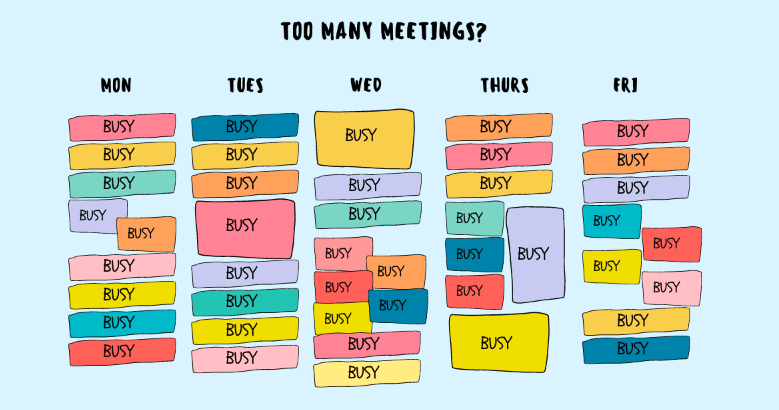
Are meetings the bane of your existence? Recently, Shopify introduced a new policy that cancels all recurring meetings with more than two people in an effort to give employees time back in their day so they can actually do work.
The company has instituted a six-hour window on Thursdays for large meetings, and they’re encouraging employees to decline other meetings, and remove themselves from large internal chat groups.
Meeting mania has been sweeping workplaces for years, and only became worse during the pandemic when Zoom became a verb that became synonymous with fatigue and eye strain.
In my old job, I probably spent anywhere from 3-4 hours a day in meetings, and my meeting schedule was considered light compared to most other managers.
In my new bridge retirement job, I have very few meetings. I just work. What a novel concept.
Here are some tips on how you can reduce the number of meetings in your work day and increase your job satisfaction:
Book shorter meeting times: try 15-minute touch bases or half-hour meetings instead of a full hour
List all the meetings where you’re just mainly listening in and not really participating. Chances are, you don’t need to be there. Decline and clear your schedule.
Have 5 or 6 items you need to ask your boss? Book one 15-minute touch base or save your questions up for a regular weekly meeting
Call or video chat people. This is an interesting one given nobody uses the phone anymore, and some people are reluctant to video chat you if you don’t have a time booked on your calendar, but often a quick 5-minute chat can get you the answers you need without another meeting filling up your calendar
Set an ideal work to meeting ratio, then stick to it. This will be highly role dependent. The ratio for a web developer for example may be 10:1 (so in a 40 hour work week, 36 hours of work to 4 hours of meeting) whereas for a Vice-President, it may be more like 4:6 (16 hours of work to 24 hours of meetings a week)
This week’s #HappyAct is to try working for a change, instead of meeting your life away.
I’ve always believed that North Americans are workaholics. As a society, we allow work to rule our lives, from our waking hours to our sleeping thoughts (see my recent blog on sleep). In my heart, I’ve always felt more European when it comes to work.
In the past five years, I’ve been encouraged to see a growing trend of countries and businesses shifting to a four-day work week.
What’s interesting is in the UK and Europe, companies adopting a four-day work week are generally working less hours than before: between 30 to 32 hours a week.
In North America, not surprisingly, companies experimenting with a four-day work week in some cases are simply proposing to eke the same number of working hours out of employees, but in four days instead of five.
The four-day work week movement 4dayweek.co.uk says it is campaigning “for a four-day, 32-hour work week with no loss of pay which would benefit workers, employers, the economy, our society, and our environment”.
The UK recently published the results of one of the largest pilot studies on a four-day work week. About 2,900 employees across the UK took part in the pilot. Calling it a “major breakthrough”, 56 of the 61 companies extended the pilot and 18 companies made the arrangement permanent.
Of employees surveyed before and after the pilot, 39% said they were less stressed, 40% were sleeping better and 54% said it was easier to balance work and home responsibilities.
The number of sick days taken during the trial fell by about two-thirds and 57% fewer staff left the firms taking part compared with the same period a year earlier.
“The vast majority of companies reported that they were satisfied with productivity and business performance over the trial period.”
In Ontario, a growing number of rural municipalities are starting to transition to a four-day week. There are now seven municipalities offering employees the option of working a four-day week, the latest being Algonquin Highlands.
The executive director of the Ontario Municipal Administrators Association says it’s easier for rural municipalities to adopt a four-day work week because they are smaller, more nimble, and have more difficulty attracting and retaining talent, so it’s to their benefit to offer more flexibility in the workplace.
In Algonquin Highlands, one group of employees works Monday to Thursday, with another group working Tuesday to Friday. All employees worked an extra hour a day. It’s been a success. As Mayor Liz Danielsen says, “There’s nothing better than having happy staff.”
This week’s #HappyAct is to start the conversation in your workplace. Ask your leaders about a four-day work week.
A few months ago, I made a decision that didn’t make me smile.
The worst part was, I knew it right away. As soon as I made it, I had that sinking feeling in my gut, but I knew I needed a change, and I resolved once I had committed to a course of action, to make the most of it and apply all my energies to making it work.
Of course it was the wrong decision. The serious reservations I had going in transpired, and it took an immediate toll on my happiness.
Luckily, I was able to extricate myself from the situation and am now in a much happier place.
Sometimes the path forward isn’t always clear. But you will always discover the right path if you make decisions that make you smile.