Reach out your hand in peace and friendship

Paris, Brussels, Lahore, Pakistan.

The world has become a bloody place.

I don’t claim to understand these terrorist acts, but I have been thinking about what drives a person to destroy human life and what we can do to turn hatred into love and acceptance.

I’ve also had a lot of different experiences in the past few weeks that continue to send these thoughts swirling in my head.

On Easter Weekend, we took Dave’s Dad to the Canadian Warplane Heritage Museum in Hamilton. There was a special exhibit on Anne Frank that detailed her journey into hiding alongside Hitler’s rise to power. It was the week of the Brussels bombing and as I stood looking at the images of the Nazis in the 1930s, it was easy to draw parallels to today and how circumstances can make otherwise good people conduct acts of horror under the philosophical banner that the end justifies the means in fighting evil.

Leaving Hamilton and arriving at Union station in Toronto during rush hour on Easter Monday for business, I tried to imagine the destruction if a bomb exploded in the station. I thought of those people in Brussels and the images I had seen on television earlier that day of the Easter bombing in Lahore, Pakistan. Years ago, I had been in London, England a month before the bombs went off at the Kings Cross tube station. We had been in that station at least two or three times a day.

When my kids ask about these terrorist acts and whether they could happen where we live, my answer is always the same. “Yes, they can, but we cannot live in fear.”

Later that night, over dinner with a friend, we talked about everything going on in the world. We both admitted despite being “good people” and wanting to accept all races, creeds, cultures, we were not above profiling people (see an earlier blog post on stereotyping kids with autism).

Then I went and saw Johnny Reid and his What Love is All About tour at the KRock Centre in Kingston. I’m a huge Johnny Reid fan. I was fortunate to sit next to him on a plane to Nashville once. He was so genuine and generous with his time I became just as big a fan of Johnny Reid the man, as Johnny Reid the musician. During the concert, he said that one of the reasons he loves Canada so much is because it is one of the few countries in the world that truly accepts and celebrates diversity. His message was clear: love is the cure for the evils of the world.

It is hard to hate someone you know. This week’s #HappyAct is to say a kind word, or reach out and offer your hand in peace, friendship and acceptance the next time you experience fear or prejudice without basis. Get to know the person. Together we can try to change the world.

A bagpiper walks into a blog

Man in kiltSpecial guest blog by David Swinton.

Ok, I’ll admit it. When my wife started this blog, I rolled my eyes and said ‘God Help Us’. Why would any person feel she is in a position to tell others how to be happier?

For a while, I even nicknamed it the ‘Crappy Act’. But personally deep down, I knew that there was no one better qualified to accomplish this mission. I have known my wife for almost 35 years. To this day, she continues to amaze me with her positive, energetic look at life. You might not always agree with her take on happiness (what the heck is an Easter Chicken anyway) but you loyal readers still come week after week to expand your happiness quotient.

When she asked me to fill in for her this week, I knew exactly what I wanted to say. After my Mom died over a year ago, I spent a lot of nights asking myself why should someone so giving of herself be taken in such a cruel manner. As with all tragic events, I started to question my own existence and where I fit into this continually evolving saga we call life. As my thoughts drifted more and more, I realized how complicated my own life had become. Between work, hockey practices, 4-H, bagpipes and the general pace of the world these days, I felt myself struggling to stay engaged. What kind of life is that? You only get one shot at it, folks.

So, in response to this, I have decided to focus at least a half hour each day to the appreciation of the simplest things in my life. One day, it might be the cardinal that has mysteriously appeared after my mother (an avid birder) died. The next day it might be the sound of wind whistling through the large pines around the house. One night I might watch a flying squirrel drift into the feeder from the darkness of the forest. The next, read a good book in a quiet corner boiling maple syrup. Laugh with your child as she pranks you for April Fools or savour a cold Corona at 10 in the morning on a hot day. Kneel down while your 9 year old shows you how intricate insect galleries under pieces of bark from a dead tree can be. Explain to her that the simplest of organisms created something this beautiful.

Your assignment this week? Put the world away for a half hour, slow down and take the time to glean a moment of pure joy from your world. And next week, enjoy while someone with actual writing talent takes back this blog.

How well do you bounce?

George Patton quoteHere’s a riddle for you. What do Taylor Swift and Wipeout have in common? They are teachers of resiliency.

My kids love Wipeout, that show where people jump from huge balls in a wacky obstacle course. Inevitably, they get knocked down, and the audience waits to see how quickly they can get back up and complete the course.

We all get knocked down in life. It’s how you bounce back, or in the words of TSwift, Shake It Off that is a real test of character. If you can develop resiliency, you’ll have far greater chance of being happy.

Here are 7 things I’ve found has helped build resilience.

  1. Always look for a silver lining. No matter how bad things are, see if you can see a positive —what did you learn about yourself or the other person if someone else is involved, or maybe just be proud of how you handled the situation.
  2. Believe all things happen for a reason. This has been a personal mantra of mine for years. It leads to acceptance faster, and then you can move on.
  3. Share the load. The first thing Dave and I do when we have a bad day is unload on each other. It’s one of the things I love most about him—that no matter what happens, I can come home and share my feelings and he will always listen and support me.
  4. Be self-aware. Take time to deconstruct what happened and why it affected you the way it did. Don’t dwell on the past, but be self-aware to learn and grow. Read my earlier post on developing emotional intelligence.
  5. Refocus on what’s important. Once you’ve deconstructed the event, focus on the future and what’s next. Set goals. Decide where you go from here and take decisive action.
  6. Recharge your batteries. When we’ve been knocked down, it takes a toll, both physically and emotionally. Take time to recharge your batteries. Go for a walk, zone out, do something that will help you get your inner strength and resolve back.
  7. Laugh in the face of adversity. This one’s easier said than done, but sometimes forcing yourself to laugh or trying to find humour in the situation can help.

This week’s #HappyAct is to think about how resilient you are. When you get knocked down, how fast do you bounce back? Try some of these tips to help build your resiliency. Leave a comment–how do you stay strong so you can bounce back?

Develop your emotional intelligence

EQI’ve been reading a lot about emotional intelligence lately. Emotional intelligence is the ability to recognize, understand and manage emotions. Studies show that people with high emotional intelligence have better mental health overall, higher job performance and satisfaction, and are strong leaders.

While I haven’t read enough about emotional intelligence to know for sure, it seems safe to reason that people who are emotionally intelligent are also happier. If you can recognize, understand and manage your own emotions and the emotions of those around you, you are far more likely to be able to connect with people and be happy with who you are.

The article, 13 Habits of Exceptionally Likeable People, lists thirteen habits of people who are emotionally intelligent that make them likeable. You can read the full article—it’s quite interesting, but for the purpose of what makes you happy, I will focus on these seven:

  • Be curious and ask questions—it shows you care, but it also pays off in dividends in terms of learning new things, understanding, and acceptance
  • Be genuine: it will make you feel confident and instill trust in others
  • Be open-minded and don’t pass judgment
  • Be consistent—people want to know what to expect from you
  • Balance passion with fun—be serious when serious is called for, but don’t be afraid to have fun
  • Use positive body language and words. Remember “how you say something can be more important than what you say” or in the words of mother Maya, people won’t remember what you say or do, but they will remember how you make them feel
  • Smile and greet people by name

Here’s the good news: we all have the capability to build our emotional intelligence. This week’s #HappyAct is to raise your emotional IQ. How well did you listen to others? Did you smile and greet people by name? Were you consistent and open-minded? Have a great week everyone.

Puzzle and colour therapy

colouring sheetOne of the hot gift trends this holiday season was adult colouring books. Yes, you heard me right, adult colouring books. The idea is you de-stress from life by sitting down and colouring, just like you did when you were a kid. I had several friends who received these books as gifts this year.

It scares me a bit that we need adult colouring books as a society, but as I started thinking about it more, I can see why they’ve become such a craze. We also love to do puzzles in our house, which is along the same lines.

There are many therapeutic benefits of colouring and doing puzzles. In a world where pens and pencils have been replaced by computer keys, the tactile enjoyment of picking up a crayon and creating beautiful combinations of colours and artful designs is immediate. And while puzzles don’t give you the same creative fulfillment, they do give you an incredible sense of satisfaction as each piece takes you one step closer to finishing the darn thing and seeing the big picture.

I think what makes colouring and doing puzzles so therapeutic is you can literally shut off your brain when you do them. We need this. We suffer from information overload. We need to take time to free our minds and let our brains zone out.

It’s an unusual rainy day in January. Look at it as a gift. A gift to give yourself permission to do nothing, be still and enjoy down time.

This week’s #HappyAct is to turn off the TV or computer today, forage into the back of that closet, and get a puzzle out or colouring book and start puzzling or colouring. Enjoy your lazy Sunday. Here are two mindless creations from our house this past week.

puzzle


The Science of Happiness Part 3: Don’t be SAD this winter

winter sunsetI came across a fascinating article the other day about Seasonal Affective Disorder (SAD). It said up to 4% of Canadians are clinically depressed in the winter. Another 10-15% suffer from SAD, most of them women.

The reasons are interesting. SAD is said to stem from the genes of our cave-dwelling ancestors who thousands of years ago would have hibernated during the winter months.

Fast forward to the average Canadian today. In November and December, we get up in the dark, drive to work as the sun is coming up, and drive home again at night in the dark. There are days when some of us literally do not see daylight. It’s incredibly unnatural and unhealthy.

I’m lucky. I’ve never suffered from any of these conditions, but I do crave sunlight during the winter months. Even doing such a tedious chore as cleaning my windows today made me feel good knowing that the warmth of the sun’s rays would wash through my sunroom during the long winter’s months ahead.

This week’s #HappyAct is to increase your exposure to sunlight. Get out for a walk at lunch. Clean your windows. Get a high intensity ultraviolet light. Do what you need to do to beat those caveman genes.

Clear some columns on the spreadsheet of life

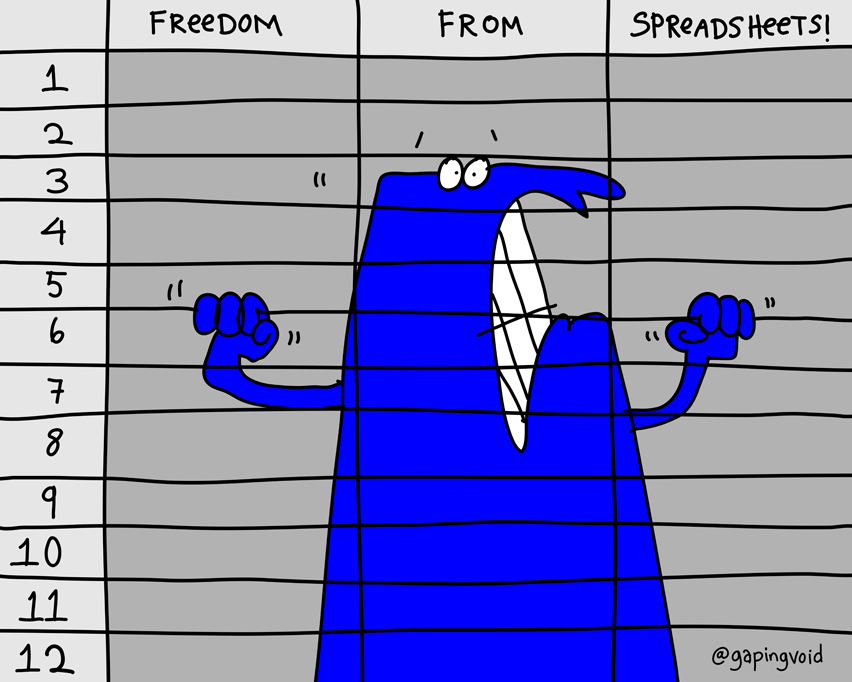
cartoon character wants freedom from spreadsheetsI don’t know about you, but I’ve been a bit too busy lately. It all came to a head this week between work, school commitments, travelling and neglecting my family. It’s time to clear some columns on the spreadsheet of life.

I think most people carry around a virtual spreadsheet in their head. Mine has columns for work, Boards I sit on, school council to dos, social events, family commitments, planning the kids summer camp schedule, stuff to do around the house…some days it feels like the columns keep multiplying.

And then the May long weekend and summer comes along. Glorious, wonderful summer. Time to slow down, kick back and relax, and grab a beer.

Being busy is good. Being busy to the point where you miss spending time with your family or are constantly thinking about work or calculating your next move isn’t good. It’s easy to make the mistake of thinking it’s the sum on the spreadsheet that counts. It’s not. It’s the joy and enrichment you get out of life from the items on the rows and columns.

So welcome summer. It’s about time you got here. This week’s Happy Act is to clear some columns on your spreadsheet of life. Live in the moment and clear your mind of everything except wondering if the beer is cold and the lake is warm enough for that first dip.

Gotta go and make a to do list—let’s see, make potato salad, buy garden plants, buy beer…

This week’s reads

If you didn’t get a chance to read last week’s blog, Take the 90/110 challenge, read it now and take the challenge. Stay safe on the roads this weekend friends.

Tired of summer taking its sweet time? Read this great Toronto Start editorial, “Star demands action: Spring, you’re late.