Imagine your dream home

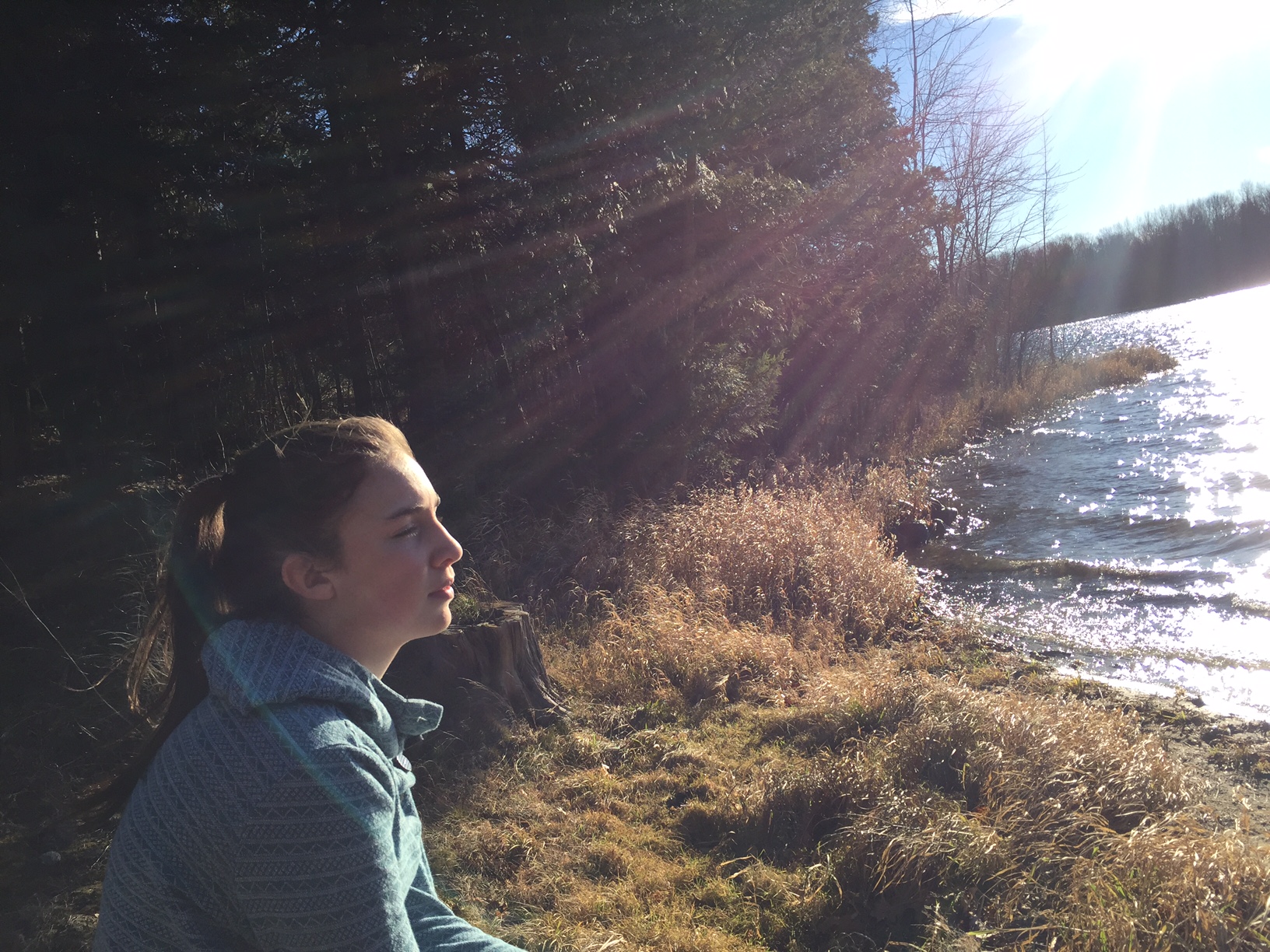
Girl looking up lakeThere’s a vacant lot up the road. It faces west, has a clearing with a charming apple tree and is surrounded by beautiful pines. It would be the perfect spot to build your dream home.

We’ve never built before and probably never will, but it’s fun to imagine…

…a quaint Cape Cod style house with a large wrap-around deck with a screened in porch to enjoy bug-free summer nights…

…beautiful English style perennial gardens, a hot tub on the back deck and a swim-up bar at the lake…

…a games room with a pool table, ping pong table, air hockey and shuffleboard…

…two bathrooms, and a bedroom with a walk-in closet…

I think that’s reasonable, don’t you? Grace on the other hand has a different dream: to build a tiny house that she’d leave on our property, but that would be on wheels so she could move if she got tired of us (our kids clearly watch too much HGTV). Clare’s dream home would have a hockey rink.

Actually, I don’t have to imagine my dream home. I’ve found it. There’s a cottage on Sydenham Lake that is absolutely stunning. I’d be happy to live in their garage.

cottage on lake
My dream house on Sydenham Lake

This week’s #HappyAct is to imagine your dream home. What would yours look like? Leave a comment, and have fun dreaming.


A bagpiper walks into a blog

Man in kiltSpecial guest blog by David Swinton.

Ok, I’ll admit it. When my wife started this blog, I rolled my eyes and said ‘God Help Us’. Why would any person feel she is in a position to tell others how to be happier?

For a while, I even nicknamed it the ‘Crappy Act’. But personally deep down, I knew that there was no one better qualified to accomplish this mission. I have known my wife for almost 35 years. To this day, she continues to amaze me with her positive, energetic look at life. You might not always agree with her take on happiness (what the heck is an Easter Chicken anyway) but you loyal readers still come week after week to expand your happiness quotient.

When she asked me to fill in for her this week, I knew exactly what I wanted to say. After my Mom died over a year ago, I spent a lot of nights asking myself why should someone so giving of herself be taken in such a cruel manner. As with all tragic events, I started to question my own existence and where I fit into this continually evolving saga we call life. As my thoughts drifted more and more, I realized how complicated my own life had become. Between work, hockey practices, 4-H, bagpipes and the general pace of the world these days, I felt myself struggling to stay engaged. What kind of life is that? You only get one shot at it, folks.

So, in response to this, I have decided to focus at least a half hour each day to the appreciation of the simplest things in my life. One day, it might be the cardinal that has mysteriously appeared after my mother (an avid birder) died. The next day it might be the sound of wind whistling through the large pines around the house. One night I might watch a flying squirrel drift into the feeder from the darkness of the forest. The next, read a good book in a quiet corner boiling maple syrup. Laugh with your child as she pranks you for April Fools or savour a cold Corona at 10 in the morning on a hot day. Kneel down while your 9 year old shows you how intricate insect galleries under pieces of bark from a dead tree can be. Explain to her that the simplest of organisms created something this beautiful.

Your assignment this week? Put the world away for a half hour, slow down and take the time to glean a moment of pure joy from your world. And next week, enjoy while someone with actual writing talent takes back this blog.

Visit a Toronto landmark before it’s too late

Honest Ed's signTwo Toronto landmarks only blocks away from each other are closing soon: the Brunswick House and Honest Ed’s.

It’s a sad end to an era.

I have fond memories of both these Toronto institutions. I remember scouring Honest Ed’s for bargains as a cash-strapped Ryerson student. Walking into Honest Ed’s was a smorgasbord for the senses. Housewares, clothing and knick knacks were crammed into every nook and cranny of the store, forcing you to walk sideways through the aisles. It was quite the place.

And then there was the “Brunny”. The Brunny was the second home for Ryerson and University of Toronto students.

We’d stake our spot at one of the Brunny’s long tables after class in the late afternoon. At that time of day, it was just the die-hard regulars drinking and talking. But by night-time, the place became a raucous party, beer hall style. By 11 o’clock, the washrooms had an inch of beer on the floor and there was a line up out the door.

You didn’t order beer by the glass at the Brunny. You ordered beer by the tray–$27 for a tray of 30 glasses. Years later, they replaced the trays of glasses with pitchers—it was never quite the same.

Brunswick house signThe best part of the Brunny by far was the entertainment. Carla and Rockin’ Irene, two old birds in their seventies would take to the stage. Irene would belt out old bar and war songs like Roll out the Barrel, and It’s a Long Way to Tipperary while Carla banged away on the piano keys. Nate replaced Carla, and the good times rolled on.

Dave and I had our first kiss coming home on the Go-train after a night at the Brunny. I often think I have The Brunswick House to thank for my marriage.

The Brunwick House closes its doors on March 31st. It’s current owner has extended an invitation to all its patrons, past and present over its 140 year history to come for one last drink and to celebrate the Brunny’s last dance.

Honest Ed’s will close its doors on December 31, 2016.

This week’s #HappyAct is to make a final trek to one of these Toronto iconic institutions. Or leave a comment sharing your favourite memory of Honest Ed’s or The Brunswick House. If we can’t make their final call, we can at least virtually raise our glass in their honour. Cheers to them and to the wonderful memories they gave us.

Be a mentor part 2: Matt’s perspective

Matt and his wifeSpecial guest blog

(Read part 1)

It took me awhile to figure it out, but, I am a writer. The longer I worked the more I realized my passion in life was with writing and communication. Since my current job involved no writing at all I was looking for a change. I didn’t want to leave my company or all of the insurance knowledge I had gained over the years, so I looked for an inside move. My sights were set on our company’s Communications area. Without any related experience or a related degree I knew it would be tough. I needed some help. That’s when I reached out to the one person I knew in the Communications area, a person I had been looking up to for inspiration for years, and asked her if she would consider mentoring me?

I had no idea what to expect when I asked Laurie if she would be my mentor. I was hoping she would accept, meet with me a few of times, give me a couple of writing assignments, and layout a rough map of what I needed to be doing to get where I wanted to be. Well, almost two years later our monthly meetings have continued and the scope of our discussions have expanded to more than the narrow field of communications.

Is this mentor – mentee relationship what I expected?

NO!

It was much, much more.

Professionally, my mentor has given me more than I expected.

  • She has shared her vast network of contacts with me.
  • Guided me on where the company is moving and where opportunities for experience and jobs will be.
  • Brought me up to speed on what industry leaders to follow and what books to read.
  • Stressed exactly the things I needed to do in our company to succeed (and have a chance at moving into the career I dream of).

Helpful? Very!

But, it was the non-professional things that had a bigger impact on me.

  • I am more motivated now then I have ever been in my work. Not only do I have that dream of moving into a communications job, but with my mentor’s support it feels like it is a realistic goal.
  • Having someone you trust, to share personal work related problems (such as conflicts with coworkers or management) is invaluable. Especially if that person, like my mentor, has been on the other side of the fence in management roles.
  • It has made me more empathetic. My mentor has changed the way I view those above me. She has allowed me to see the more human side to those in supervisory/managerial/directorial roles.

I did not expect this mentor mentee thing to cause such a monumental change in the way I feel about work, but, it definitely has. I am a much better employee in every way because of it.

This week’s #HappyAct is the a repeat of last week’s: find someone to help you grow. And thanks, Matt, it’s been a slice!

Contributing author: Mathew is a very productive and sarcastic cubicle citizen who reads way too many Dilbert comics. He blogs about his life outside of work at theplaceunderthepine.blogspot.ca.

Be a mentor

Me and my mentee MattFor the last two years, I’ve been in a mentoring relationship at work. I say mentoring relationship, because even though I think my role is technically the mentor, I’m pretty sure half the time I’m the mentee.

I knew a little bit about mentoring from some research I had done and from people I’ve known that have benefitted from having a mentor. But I had never taken the step to approach someone to help guide me in my career.

It’s been such a rewarding experience and I can safely say I’ve learned as much from Matt as Matt has hopefully learned from me. I’ve also learned a lot about myself and what I have to offer to others.

Here are some of the benefits I’ve discovered–some expected, and some quite unexpected–of mentoring.

  • In a mentoring relationship, you are constantly learning and sharing. Matt and I both blog and are involved in our kids’ school parent councils—we share ideas regularly on how to promote our blogs and council events through social media.
  • When Matt first approached me about being a mentor, my first thought was what could I possibly offer? I’ve learned that I have a lot to offer from years of experience dealing with people and issues at work.
  • Having someone you trust and can confide in is precious. Recently, I shared something with Matt that I have not shared with my team or my boss. It was something quite personal, and it felt good to be able to open up to someone who wouldn’t judge me and help me gain perspective and support me.
  • A mentor is a great sounding board. Often in our careers, we know the right course of action, but you just need a bit of advice or affirmation you’re doing the right thing.
  • A mentor can help you achieve your goals. By sharing your goals and making them “talk goals” you are far more likely to achieve them.
  • Having a mentor can also broaden your perspective and give you insights on other areas of the organization.

Tips to get the most of your mentoring relationship.

  • Meet regularly—we aim for 30 minutes each month
  • Try to set one goal or topic for each meeting
  • Trust is key—find someone who you can trust and who will respect your confidence

This week’s #HappyAct is to find someone who you can help you grow. Want to hear the flip slide? Read Matt’s perspective on mentoring next week.

Take a leap of faith and start a new tradition

Picture of woman trying to lasso a manEvery four years, we get a unique and wonderful opportunity–an entire extra day in the finite cycle of time to do whatever we want.

Leap year traditions date back hundreds of years, the most famous of which is the Irish tradition of young women proposing to their often reluctant-to-wed sweethearts on February 29th. Many other Leap year traditions follow along this same theme of women taking matters in their own hands to find wedded bliss. Here are some modern twists to Leap Year traditions for you to consider starting:

  • Say a little prayer—this tradition dates back to ecclesiastical times where a member of the clergy would say a prayer for couples contemplating marriage in case the person being proposed to said “no”
  • Throw a Leap Year party—this was a chance for women to ask a man to dance, but you can just make it an excuse to throw a once-in-every-four years blow-out bash
  • Send a card—this tradition stems back to the days when women would send postcards to men as invitations to a Leap Year party—why not send a thank you note or note of appreciation to someone you know to make their day, or have a little fun and send a note from a secret admirer
  • Buy a new pair of gloves: Queen Margaret of Scotland in 1288 required that fines be levied if a marriage proposal was refused by the man. The fine was a pair of leather gloves, a single rose and a kiss (the gloves were meant to mask the ring finger of the woman)
  • Of course, if you’re single, and there’s someone in your sights, this is your chance to go for it!

I thought I would add a few of my own Leap Year traditions to the list:

  • Brew a special batch of Leap Year beer or if you’re a winemaker, Leap Year wine to imbibe throughout the year
  • Declare Feb 29th Reverse Roles day. If you have kids, make them the parents—tell them they can make all the decisions about what you eat and do that day. If you’re in a relationship, switch roles—whatever household duties you’d normally do, switch with your partner
  • And my personal favourite: lobby the government to declare Feb 29 a National Holiday so we can truly gain an extra day in the year to do whatever we want (who’s in?)This week’s #HappyAct is to adopt one of these Leap Year traditions or start your own. How will you celebrate Leap Year? I’m off to buy new leather gloves. Leave a comment.

How well do you bounce?

George Patton quoteHere’s a riddle for you. What do Taylor Swift and Wipeout have in common? They are teachers of resiliency.

My kids love Wipeout, that show where people jump from huge balls in a wacky obstacle course. Inevitably, they get knocked down, and the audience waits to see how quickly they can get back up and complete the course.

We all get knocked down in life. It’s how you bounce back, or in the words of TSwift, Shake It Off that is a real test of character. If you can develop resiliency, you’ll have far greater chance of being happy.

Here are 7 things I’ve found has helped build resilience.

  1. Always look for a silver lining. No matter how bad things are, see if you can see a positive —what did you learn about yourself or the other person if someone else is involved, or maybe just be proud of how you handled the situation.
  2. Believe all things happen for a reason. This has been a personal mantra of mine for years. It leads to acceptance faster, and then you can move on.
  3. Share the load. The first thing Dave and I do when we have a bad day is unload on each other. It’s one of the things I love most about him—that no matter what happens, I can come home and share my feelings and he will always listen and support me.
  4. Be self-aware. Take time to deconstruct what happened and why it affected you the way it did. Don’t dwell on the past, but be self-aware to learn and grow. Read my earlier post on developing emotional intelligence.
  5. Refocus on what’s important. Once you’ve deconstructed the event, focus on the future and what’s next. Set goals. Decide where you go from here and take decisive action.
  6. Recharge your batteries. When we’ve been knocked down, it takes a toll, both physically and emotionally. Take time to recharge your batteries. Go for a walk, zone out, do something that will help you get your inner strength and resolve back.
  7. Laugh in the face of adversity. This one’s easier said than done, but sometimes forcing yourself to laugh or trying to find humour in the situation can help.

This week’s #HappyAct is to think about how resilient you are. When you get knocked down, how fast do you bounce back? Try some of these tips to help build your resiliency. Leave a comment–how do you stay strong so you can bounce back?

Develop your emotional intelligence

EQI’ve been reading a lot about emotional intelligence lately. Emotional intelligence is the ability to recognize, understand and manage emotions. Studies show that people with high emotional intelligence have better mental health overall, higher job performance and satisfaction, and are strong leaders.

While I haven’t read enough about emotional intelligence to know for sure, it seems safe to reason that people who are emotionally intelligent are also happier. If you can recognize, understand and manage your own emotions and the emotions of those around you, you are far more likely to be able to connect with people and be happy with who you are.

The article, 13 Habits of Exceptionally Likeable People, lists thirteen habits of people who are emotionally intelligent that make them likeable. You can read the full article—it’s quite interesting, but for the purpose of what makes you happy, I will focus on these seven:

  • Be curious and ask questions—it shows you care, but it also pays off in dividends in terms of learning new things, understanding, and acceptance
  • Be genuine: it will make you feel confident and instill trust in others
  • Be open-minded and don’t pass judgment
  • Be consistent—people want to know what to expect from you
  • Balance passion with fun—be serious when serious is called for, but don’t be afraid to have fun
  • Use positive body language and words. Remember “how you say something can be more important than what you say” or in the words of mother Maya, people won’t remember what you say or do, but they will remember how you make them feel
  • Smile and greet people by name

Here’s the good news: we all have the capability to build our emotional intelligence. This week’s #HappyAct is to raise your emotional IQ. How well did you listen to others? Did you smile and greet people by name? Were you consistent and open-minded? Have a great week everyone.

Love in the workplace

Tomorrow, most of us will go back to work after some much deserved time off. Not a single person I asked this year had a new year’s resolution about work and yet global employee engagement is at an all time low.

A 2015 Gallup study showed just 13% of employees are engaged in their workforce. Gallup defines employee engagement as employees being involved in, enthusiastic about and committed to their work and workplace. The remaining 87% of employees are either not engaged or indifferent–or even worse, actively disengaged and potentially hostile to their organizations.

What if we had more love in the workplace? Not romantic love, but the supreme emotion of love that affects how we feel, think and motivates us to act.

One leadership expert, Mark Crowley thinks love is the answer. In his Fast Company post, “Why engagement happens in employees hearts, not minds, Crowley says while traditionally using the word “love” in the context of the workplace has been taboo, when people feel cared for, nurtured and growing they will serve the organization well.

Another fascinating thing Crowley discovered in his research is “while people used to derive their greatest sense of happiness from time spent with family and hobbies, how satisfied workers feel in their jobs now determines their overall happiness with life. This monumental shift means that job fulfillment has become essential to people everywhere.”

I think employee engagement boils down to this. Your pay cheque is what makes you show up for work every day. What you do with your time when you’re there depends on four things:

  1. the degree to which the work you do is aligned to your passion and strengths
  2. the relationships you have at work and the “love” factor Crowley talks about
  3. how much you believe and are committed to the purpose of the organization,
  4. and what I call the “negative quotient”: the degree to which negative factors at work affect your ability to succeed. This can be anything from office politics to feelings of anxiety around change or direction to not having access to tools or resources to help you do your job (what experts call being “enabled” when defining sustainable engagement)

Employee rewards are important for attracting and keeping good talent, but not necessarily motivating people. Only people and love can motivate people.

If you have five minutes, read his full post. There are some great basic nuggets in the article: companies only focused on profits without a compelling mission will inherently neuter employee engagement and the importance of recognizing people.

This week’s #HappyAct is to love your co-workers and the people at work. And if I don’t say it enough to my team: thank you for everything you do. I think it’s a miracle you show up at work every day and do the amazing work you do. I love you all.

Best happy acts of 2015

Best of 2015 graphicSomeone once said you need to focus on the future, not the past, to be happy. While I think there is some truth in this statement, I think reflecting and learning from the past is valuable.

So in the spirit of reflection, here’s my Eleven Best Happy Acts of 2015 (once again eleven “for that extra push” in the immortal words of Nigel Tufnel). Most of these should inspire, but some are just for fun!

  1. Host your own awards show—with awards show season upon us, this is a great activity to do with the family or at a party.
  2. Listen with your heart—with 24 comments, this post struck a chord and sparked a debate about being self-absorbed and managing expectations in the selfie age.
  3. Whistle while you work—from guest blogger Matt Smith on the importance of being happy at work.
  4. The best investment you can make—and more pearls of wisdom from Warren Buffett, just in time for RRSP season.
  5. Make a pilgrimage to Cooperstown—my friend and guest blogger Ray Dorey wrote this before the Blue Jays came oh so close to reviving our dreams of ’85 and bringing baseball fever to a new pitch. Plan to visit in 2016.
  6. A twist on 13 things you must give up to be happy—an important lesson on reframing thoughts.
  7. Rise and shine—if January finally heralds winter winds and snow, this post will transport you back to warmer days.
  8. The science of happiness-part 2—answers the question, who do you think is more happy, lottery winners or parapalegics?
  9. Marriage is a life sentence—makes me think of my father-in-law, John Swinton every time…and smile.
  10. Diss the dis in disability—an invaluable lesson from the creators of Sesame Street. Make this your New Year’s resolution for 2016.
  11. Does being a leader make you happy? An important question. See more comments on this page on Quora.

This week’s #HappyAct is to catch up on any happy acts you missed in 2015 and look forward to happiness in 2016. Happy New Year everyone and thanks for reading!