Findings from the 2025 World Happiness Report

man sharing a meal in Africa with others

The 2025 World Happiness Report was released on March 20, the International Day of Happiness. The first World Happiness Report was published in 2012 after Bhutan, a country that measures its success based on the happiness of its people urged the UN and national governments to “give more importance to happiness and well-being in determining how to achieve and measure social and economic development.”

Since then, the report has been measuring which countries in the world have the happiest citizens and exploring various themes related to global happiness including age, generation, gender, migration, sustainable development, benevolence, and the effects of the COVID-19 pandemic on global well-being.

As always, the results of this year’s report are fascinating (you can read the full report here.) The authors chose the theme “Caring and Sharing”, delving into how caring and sharing and specifically three benevolent acts, donating, volunteering and helping strangers can make people happier.

The Happiest Countries

Finland ranked #1 for the eighth year in a row while Canada ranked 18th. The US fell off the list of the top 20 happiest countries to #24. One troubling statistic is that in general, the western industrial countries are now less happy than they were between 2005 and 2010 with the US, Canada and Switzerland experiencing the biggest drops.

Here are the top 20 happiest countries in order:

Finland
Denmark
Iceland
Sweden
Netherlands
Costa Rica
Norway
Israel (if you’re wondering about Israel, it scored highest in several areas, including the quality of social connection amongst youth)
Luxembourg
Mexico
Australia
New Zealand
Switzerland
Belgium
Ireland
Lithuania
Austria
Canada
Slovenia
Czechia

Key findings

Beyond health and wealth, simple acts of caring and sharing can influence happiness, including sharing meals with others, having somebody to count on for social support, and household size.

  • While it’s well documented that people who live alone are unhappier, research shows that happiness rises with household sizes up to four people, but above that happiness declines.
  • We are too pessimistic about kindness in our communities, and this pessimism is contributing to our unhappiness. For example, when wallets were dropped in the street by researchers, the proportion of returned wallets was far higher than people expected.
  • One interesting piece of research and a positive from the global pandemic is we’ve seen a “benevolence” bump of 10% since COVID-19. The pandemic taught us to think and care for others more, and that benevolence has continued.
  • One disturbing trend is young people in North America and Western Europe now report the lowest well-being and happiness among all age groups. In 2023, 19% of young adults across the world reported having no one they could count on for social support, a 39% increase compared to 2006. In fact, the fall in the United States’ happiness ranking is largely due to the decline in well-being among Americans under 30.
  • When society is more benevolent, the people who benefit most are those who are least happy. As a result, happiness is more equally distributed in countries with higher levels of expected benevolence

So what does this year’s report tell us and what simple happy acts can we all do to promote caring and sharing?

  • Share meals together: people who eat frequently with others are happier
  • Be kind and don’t underestimate the kindness of others
  • Try not to live alone
  • Build social connections and don’t be afraid to reach out to people
  • Practice benevolent acts–do what you can to volunteer, donate or help a stranger (several African countries reported low scores for donating but scored very high for helping strangers which helped their happiness scores)

Finally remember that caring is “twice-blessed”: it blesses those who give and those who receive. Have a happy week.

The happiness number in 2024

Denzel Washington quote: "Money doesn't buy happiness. Some people say it's a heck of a down paymen though."

In 2010, Gallup published a study asking Americans what amount of income would make them happy. The answer was $75,000 (USD).

In a new study released this summer, Americans were asked what amount of money would make them feel content, as measured by their liquid net worth. 56% of Americans responded $200,000.

This amount would give them enough of a safety net, peace of mind, and presumably extra funds to pursue their interests and passions.

Millennial respondents said that they would be more content with a higher salary job, whereas Gen Z respondents preferred having a higher liquid net worth. The average salary in the United States at the end of 2023 was $59,384.

So what’s our takeaway here?

As families grapple with the higher cost of living, it’s getting harder and harder to maintain a financial cushion, and yet having that cushion helps alleviate stress, anxiety, and contributes to our overall happiness.

To maintain that cushion, we may need to change our spending habits. It’s more than about dollars and cents. It’s about happiness and common sense.

What’s your happiness number? Leave a comment.

Finding happiness in the me age

girls taking selfies at a garden

They say the road to hell is paved with the best intentions. For almost a decade now, I’ve been blogging about happiness. I started this blog as an outlet for my writing and because I was fascinated by the juxtaposition of people living in a world with so much wealth, but struggling more than ever to be happy.

I’ve learned much about what makes me happy, the science of happiness and the intrinsic benefits of having purpose, showing gratitude and helping others.

I now fear instead of helping people live a happier life, I’ve contributed to the navel-gazing narcissistic culture our society has become.

Forget the #MeToo movement. We’re living in the age of #JustMe.

I know what you’re thinking. Every generation has claimed that the next generation is more selfish and self-absorbed than they were. Perhaps, but the advent of computers, cell phones, celebrity culture and the seismic shift in how we work and play in the past fifty years has propelled us into a whole new level of egocentricity.

Honestly, if I see another selfie of a 20-something posing sideways in front of a bathroom mirror holding up their cell phone with pouty lips, accentuated hips, and frosted tips, I think I’m going to lose it.

And don’t even get me started on the hyper-focus on resilience. Try telling a farmer living a hundred years ago in rural Canada with six mouths to feed and no running water you’re taking a break to “practice self-care” or going on a “forest therapy walk”, they’d mock you until their cows came home.

A sad and disturbing product of this #JustMe movement is we all have become more polarized in our views and unaccepting of other people’s opinions. What’s more, we don’t hesitate to share our views in the most public of forums. “We” are always right and everyone else is wrong.

It’s time we went from taking selfies to choosing selflessness, from practicing self-care to caring for others.

It was Ghandi who said, “The best way to find yourself is to lose yourself in the service of others.”

This week’s #HappyAct is to change the #JustMe narrative and find happiness by looking outward instead of in.

How to be a happy shopper this Black Friday

black friday poster

Black Friday and the holiday shopping season is upon us. Canadians are being lured by savvy marketers with promises of up to 70% off, Black Friday Deals and Super Savings you can’t pass up.

While some people refuse to cave to the consumerism of the season, most of us succumb to varying degrees to the shopping craze this time of year.

Which begs the question. Does retail therapy make people happy? The science shows the answer is yes.

A 2014 study from the Journal of Consumer Psychology found that retail therapy not only makes people happier immediately, but it can also fight lingering sadness. 

Even just the anticipation of making a purchase or treating ourselves to something we desire releases dopamine, the hormone neurotransmitter in our brain that makes us feel good. 

The choices we make when shopping can restore a feeling of personal control and autonomy which helps in fighting feelings of sadness and anxiety over the things that are outside of our control in the world.   

In another 2014 study by University of Michigan, researchers showed that purchasing things you personally enjoy can be up to 40 times more effective at giving you a sense of control than not shopping, and those who actually purchased items were three times less sad when compared to those who only browsed.

Shopping also stimulates our senses, creating pleasure, especially this time of the year when the stores have festive displays and merry music playing.  

But before you go filling up your virtual or actual shopping cart, remember these caveats. For every instant hit of pleasure, there is a corresponding pang of potential regret when it comes time to pay the bills. You need to calculate whether the pleasure from the purchase would exceed the pain from the cost, and whether you can afford the purchase at all.

The Journal of Consumer Psychology study showed that even just the act of filling up your online shopping cart, then abandoning it, can create the same pleasure as if you had actually made the purchase.

In the end, spending less money may be more rewarding.

This week’s #HappyAct is to be a smart, savvy and happy Black Friday shopper. Find a few bargains and enjoy the small hit of dopamine, but don’t do anything you’re going to regret later.

Special #HappyAct Experiment: Go online this week to one of your favourite retailers and fill up your shopping cart with a bunch of items, then close down your browser without making the purchase. Did you feel happier just browsing? Leave a comment!

One simple thing you can do starting today to be happier

I’m a huge fan of TedTalks. Recently, I stumbled across one on the science of smiles by Ron Gutman, a professor from Stanford University whose mission is to help everyone live happier, healthier lives.

Gutman talks about a 30-year old study from the University of Berkeley, California that looked at old photos in school yearbooks and measured the success and well-being of the graduates throughout their lifetime based on their smiles. The students with the biggest smiles tended to lead more successful, well-rounded lives.

Another study involved looking at old baseball cards and the longevity of the ball players in correlation to the smiles on their cards. The ball players with the biggest smiles lived the longest.

Gutman says one-third of people smile more than 20 times a day, but sadly 14% of us smile less than 5 times per day. Children smile more than 400 times per day.

He claims smiling creates the same positive brain stimulation as eating up to 2,000 bars of chocolate!

Smiling is one of the most basic expressions of humans and something we all do every day.

This week’s #HappyAct is to make a conscious effort to smile at least 20 times a day this week and if you see someone sad, struggling or frowning, ask what’s wrong, tell them a joke, or do something to put a smile on their face.

Watch the full Ted Talk, the Hidden Power of Smiling.

Take this simple positivity test and remember the magic number

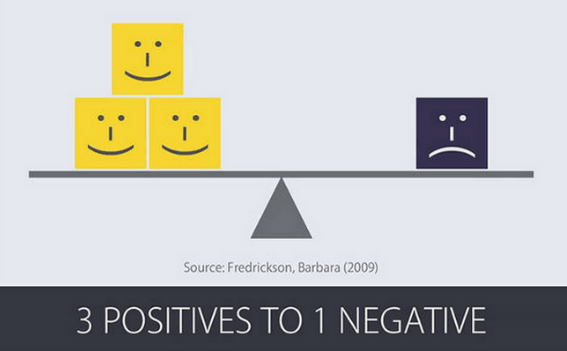
three smiling boxes and one frowning box

What if I told you the secret to happiness and success is a line and a number?

The line is called the Losada line and the number is 2.9013 which is the ratio of positive to negative interactions you need to have to be happy and successful. Simply put, you need to have at least three positive interactions to every negative one to be happy.

The Losada line and ratio came out of a study done in 2005 by two psychologists, Marcial Losada and Barbara Fredrickson who analyzed the interactions of management teams and how successful they were. The mathematical formula they used was subsequently challenged and discredited by some experts, but many psychologists still cite their work and adopt the principles of the Losada line in sport, business, and to help individuals achieve positive mental health.

They found if teams generate more than 2.9013 positive feelings, emotions or interactions to every 1 negative feeling, emotion or interaction, the team has positive energy needed to feel good about themselves and flourish. A 5:1 ratio is a culture everyone wants to be part of. Teams below the Losada line of 2.9013 have a deteriorating culture, and at 0.73 to 1, the team culture destructs.

In another study, Dr. John Gottman looked at similar research in marriages. Gottman claims he can predict divorce with 90% accuracy by counting the number of positive versus negative interactions a couple has.

In marriage, the magic ratio is 5:1 (why the ratio is higher in marriage is an interesting question, presumably because marriage is hard and there are two individuals’ happiness at stake!)

Happy couple have at least 5 positive interactions for every negative one. You can read more about Gottman’s study and the types of positive interactions between happy couples here.

This week’s #HappyAct is to take the personal positivity test and strive to increase your personal to negative interactions to 3:1 or higher. Gottman also has a quiz on his website called “How Well Do You Know Your Partner” (note you have to provide your email address to get the results emailed to you but a summary pops up on the screen as soon as you provide your email).

And don’t worry if you score low initially on the personal positivity test. I expected to because I’m at home nursing a broken ankle right now. Think of it more as a check in with how you’re feeling, then start working towards improving your positive interactions and on a path to better mental health and happiness.

You’ve got a friend

Author and her best friend

There are no words to describe the comfort of a friend. Friends console us when we’re down. They are a sympathetic ear when troubles weigh heavy on your heart and the first person to say I believe in you. You will overcome this.

They share in life’s joys, sorrows and celebrations. They are the person you turn to when you need a hug, or someone to listen without judgement, or just want to share a laugh or what’s on your mind. They love you unconditionally, warts and all. Without them, we’d be lost.  

It’s a scientific fact that having one good friend has a significant impact on happiness. It’s not surprising having a friend increases your happiness in good times, but it’s been proven that having a friend is critical during times of stress when you need help.

In his New York University course The Science of Happiness, Dr. Alan Schlechter lectures about the “tend and befriend” response. The cousin to the fight or flight response, the tend and befriend response is when the hormone oxytocin, induced by stress tells us to reach out for help. When we reach out to a friend, our cortisone level goes down and we feel better.

They say you’re lucky to have at least one true friend in your lifetime. I’ve been fortunate enough to have two, my best friend Leslie and my husband Dave. Thanks for being my rock, guys. I love you both.

This week’s #HappyAct is to tell your best friend how much they mean to you.

Author and her other best friend, her husband

Happy? New Year–try going for joyful and hopeful instead

There are two sayings we bandy about at this time of year: Merry Christmas and Happy New Year.

This year as I was writing out Christmas cards, I found myself naturally avoiding those usual seasonal sayings and writing sentiments instead like, “Joyous wishes” and “I hope you can find moments of joy” for friends who had lost loved ones in this particularly difficult year.

Alan McPherson, a retired minister with the Central Presbyterian Church in Hamilton says there is a difference between happiness and joy. “Happiness is an emotion. Joy is deeper, more long-lasting. It is based more on inner certainties, not external events.”

Who knows what the new year will bring. With the second wave of COVID-19 still having an icy grip on the country and most regions in lockdown, happier times seem a way off. But we can always find joy each day in simple acts. Curling up with a good book. Catching up with an old friend. Going for a walk on a bright wintry day and hearing the snow crunch underfoot.

Yes, we can always find joy. And we always have hope.

Have a joyful and hopeful New Year everyone.

The year in review: my favourite happy acts from the year of COVID

Two girls graduating

Each year at this time, I select my top ten favourite blog posts for my annual year in review.

I was a bit worried this year that pickings would be slim. Truth be told blogging about happiness during a global pandemic is a bit of a tough slog. With little prospects for fun excursions, and at times struggling with my own mental and physical health, there were many weeks when I wondered what simple act could I share this week to make the world a happier place?

But as I re-read the posts two things hit home. You can feel moments of happiness and gratitude at the most unexpected times and by doing the simplest of acts.

The other realization was happiness cannot be viewed in isolation. We are vastly impacted by events happening around us. My blog this past year has been as much a reflection and chronicle of the times as anything else.

Here were my favourite happy acts from a year that will go down in the history books as a year to remember:

There you have it. Another year under the bridge, another year of happy acts. Here’s to a happier 2021 for us all.

Living a life of no regrets

I had an interesting conversation with a friend the other night about regrets and the impact they have on our lives and relationships.

Regret is a negative emotion, but it can have positive outcomes. It can give us insight and help us make sense of the world and our place in it, and impel us to make positive changes in our lives.

Left to fester, however, regret can make us doubt our decisions and path in life, and create a devalued sense of self-worth. It may lead to us withdrawing within ourselves and to feelings of unhappiness and depression.

We can regret actions we’ve taken, or actions we didn’t have the courage to take.

It was a heartfelt conversation, and my friend and I learned this the other night about dealing with regret:

  • First, it’s never too late. It’s never too late to say I’m sorry, to reach out, to take action.
  • Accept that sometimes life has its own plan and your path is where it decides to take you.
  • When it comes to regret and relationships, know that the other person’s perception of what happened may be completely different than yours.
  • Forgive yourself, forgive others and move on. We are all human, we make mistakes.

No one lives a life of no regrets. If someone says they have no regrets, they’re lying. But hopefully our regrets are few and we’ve learned from them.