If I had one wish for 2024, it would be for the world to be more compassionate.
Yesterday when we were driving to Cobourg for hockey, there was a person driving a bit erratically. As we passed them on the highway, I looked over, expecting to see someone on their phone and noticed they looked distressed.
We started talking about a post we’d seen on our local community Facebook group about high beams. Someone posted an apology to people driving on the highway the night before, saying they just had their new car in for servicing and something happened and they couldn’t unlock their high beams so they were blinding everyone on the drive home. Apparently it’s a known issue with a certain make and model of car.
I can only imagine how many people that night were cursing under their breath, calling them an a**hole and worse, thinking they were doing it on purpose or were just a bad driver.
It’s a good reminder that you never know what is going on in a person’s life and to be compassionate.
So the next time someone is short with you or does something that ticks you off, remember they may be having a bad day or fraught with worry, or something else may be going on that deserves your compassion instead of your censure.
I’m a huge fan of TedTalks. Recently, I stumbled across one on the science of smiles by Ron Gutman, a professor from Stanford University whose mission is to help everyone live happier, healthier lives.
Gutman talks about a 30-year old study from the University of Berkeley, California that looked at old photos in school yearbooks and measured the success and well-being of the graduates throughout their lifetime based on their smiles. The students with the biggest smiles tended to lead more successful, well-rounded lives.
Another study involved looking at old baseball cards and the longevity of the ball players in correlation to the smiles on their cards. The ball players with the biggest smiles lived the longest.
Gutman says one-third of people smile more than 20 times a day, but sadly 14% of us smile less than 5 times per day. Children smile more than 400 times per day.
He claims smiling creates the same positive brain stimulation as eating up to 2,000 bars of chocolate!
Smiling is one of the most basic expressions of humans and something we all do every day.
This week’s #HappyAct is to make a conscious effort to smile at least 20 times a day this week and if you see someone sad, struggling or frowning, ask what’s wrong, tell them a joke, or do something to put a smile on their face.
Recently, I’ve moved to a four-day work week. Dave started working four days a week a year ago. It’s all part of our plan to eventually transition into retirement.
I’ve worked a four-day week one other time during my career. It was a short span of three months when the kids were little and we had many doctors and other medical appointments. It was a lifesaver—the perfect mix of having a rewarding, vibrant career, but having enough time to focus on my family and friends and get things done at home.
I can tell you I already feel a difference in both my mental and physical health.
I feel more well-rested, my brain feels like it has more space to breathe, and I’m taking time more slowly.
I’m no longer rushing through the weekend, trying to squeeze in a million things before Sunday night arrives and I have to steel myself up to do it all over again.
I’m making more plans to do the things I want to do, whether it’s having a coffee on a Friday with a friend (a luxury!), tackling a project, a long weekend away, or just spending time with Dave on little day trips here and there.
I’m getting more exercise and already feeling the positive benefits of not sitting at a desk 8 hours a day which has increasingly become more difficult and painful over the past several years.
Yes, I’m liking this four day a week thing.
Now if only more employers would wake up and realize the benefits of a four-day work week and make it happen. The world would be a happier place.
The photo above is a picture of me and my girlfriend Barbara on one of my first three-day weekends this summer when I went to visit her in Thornbury. Read about our day at the Thornbury Cider Company to see the Clark Drag Show
I’m fine and Dave and the girls are fine, but there are just too many people I care about that are getting kicked in the teeth by life right now. It’s making me feel overwhelmed and helpless.
So what can you do when your happiness is being crushed by a heavy heart?
Hug your loved ones and tell them you love them every day.
Have a good cry if you need to.
Be grateful for friends, family, and the people who will be there when you need them most.
Try to find solace in the smallest joys and moments.
And bake a lot of banana bread*.
My heavy heart goes out to all of you right now, you know who you are.
*The banana bread reference is a funny story worth sharing to end this week’s blog with a smile, even if it is a sad smile. When my sister-in-law MaryAnne was sick, I brought food over every week for her and Mac. Their wonderful neighbours in Westport also dropped off meals and baked goods regularly. One day when I showed up with soup and some cookies, Mac said “As long as it isn’t another f**kin banana bread!”
On Friday, when the temperatures were forecasted to soar into the thirties, I said to Dave, “I’m calling a cottage day”.
You don’t need to actually own a cottage to call a cottage day. A cottage day is when you pretend you are at somebody else’s cottage, where there’s no laundry or chores calling your name and you spend the entire day lounging around, relaxing on the deck reading books, playing games, eating and drinking.
It’s a day where you give yourself permission to do whatever you want and not even think about housework or chores.
I slept in, read a magazine while eating my breakfast, did a few things around the house, then headed to the lake. I read my book on the dock, threw the ball endlessly for Benny in the lake, went for a long paddle and three long swims, before heading up to have lunch on the back deck.
After lunch, I took a nap in the screened porch, then we went to our local farmer’s market to stock up on fresh greens and bread for dinner. It was exactly what I needed and the perfect panacea after a busy week and month.
Years ago, after we got married, Dave and I had the great debate. Do we save and buy a cottage property, or buy a home on the water? Two big factors swayed us to our decision to buy a year-round waterfront home.
The first was we were both absolutely useless at home renovations, repairs and maintenance. The idea of maintaining two properties was just not in the cards for us.
The second was our decision to move out of the Greater Toronto Area to north of Kingston where lakefront properties abound. We made it a goal the minute we moved down here to own lakefront and bought our little piece of paradise six years later and have never looked back.
Now Dave’s favourite thing is to go fishing on Sunday nights after supper. When we’re out on the boat, he always says the same thing. “If we were up at a cottage, we’d be stuck in traffic right now driving back to the city.” Then he casts his line into the still waters, the setting sun casting a warm glow behind him, and turns to me and smiles.
The perfect end to the perfect cottage day.
This week’s #HappyAct is to call a cottage day. Enjoy!
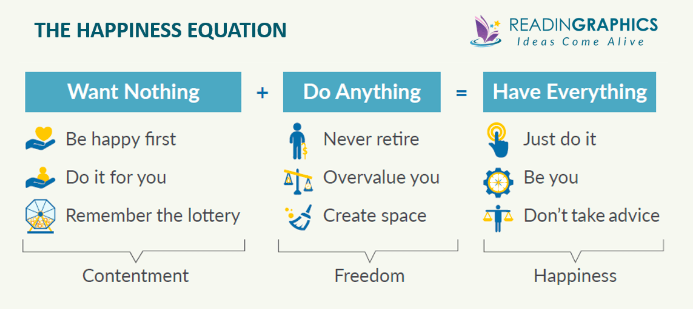
I’ve just finished reading two books, Neil Young’s biography Wage Heavy Peace and Neil Pasricha’s New York Times Bestseller from 2016, The Happiness Equation.
Both were great reads and even though they were very different books, the authors shared a common message: to be happy and successful in life, you have to do it for you.
I didn’t know much about Neil Young before I read his biography, other than he grew up in Omemee (pronounced Oh-me-me) outside of Peterborough and of course his music, since I’m a big fan.
To say he’s led an interesting, incredible life is an understatement, but I was surprised to learn of all the health challenges, personal tragedy and struggles he’s shared in his life from polio as a child, to back surgeries, grief and loss.
Throughout, music has been his inspiration, solace, escape and passion. I wasn’t aware of his other passions in life–his love of old cars, model trains and his quest to revolutionize sound by developing technology to restore the purity of records through his company Pona and interest in electric vehicles through his Lincvolt project. What an amazing guy.
Did he pursue any of these things because his record labels wanted him to, or to sell records or ingratiate himself with fans? No, he did it for himself.
Young insisted on festival seating for all his indoor shows, even though it meant less money for the band because he wanted people who were stoked to be there at the front of the stage instead of “rich folk on cell phones”, saying the feeling of the shows and experience for the band and audience was much better. He once had his manager rewrite the contracts for a tour already booked because they hadn’t included festival seating.
A writer once accused him of compiling his archives just to further his own legend “whatever that is”. He writes, “What a shallow existence that would be…” and then in classic Neil Young fashion, “it pissed me off.”
In The Happiness Equation, Parischa openly admits he was a victim of his own success early in his career, equating happiness with more book sales, speaking engagements and the number of hits on his blog.
Parischa talks about intrinsic and extrinsic motivators, saying the happiest people are driven by intrinsic motivation. They eschew the critics, the pressure to do what others want them to do, and they forge their own path. He quotes John Lennon who once famously said, “I’m not judging whether ‘I Am the Walrus’ is a better or worse than ‘Imagine’. It is for others to judge. I am doing it. I do. I don’t stand back and judge…I do.”
This week’s #HappyAct is to take it from the Neils and do it for you.
Sometimes you find inspiration in the least likely of places.
I often glance at the obituaries in my local newspaper. This morning, I was reading the obit from an accomplished doctor, Dr. Nicholas Evans. The caption under his photo read, “I have used my days well.”
He was Chief of Gastroenterology at The Toronto Western Hospital and a world leader in the research of the gut-brain interaction. What struck me the most was the majority of the column was devoted to his family and life outside of work. One paragraph in particular captured my attention.
His family wrote, “He shared his life-long belief in the ‘Joy/Crap’ ratio with generations of family, friends and colleagues in need of guidance. Everything in life can be distilled down to one simple question—does the crap outweigh the joy? If so, you have your answer, follow the joy, ditch the crap and change what you can to ensure the joy always outweighs the crap.”
So my friends, what is your crap/joy ratio? This week’s #HappyAct is to make one change to achieve a healthier ratio. Ditch the crap. Find the joy.
And if you need a smile, along the same vein of dealing with life’s crap:
Sharing a pot of tea is a ritual in many cultures. My family has a British-Australian background so I learned how to make a decent cup of tea early on, and our family often made a pot of tea after dinner. My husband’s family is Japanese and my late mother-in-law’s green tea set is a cherished possession in our house, a connection to someone very dear to us.
Morning tea in Australia and New Zealand is a daily tradition at 10:30 or 11:00 am. It is a break at school or work when everyone pauses for a cup of tea (or coffee) and a biscuit or small snack. It is a time to make announcements, welcome new employees, give a shout-out to someone who deserves it, or have a friendly chat with colleagues. Even on a road trip Australians will have a morning tea break with a thermos of tea at a roadside picnic table. No Tim Hortons drive-thru for the Aussies!
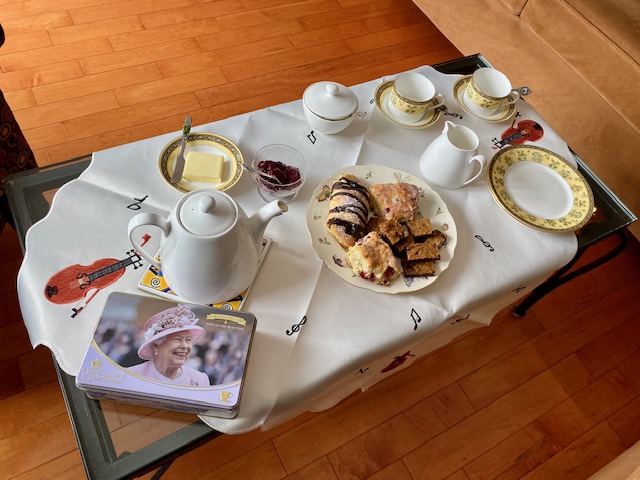
Tea is a beverage used to comfort others, a way of saying “everything will be alright”. The acts of boiling the kettle, warming the teapot, letting the tea steep, stirring the tea in the cup are comforting. Teatime reminds us of civility and of the late Queen Elizabeth II who many people viewed in a grandmotherly way. Problems big and small can be shared and solved over a cup of tea and a biscuit.
I have a friend who suffered a loss over the holidays. I wanted to offer her some comfort and a chance to sit and relax for a bit. It was fun for me to assemble a plate of sweet treats, get out all my finest teacups, saucers and spoons, and open up the tin of English tea that was a holiday gift.
We whiled away the afternoon with warm tea and conversation while the cold winter snow piled up outside the door. In a busy, chaotic world the tradition of sharing tea is just one way to maintain connections with friends. Consider it part of the shared effort that one puts into relationships that makes them cherished and lasting, and a way of showing that we care.
On these grey, dreary wintry days, I find I have to really work hard to keep smiling.
As I hunker down for the long wait for spring, I bake! Sure, the calorie count exceeds the daily recommended limit, but I try to offset it with morning winter walks.
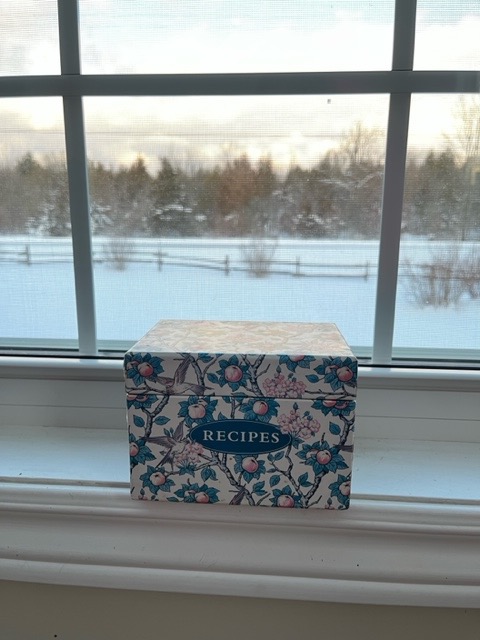
I love trying new recipes and my husband is happy to be the test taster. I search the internet for yummy recipes or go to my recipe box for the old faithfuls from my childhood.
Cookies, squares, cakes. All good! Sometimes that little hit of sugar gives you the boost you need to make it through the winter blues.
So preheat your oven to 350F, grease the cookie tray, and start mixing up some yummy goodness for you and your family to enjoy and get you through those long winter days.
Light as a Feather Gingerbread Cake
½ cup boiling water ½ cup shortening ½ cup brown sugar ½ cup light molasses 1 egg 1 ½ cup flour ½ tsp salt ½ tsp baking powder ½ tsp baking soda ¾ tsp ginger ¾ tsp cinnamon
Directions: Pour hot water over shortening. Add sugar, molasses, egg and beat well. Add sifted dry ingredients. Beat well until smooth. Bake in a 8” square pan at 350 degrees for 35 minutes. Serve with whipped cream and fresh strawberries (optional).









 Happy Act