
The one skill you’ll need to succeed in an AI world

robot looking at blackboard

As a communications professional, I’ve always believed my greatest skill was the ability to listen and ask questions.

It has served me well in my career. In the age of artificial intelligence, I predict the ability to ask good questions will become the most important skill crossing nearly every profession.

In case you haven’t experimented with ChatGPT or any of the AI programs yet, the way it works is you ask a question, and the program uses machine learning to generate information. Just like any program, the quality of the output is 100% determined by the quality of the input. The more detailed, descriptive and targeted the prompt, the more accurate and helpful the result.

The possibilities are endless, just like the number of results you can receive. I know colleagues who now keep detailed spreadsheets of prompts to ask ChatGPT and similar programs. Here is an example of career-based prompts from Chris Donnolly for job hunting, expanding your network or updating your resume, a good one to keep handy since many of us could be out of work soon thanks to AI.

The key is to be as detailed and specific as you can. OpenAI recently unveiled its new video AI generator called Sora. At the launch, CEO Sam Altman asked people to send in prompts for Sora to demonstrate their ability to create videos in seconds. Here is a Twitter/X post with one of the videos based on the prompt:

“Beautiful, snowy Tokyo city is bustling. The camera moves through the bustling city street, following several people enjoying the beautiful snowy weather and shopping at nearby stalls. Gorgeous sakura petals are flying through the wind along with snowflakes.”

Scary isn’t it? And just like buyer beware, prompter beware. You can never completely trust the information you receive.

A lawyer in BC recently used ChatGPT to prepare legal briefs in a family law case. The brief cited cases that never existed. She was ordered to pay special costs in the case to opposing counsel and is under investigation by the law society for her actions.

Just like every new technology, we will need to navigate the ethics of AI and find the right balance and place for it in our lives. As I’ve been grappling with how to use it professionally and personally, I’ve decided not to use it for any creative projects unless it is to do research so my own thoughts, words and voice are represented in my work.

This blog is called the #HappyAct for goodness sake, so I thought I would end this week’s post on a positive note. I asked Bing Copilot, “I’m a communications specialist working in a small rural municipality. How much time before my job becomes obsolete due to AI?” I’ve shared the response it gave below.

The final line was “Remember, the future isn’t about humans vs. AI; it’s about humans collaborating with AI to achieve better outcomes. 🤝

Wait a minute. It didn’t answer my question. I guess machines are more like humans after all (time to brush up my resume…)

Bing Copilot response

“As a communications specialist working in a small rural municipality in Ontario, your role involves critical human skills that are not easily replicated by artificial intelligence. Let’s explore this further:

  1. Contextual Understanding: Your job requires understanding the unique context of your municipality, its people, and their needs. AI can process data, but it lacks the empathetic understanding that comes from human experience.
  2. Effective Communication: Your ability to convey information clearly, tailor messages to different audiences, and build relationships is invaluable. While AI can generate text, it often lacks nuance and emotional intelligence.
  3. Creativity and Adaptability: As a communications specialist, you adapt to changing situations, create engaging content, and find innovative ways to connect with residents. AI can’t match human creativity and adaptability
  4. Community Engagement: Building trust and engaging with the community is a core part of your role. AI can’t attend town hall meetings, listen to concerns, or build personal connections.
  5. Ethical Decision-Making: You navigate ethical dilemmas, handle sensitive information, and make judgment calls. AI lacks moral reasoning and can’t weigh complex ethical considerations.
  6. Local Knowledge: Your understanding of local history, culture, and politics is irreplaceable. AI lacks this context.

Predicting obsolescence is challenging, but here’s the optimistic view: AI can enhance your work by automating repetitive tasks, analyzing data, and suggesting content. However, your uniquely human skills will remain essential. As technology evolves, consider upskilling to stay relevant. 🌟

Remember, the future isn’t about humans vs. AI; it’s about humans collaborating with AI to achieve better outcomes. 🤝

Read part 1 on AI from last week: My new love-hate relationship
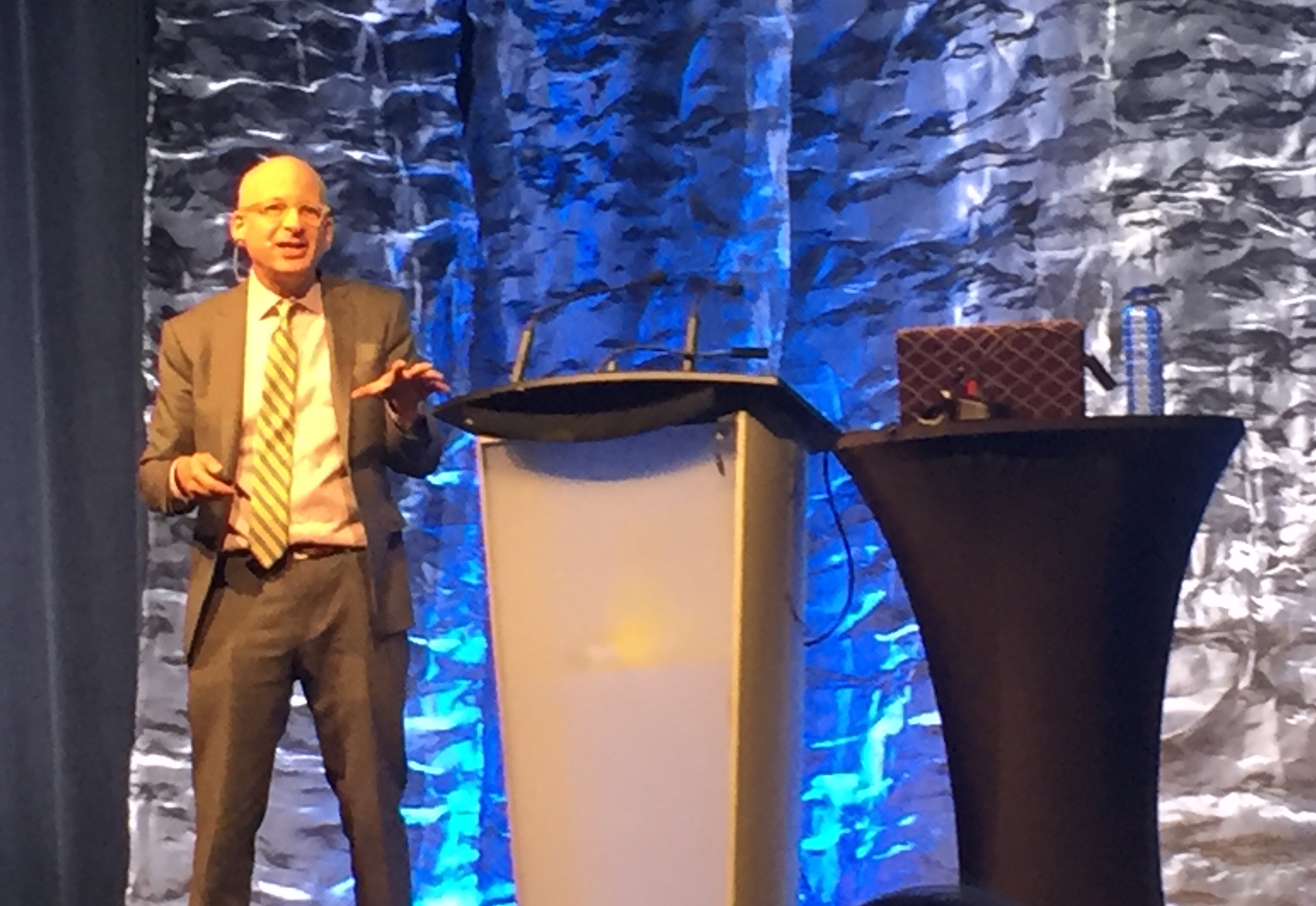
This is Seth Godin live

Speaker Seth Godin

It’s not every day you get to see one of your heroes live.

Last month, I had the privilege of hearing Seth Godin live. If you are in marketing or communications, you know the name Seth Godin. Marketing guru, brand revolutionary, author of 18 best-selling books and changemaker. This is Seth Godin.

Screw E.F. Hutton. When Seth Godin talks, people listen.

In his opening keynote, Seth talked about the power of communication to connect people and culture. He said most organizations are at a crossroads. We are living in an age of distraction. We need to be telling human-centric, emotional stories to cut through the noise.

My favourite business mantra is “strategy eats culture for lunch” (Peter Drucker). You can strategize all you want, but if what you are trying to achieve goes against the culture of an organization, you will fail. And yet many leaders do not pay close enough attention to culture within their organizations.

Here were Seth’s insights on culture:

You can’t fake culture. Honour your past; define your future. Make symbolic changes, big and small. Have all oars in the water. Be humble, stay the course.

We are experiencing a revolution, and a renaissance for business communicators who will be key strategic advisers in the age of information.

This week’s #HappyAct is to find a hero and learn from them. Or you can adopt mine and sign up for Seth’s blog.

Epic fails and lessons in writing from the school of hard knocks

Mark Zuckerberg

This week, on the 14th anniversary of Facebook, Mark Zuckerberg shared a posted about his failures. He wrote, “Over the years I’ve made almost every mistake you can imagine. I’ve made dozens of technical errors and bad deals. I’ve trusted the wrong people and I’ve put talented people in the wrong roles. I’ve missed important trends and I’ve been slow to others. I’ve launched product after product that failed.”

There are many days when I feel like an epic failure as a writer (or mother, or wife for that matter). The other day I read something I wrote a year ago. It was crap.

Writing for someone else’s voice is probably one of the hardest things for a writer to do. I need to do this a lot in my work. Here are some of my epic failures in writing over the course of my career.

  • Assuming someone’s spoken voice is the same as their written voice. I worked with one leader who was personable, funny and engaging in person, but whose written prose was formal and stilted.
  • Creating a narrative that wasn’t the narrative of the person giving the presentation. I prepared a presentation once for a leader and weaved a theme through it that I thought would resonate with the audience, using references to popular culture. It fell flat because it was my narrative, not their narrative.
  • Not using enough stories in my writing and not digging harder to find stories. Everyone has a story.
  • Slipping into corporate puffery. If something I’ve written sounds like a company wrote it, not a person, I’ve failed at my job, and I have.
  • Being too wordy.
  • Not being able to convince people to use clear language; people will often default to language they are used to or think others want to hear.

Yes, I have failed miserably time and time again. But there is one thing that makes me happy. I’m in good company.


Say what you mean

cat in the hat say what you meanWhy can’t people just say what they mean?

Being clear and honest would solve so many problems.

Relationships would be stronger because we would forge stronger connections from shared understanding.

There would be less uncertainty and confusion in the world.

We would make less mistakes.

We would save precious time from trying to interpret what the other person is saying or what they want.

Saying what we mean could also help advance our interests.

Look at Donald Trump. One of the key reasons he has gotten this far in the U.S. presidential race is because he says what he means. If Hillary Clinton stopped playing the political game, and just once, came out and blasted him, and said what she really felt, I wonder if she would see a spike in the polls in her favour.

Our reluctance to say what we mean is even more of an epidemic at work.

There are some professions where I swear they actually train you to speak in euphemisms and jargon. It drives me crazy.

Last week I got an email from a colleague. The first line was, “Here is the PPT that I presented to the RLT based on the work that the INV team did.”

Now, as it turns out, I actually understood the email because sadly, I’ve worked there long enough that half of these terms are second nature to me. But god help any new person in the organization, or someone who isn’t exposed to jargon and acronyms as much as I am.

Saying what you mean is even more important for some people, for instance, people with autism.

Because Grace has a tendency to interpret everything I say literally, I’ve learned to be as specific as possible in my language. For instance if I said, “I don’t care if you want to do X, you have to get your homework done first” or whatever the issue we were discussing, she would literally interpret it that I didn’t care about her. Having an autistic child makes you think about your language choice very carefully.

Of course, there are times, when it is better to not say what you mean. Here are some golden rules of communication to keep in mind:

  1. Think before you speak.
  2. If you can’t say something nice, don’t say anything at all.
  3. Always think about whether your words could be interpreted the wrong way or how they would make the person feel.

As Maya Angelou once said, “People will forget what you said, people will forget what you did, but people will never forget how you made them feel.”

This week’s #HappyAct is to say what you mean, keeping in mind the golden rules. Share a comment. Why do you think people don’t say what they mean?

The power of positive words

Puppy with words who is awesome, you are awesomeRecently I was in a team planning session at work and for an icebreaker, we had to share what our favourite word was. I was intrigued by the words the people at my table chose and why.

One girl chose the word “fluffy” because of the way it sounds, and all the f’s. Another girl liked the word “cozy” because of the way it made her feel. One guy loved the word “awesome” and said he used it all the time.

Words are the frame for the pictures we paint for people. Let me give you an example. I used to complain about being overweight. One day a co-worker said to me, “you know, Laurie, I never thought of you as heavy until you kept calling yourself overweight.” Needless to say, I’ve stopped saying anything about my weight any more. Through my choice of words, I had painted a negative image in the person’s mind.

Never underestimate the power of positive words. They can be highly persuasive and influential in creating the outcome you want to achieve. This is no secret to any business leader or those of us in communications and in media who know it’s all about crafting the right message to achieve a desired behaviour or action.

This week’s Happy Act is to join me in a little experiment. Choose five positive words and use them at least twice a day for the next week and see what happens. One of my words is going to be Awesome. Some people say words like Awesome are overused, but I think that’s just because the word is so awesome.

Report back on what you found: did you find you had a more positive outlook this week? Did you notice any change in the behaviour of the people you talked to? Leave a comment. Have an awesome week.