The comfort of routine

Author reading the Toronto Star

I have a confession to make: I’m a creature of habit.

On the weekends, my morning ritual is to sleep in, wake up, grab a coffee and read the morning papers or flyers (yes, I am a dinosaur). Since I’m not a morning person, it takes me at least an hour or two to get moving. Once up, I’m good with starting my day, whether that’s running off to hockey, walking the dog, meeting a friend for coffee or working around the house.

I come by this trait honestly—I inherited it from my father who was the very epitome of routine. Dave used to say you could set your watch by Dad and know the exact hour and minute when he would walk the dog, read the papers and have his first rye of the day.

I used to feel like I had to apologize for my habitual tendencies until I read an article from Northwestern Medicine linking the positive mental and physical health benefits of having routines. The article stated having a routine can help with stress, sleeping better, eating healthier and being active. Routines can help us achieve balance in our lives and make time to do the things we love and that keep us healthy.

Of course, my routines are the butt of my family’s jokes, but even that has become weirdly predictable and reassuring.  

I couldn’t care less about the science and what my family says. For me, there is just something so comforting and relaxing about the routines I love. They are a safe haven in a crazy world. Even writing this blog on Sunday mornings has become a welcome routine.

This week’s #HappyAct is stick to your guns and the routines you love. Gotta go. My second coffee of the morning awaits.

Happier Together

child smiling in Kinshasa

This Wednesday, March 20 is the International Day of Happiness. The day was declared by the UN in 2012 to recognize that happiness is a fundamental human right and to encourage nations and individuals to spread happiness and make happiness a priority.

The theme the UN has chosen this year is #HappierTogether. Here is a picture from their photo album of people from all over the world smiling, happier together.

It’s such a poignant theme. As individuals and societies, we’ve withdrawn from human connection, partly out of necessity from COVID-19, but also self-imposed.

Technology has only exacerbated this trend. We delude ourselves into thinking we’re more connected now by cell phones and technology, but these devices have somehow divided us, becoming platforms for discordant voices and viewpoints or have become something we hide behind instead of doing the real work of connecting with people in person.

Even our work lives have become more isolating with millions of workers now not even leaving their homes to experience human connection.

There are certain groups that are at higher risk of being unhappy in isolation, seniors and youth being two critical demographics.

After COVID, I blogged about “languishing” and wondering why I wasn’t chomping at the bit to get out and reconnect with people again. I concluded that it wasn’t because I had social anxiety and didn’t miss people, I just didn’t have the energy to re-enter the world.

It’s time. Time for us to reach out, be kind to each other, and understand that without human connection, most of us will never truly be happy.

It’s time to find the energy and make a conscious effort to be happier together.

This week’s #HappyAct is to do something to be happier together. Volunteer in your community, invite a neighbour over for a drink, check in on a senior. Post a picture of you smiling this week with people who make you happy and who you enjoy spending time with.

Happy International Day of Happiness!

My family smiling and acting goofy

How to be a happy shopper this Black Friday

black friday poster

Black Friday and the holiday shopping season is upon us. Canadians are being lured by savvy marketers with promises of up to 70% off, Black Friday Deals and Super Savings you can’t pass up.

While some people refuse to cave to the consumerism of the season, most of us succumb to varying degrees to the shopping craze this time of year.

Which begs the question. Does retail therapy make people happy? The science shows the answer is yes.

A 2014 study from the Journal of Consumer Psychology found that retail therapy not only makes people happier immediately, but it can also fight lingering sadness. 

Even just the anticipation of making a purchase or treating ourselves to something we desire releases dopamine, the hormone neurotransmitter in our brain that makes us feel good. 

The choices we make when shopping can restore a feeling of personal control and autonomy which helps in fighting feelings of sadness and anxiety over the things that are outside of our control in the world.   

In another 2014 study by University of Michigan, researchers showed that purchasing things you personally enjoy can be up to 40 times more effective at giving you a sense of control than not shopping, and those who actually purchased items were three times less sad when compared to those who only browsed.

Shopping also stimulates our senses, creating pleasure, especially this time of the year when the stores have festive displays and merry music playing.  

But before you go filling up your virtual or actual shopping cart, remember these caveats. For every instant hit of pleasure, there is a corresponding pang of potential regret when it comes time to pay the bills. You need to calculate whether the pleasure from the purchase would exceed the pain from the cost, and whether you can afford the purchase at all.

The Journal of Consumer Psychology study showed that even just the act of filling up your online shopping cart, then abandoning it, can create the same pleasure as if you had actually made the purchase.

In the end, spending less money may be more rewarding.

This week’s #HappyAct is to be a smart, savvy and happy Black Friday shopper. Find a few bargains and enjoy the small hit of dopamine, but don’t do anything you’re going to regret later.

Special #HappyAct Experiment: Go online this week to one of your favourite retailers and fill up your shopping cart with a bunch of items, then close down your browser without making the purchase. Did you feel happier just browsing? Leave a comment!

One simple thing you can do starting today to be happier

I’m a huge fan of TedTalks. Recently, I stumbled across one on the science of smiles by Ron Gutman, a professor from Stanford University whose mission is to help everyone live happier, healthier lives.

Gutman talks about a 30-year old study from the University of Berkeley, California that looked at old photos in school yearbooks and measured the success and well-being of the graduates throughout their lifetime based on their smiles. The students with the biggest smiles tended to lead more successful, well-rounded lives.

Another study involved looking at old baseball cards and the longevity of the ball players in correlation to the smiles on their cards. The ball players with the biggest smiles lived the longest.

Gutman says one-third of people smile more than 20 times a day, but sadly 14% of us smile less than 5 times per day. Children smile more than 400 times per day.

He claims smiling creates the same positive brain stimulation as eating up to 2,000 bars of chocolate!

Smiling is one of the most basic expressions of humans and something we all do every day.

This week’s #HappyAct is to make a conscious effort to smile at least 20 times a day this week and if you see someone sad, struggling or frowning, ask what’s wrong, tell them a joke, or do something to put a smile on their face.

Watch the full Ted Talk, the Hidden Power of Smiling.

Happiness by the numbers

bright yellow sneakers

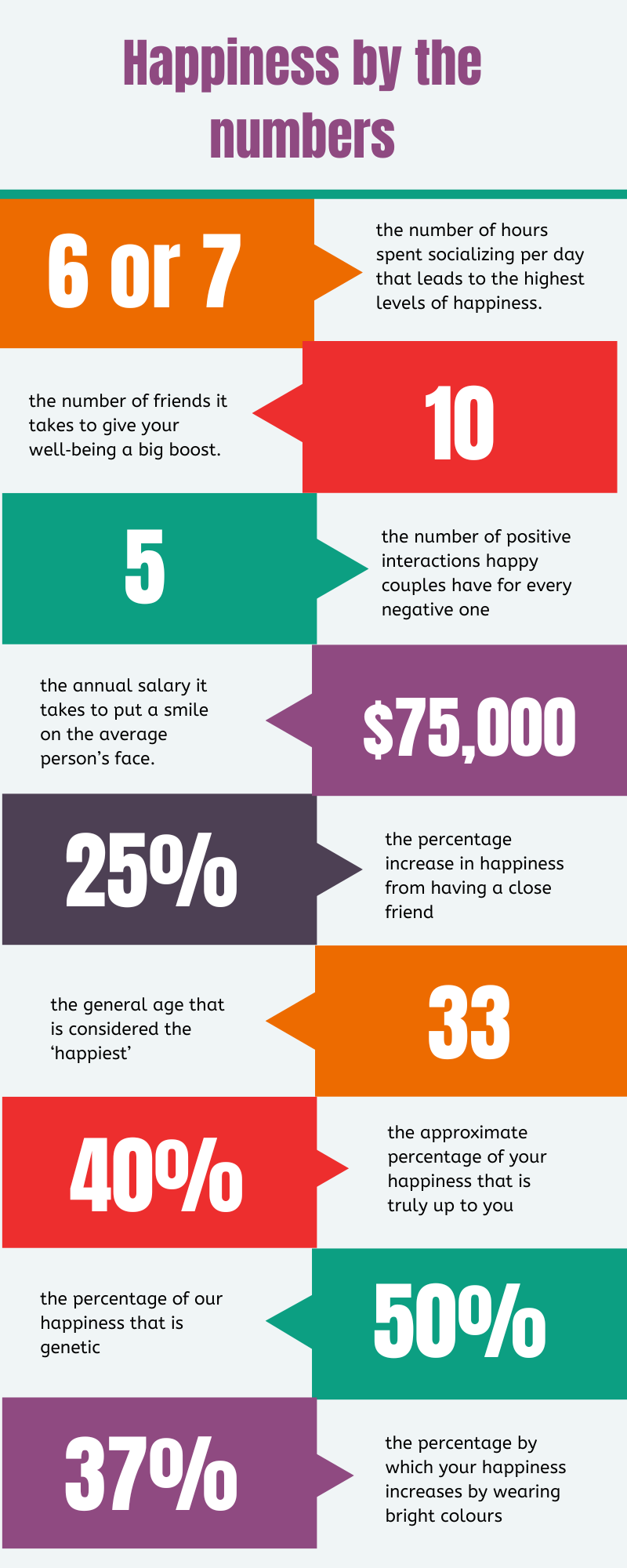
Some time ago, I stumbled across these statistics on happiness.

infographic with stats on happiness

There’s not much we can do about our age and genetic disposition, but we can make an effort to reach out to friends, spend time with our loved ones and focus on what’s most important in our lives: developing positive relationships.

If all else fails, wear something orange or yellow.

Climbing the ladder of happiness

world happiness report

If you imagine a ladder whose rungs are numbered zero to 10, and zero represents your worst possible life and 10 represents your best, which rung would you be on? 

This is the question asked of people around the world every year for the World Happiness Report. Last year marked the tenth anniversary of the report which uses global survey data to report how people evaluate their happiness in more than 150 countries. The study researchers will reveal the results of the 2023 report at noon tomorrow, March 20, the International Day of Happiness.

What’s interesting is Finland has ranked #1 for the past five years in a row, followed by Denmark and Iceland in second and third place in last year’s report. Switzerland, Netherlands, Luxembourg, Sweden, Norway, Israel and New Zealand all ranked among the top 10 ‘happiest’ countries in the world. Canada ranked 15th and the US 16th.

I dug a little deeper to understand why Finns have ranked #1 for the past five years. I’ve never been to Finland, and have only had a few Finnish friends over the years.  

Finns are not exactly known for their exuberance. There is a Finnish saying, ‘If you’re happy, you should hide it”. Their happiness manifests itself as more of a deep contentment, part of their hygge culture.

One thing the study illuminates, and is true in all the northern European nations who rank the happiest every year, is having access to the basics is a strong baseline for happiness.

In Finland, everyone has access to guaranteed health care, tuition-free school, a living wage, affordable housing, and free universal daycare from eight months until the start of formal education at age seven. It also doesn’t hurt that all Finns get five weeks of vacation every year.

But a key reason why Finland ranks #1 each year is their emphasis on family, friends, relationships and not on accumulating wealth or material possessions. They have their priorities straight.

This week’s #HappyAct is to watch for tomorrow’s report and ask yourself the question, which rung would you be on?

Ed note: If you’d like to read the full report, go to worldhappiness.report. I highly recommend taking 20 minutes to read a few of the sub-reports which are fascinating. For instance, in the report “Exploring the biological basis of happiness”, the researchers concluded that genetics does play a role in happiness. In fact, one study that tracked the lives of identical and fraternal twins found remarkably, that identical twins who were reared apart (100% genetically identical, no shared environmental influences or experiences) turned out to be more similar with respect to their well-being than fraternal twins who grew up together.

Another study on optimism during the pandemic found that while most participants experienced decreases in their optimism and meaning in life during COVID-19, for more than a third of the participants, their levels of optimism and meaning in life remained stable. Fascinating stuff.

Take this simple positivity test and remember the magic number

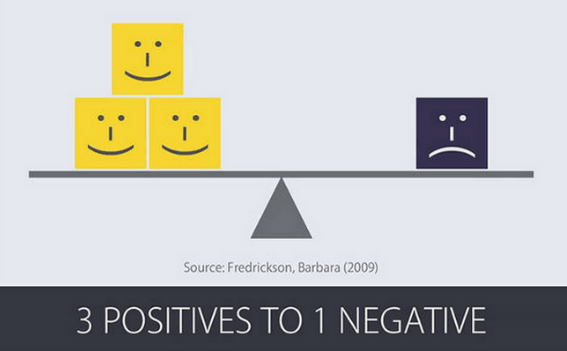
three smiling boxes and one frowning box

What if I told you the secret to happiness and success is a line and a number?

The line is called the Losada line and the number is 2.9013 which is the ratio of positive to negative interactions you need to have to be happy and successful. Simply put, you need to have at least three positive interactions to every negative one to be happy.

The Losada line and ratio came out of a study done in 2005 by two psychologists, Marcial Losada and Barbara Fredrickson who analyzed the interactions of management teams and how successful they were. The mathematical formula they used was subsequently challenged and discredited by some experts, but many psychologists still cite their work and adopt the principles of the Losada line in sport, business, and to help individuals achieve positive mental health.

They found if teams generate more than 2.9013 positive feelings, emotions or interactions to every 1 negative feeling, emotion or interaction, the team has positive energy needed to feel good about themselves and flourish. A 5:1 ratio is a culture everyone wants to be part of. Teams below the Losada line of 2.9013 have a deteriorating culture, and at 0.73 to 1, the team culture destructs.

In another study, Dr. John Gottman looked at similar research in marriages. Gottman claims he can predict divorce with 90% accuracy by counting the number of positive versus negative interactions a couple has.

In marriage, the magic ratio is 5:1 (why the ratio is higher in marriage is an interesting question, presumably because marriage is hard and there are two individuals’ happiness at stake!)

Happy couple have at least 5 positive interactions for every negative one. You can read more about Gottman’s study and the types of positive interactions between happy couples here.

This week’s #HappyAct is to take the personal positivity test and strive to increase your personal to negative interactions to 3:1 or higher. Gottman also has a quiz on his website called “How Well Do You Know Your Partner” (note you have to provide your email address to get the results emailed to you but a summary pops up on the screen as soon as you provide your email).

And don’t worry if you score low initially on the personal positivity test. I expected to because I’m at home nursing a broken ankle right now. Think of it more as a check in with how you’re feeling, then start working towards improving your positive interactions and on a path to better mental health and happiness.

You’ve got a friend

Author and her best friend

There are no words to describe the comfort of a friend. Friends console us when we’re down. They are a sympathetic ear when troubles weigh heavy on your heart and the first person to say I believe in you. You will overcome this.

They share in life’s joys, sorrows and celebrations. They are the person you turn to when you need a hug, or someone to listen without judgement, or just want to share a laugh or what’s on your mind. They love you unconditionally, warts and all. Without them, we’d be lost.  

It’s a scientific fact that having one good friend has a significant impact on happiness. It’s not surprising having a friend increases your happiness in good times, but it’s been proven that having a friend is critical during times of stress when you need help.

In his New York University course The Science of Happiness, Dr. Alan Schlechter lectures about the “tend and befriend” response. The cousin to the fight or flight response, the tend and befriend response is when the hormone oxytocin, induced by stress tells us to reach out for help. When we reach out to a friend, our cortisone level goes down and we feel better.

They say you’re lucky to have at least one true friend in your lifetime. I’ve been fortunate enough to have two, my best friend Leslie and my husband Dave. Thanks for being my rock, guys. I love you both.

This week’s #HappyAct is to tell your best friend how much they mean to you.

Author and her other best friend, her husband

My unscientific poll on work and happiness

happy co-workers

Recently I emailed a dozen friends and asked them three questions about how happy they were at work. The results were very revealing. The people who responded work in all sectors, government, private sector and self-employed. Here are the results of my unscientific poll on work and happiness:

My first question was, “Are you happy at work?”

More than half were not happy at work. Some said they were ashamed to admit it, because “they have a pretty good gig”; one person said they weren’t happy but planned to slog it out until retirement. A quarter of respondents said they were happy, and one person said at different times in their career they’ve been happy, and unhappy at other times.

When I asked what was the cause of their happiness or unhappiness at work,

On the plus side, the common themes were working with great people, loving what they do, and the variety of work. One person said they work in a low-stress environment and have an eight-minute commute, so they can come home for lunch every day if they want.

For those unhappy at work, here were some of the reasons they cited for their unhappiness:

  • Lack of involvement and inclusion and team camaraderie.
  • Being tired of dealing with some teams who don’t appreciate the work they do.
  • The inactivity associated with being on a computer eight hours a day.
  • One person said working within an environment where there are too many people in authority who “literally don’t have a clue what they are doing” and a “poisonous” atmosphere as a result of so many people being off on leave, creating more work for those left behind who are still working diligently.
  • One person who is self-employed said, “I’m bored, but I like the flexibility of what I do, so I stay at it. Also, the administration associated with being self-employed is a tough slog. I’m always behind on that, so that creates guilt that I’m not keeping on top of things.”

My final question was “What would make you happy or happier at work?”

  • Being valued and respected and having their work acknowledged was a common theme, along with being able to do more of what they love to do and having challenging projects.  
  • Better work-life balance, and being compensated fairly and seeing more transparency in salary grids were cited as other key factors.
  • One person said they’d like to have a friend at work and work with a diverse team.
  • The one person who was unhappy at work in the “poisonous” environment said they cope by focusing on their family, volunteering and sports and outdoor activities to remind themselves of what’s important in life.
  • On a lighter note, one person wanted a Keurig machine, a fitness room with a treadmill or exercise bike and another an office cat (for me, it would be a dog!)

So what does this tell us and what can we do to be happier at work? Scientific studies show having at least one good friend at work is a key contributor to happiness. Making sure we choose a positive environment where we work with good people and where our work is respected is critical.

As we emerge from this pandemic, we have a unique opportunity to redefine our relationship with work. At the core of the discussion should be these three questions.

Special thanks to the people who participated in my unscientific poll.

More reading on work and happiness

Listen to a happiness podcast

happiness podcasts poster

There’s a not-so-new craze sweeping the nation, and all it takes is a device and twenty minutes of your time.

It seems everybody these days is listening to podcasts. According to buzzsprout, 9 million Canadian adults listen to podcasts every month.

There are literally dozens of podcasts on happiness. This FeedSpot blog lists 80 of the most popular ones or check out Oprah’s top 16 picks.

I’d recommend the Ten Percent Happier podcast with Dan Harris. You may know Harris as the ABC news anchor who had a panic attack live on Good Morning America. He turned to meditation and started his podcast, which discusses the benefits of meditation on happiness and explores happiness in the context of current events.

On his most recent podcast, “The Upside of Apocalypse” Buddhist minister, author and activist Lama Rod Owens talks about the benefits of having an existing practice in times of heightened anxiety, the obstacles to empathy in the world right now and social erosion caused by the pandemic.

This week’s #HappyAct is to listen to a podcast on happiness on this International Day of Happiness. What’s your favourite podcast? Leave a comment.